
Homework Answers

 Please give me thumbs up,if you like the
answer .
Please give me thumbs up,if you like the
answer .
Please let me know if you don't understand any step before giving
Down rating directly :). Happy to help
Add Answer to:
Question 3: Realize the circuit below using Verilog. Include a signal “reset_n” for asynchronously clearing the...
(15 pts) 1. Draw a logic diagram for the Verilog code. module Seq_Ckt ( CLK, PR,...
 (15 pts) 1. Draw a logic diagram for the Verilog code. module Seq_Ckt ( CLK, PR, sel, Q); input CLK, PR, sel; output reg [2:0] Q; reg [2:0] y; assign Q = y; always @ (posedge PR, posedge CLK) begin if (PR== 1) then y <= 3'b111; else if (sel) begin y[2] <= y[1] ^ y[0]; y[1] <= y[2]; y[1]; end else y[2] <= y[2] ; y[1] <= y[1]; y[0]; y[O] <= y[0] <= end endmodule
Write a test bench to thoroughly test the Verilog module dff_fe_asyn_h. below is the module ddff_fe_asyn_h.code...
Write a test bench to thoroughly test the Verilog module dff_fe_asyn_h. below is the module ddff_fe_asyn_h.code Simulate the circuit using ISim and analyze the resulting waveform. Take full screenshots of all Verilog source codes and the resulting simulation waveform to be included in the lab report. Include explanation of the waveform and how you can conclude that the D flip flop implemented in step 9 is correct in the lab report. Verilog Code for dff_fe_asyn_h is mentioned below:- //DFF module...
I need the following in verilog. Attached is also the test bench. CODE // Design a...
I need the following in verilog. Attached is also the test bench. CODE // Design a circuit that divides a 4-bit signed binary number (in) // by 3 to produce a 3-bit signed binary number (out). Note that // integer division rounds toward zero for both positive and negative // numbers (e.g., -5/3 is -1). module sdiv3(out, in); output [2:0] out; input [3:0] in; endmodule // sdiv3 TEST BENCH module test; // these are inputs to "circuit under test" reg...
Write the verilog code that implements a negitive edge D-Flip Flop with asynchronous active low preset...
Write the verilog code that implements a negitive edge D-Flip Flop with asynchronous active low preset and clear I have : module dff( preset, clear, clk, D, Q) input preset; input clear; input clk; input D; output Q; reg Q; always @ (negedge clk or negedge preset or negedge clear); if (preset); Q = 0; else (clear == 0); Q = D; endmodule I honestly just want to know if i'm doing this right or not, if im not correct,...
WRITE THE CODE IN VERILOG: Instead of using Registers, USE D FLIP FLOPS and a clock....
 WRITE THE CODE IN VERILOG: Instead of using Registers, USE D
FLIP FLOPS and a clock. Include the logic for a reset
A sequential circuit with three D flip-flops A, B, and C, a trigger x, and an output z1, and zo. On this state machine diagram, the label of the states are in the order of (ABC), the transition is the one bit x, and the output is under the forward slash. x/z1zo. The start state is 001 0/01...
WRITE THE CODE IN VERILOG: Instead of using Registers, USE D
FLIP FLOPS and a clock. Include the logic for a reset
A sequential circuit with three D flip-flops A, B, and C, a trigger x, and an output z1, and zo. On this state machine diagram, the label of the states are in the order of (ABC), the transition is the one bit x, and the output is under the forward slash. x/z1zo. The start state is 001 0/01...
why its 4-to-1 mux behavioral? What does the logic circuit represented by the following Verilog module...
 why its 4-to-1 mux behavioral?
What does the logic circuit represented by the following Verilog module do, and what Verilog description style does it use? // My Verilog module #1 module mymodl ( x, d, q) input[1:0] x;input[3:0] d;output q; reg q; wire [1:0] x; wire [3:0] d; always ( x or d) begin case ( x ) 1 : q=d[1]; 2 : g=d[2]; 3 q d[3]; endcase end endmodule
why its 4-to-1 mux behavioral?
What does the logic circuit represented by the following Verilog module do, and what Verilog description style does it use? // My Verilog module #1 module mymodl ( x, d, q) input[1:0] x;input[3:0] d;output q; reg q; wire [1:0] x; wire [3:0] d; always ( x or d) begin case ( x ) 1 : q=d[1]; 2 : g=d[2]; 3 q d[3]; endcase end endmodule
3. (10 Points) RTL Combinational Circuit Design a Draw the schematic for the Verilog code given...
 3. (10 Points) RTL Combinational Circuit Design a Draw the schematic for the Verilog code given below: module abc (a, b, c, d, si, s0); input 31, 30; output a, b, c,d; not (51_, 51), (50_, 0); and (a, s1_, SO_); and (b, s1_, 0); and (c, sl, s0_); and (d, sl, s0); endmodule b. Draw the schematic for the Verilog code given below: module Always_Code input a, b, c, output reg F ); always @(a, b, c) begin F...
I need help doing the code using Verilog modelsim Design a 32-bit register using the D...
I need help doing the code using Verilog modelsim Design a 32-bit register using the D Flip-Flop from part (1) so that it has the following features: (a) The Register has these ports Outputs: Q[31:0] Inputs: D[31:0] CLK is the clock signal EN is a synchronous signal for enabling the register. When EN is asserted at the sensitive edge of the CLK, the input D is loaded into the register. RESET We will leave this input unconnected, but will define...
Write a test bench to thoroughly test the Verilog module dff_fe_asyn_h. below is the module ddff_fe_asyn_h.code...
Write a test bench to thoroughly test the Verilog module dff_fe_asyn_h. below is the module ddff_fe_asyn_h.code Simulate the circuit using ISim and analyze the resulting waveform. Verilog Code for dff_fe_asyn_h is mentioned below:- //DFF module with asynchronous active high reset with negative edge trigger with clock module dff_fe_asyn_h ( input clock, // Clock Input input reset, // Reset Input input data_in, // Input Data output reg data_out // Output Data ); always @ (negedge clock or posedge reset) // triggers...
Question 3 (3 marks) Identify at least 3 errors in the Verilog modules below. module simpleALU(mput...
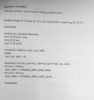 Question 3 (3 marks) Identify at least 3 errors in the Verilog modules below. module simpleALU(mput [31:0) A, B, input [2:0) F, output reg [31:0) Y) endmodule module alu simpleTestbenchO; wire [10:0] inA, inB wire [2:0] sel; reg [31-0] outY simpleALU dut(sel, outY, inA, inB) initial (sel, inA, inB)-: #10 sei 3.6010; (inA, inB) - 16h0000 0000 0000 0000; #10 sel 3bl 10; finA, inB)- 16h0000 0000 FFFF_FFFF: endmodule
 (15 pts) 1. Draw a logic diagram for the Verilog code. module Seq_Ckt ( CLK, PR, sel, Q); input CLK, PR, sel; output reg [2:0] Q; reg [2:0] y; assign Q = y; always @ (posedge PR, posedge CLK) begin if (PR== 1) then y <= 3'b111; else if (sel) begin y[2] <= y[1] ^ y[0]; y[1] <= y[2]; y[1]; end else y[2] <= y[2] ; y[1] <= y[1]; y[0]; y[O] <= y[0] <= end endmodule
 WRITE THE CODE IN VERILOG: Instead of using Registers, USE D
FLIP FLOPS and a clock. Include the logic for a reset
A sequential circuit with three D flip-flops A, B, and C, a trigger x, and an output z1, and zo. On this state machine diagram, the label of the states are in the order of (ABC), the transition is the one bit x, and the output is under the forward slash. x/z1zo. The start state is 001 0/01...
WRITE THE CODE IN VERILOG: Instead of using Registers, USE D
FLIP FLOPS and a clock. Include the logic for a reset
A sequential circuit with three D flip-flops A, B, and C, a trigger x, and an output z1, and zo. On this state machine diagram, the label of the states are in the order of (ABC), the transition is the one bit x, and the output is under the forward slash. x/z1zo. The start state is 001 0/01...
 why its 4-to-1 mux behavioral?
What does the logic circuit represented by the following Verilog module do, and what Verilog description style does it use? // My Verilog module #1 module mymodl ( x, d, q) input[1:0] x;input[3:0] d;output q; reg q; wire [1:0] x; wire [3:0] d; always ( x or d) begin case ( x ) 1 : q=d[1]; 2 : g=d[2]; 3 q d[3]; endcase end endmodule
why its 4-to-1 mux behavioral?
What does the logic circuit represented by the following Verilog module do, and what Verilog description style does it use? // My Verilog module #1 module mymodl ( x, d, q) input[1:0] x;input[3:0] d;output q; reg q; wire [1:0] x; wire [3:0] d; always ( x or d) begin case ( x ) 1 : q=d[1]; 2 : g=d[2]; 3 q d[3]; endcase end endmodule
 3. (10 Points) RTL Combinational Circuit Design a Draw the schematic for the Verilog code given below: module abc (a, b, c, d, si, s0); input 31, 30; output a, b, c,d; not (51_, 51), (50_, 0); and (a, s1_, SO_); and (b, s1_, 0); and (c, sl, s0_); and (d, sl, s0); endmodule b. Draw the schematic for the Verilog code given below: module Always_Code input a, b, c, output reg F ); always @(a, b, c) begin F...
 Question 3 (3 marks) Identify at least 3 errors in the Verilog modules below. module simpleALU(mput [31:0) A, B, input [2:0) F, output reg [31:0) Y) endmodule module alu simpleTestbenchO; wire [10:0] inA, inB wire [2:0] sel; reg [31-0] outY simpleALU dut(sel, outY, inA, inB) initial (sel, inA, inB)-: #10 sei 3.6010; (inA, inB) - 16h0000 0000 0000 0000; #10 sel 3bl 10; finA, inB)- 16h0000 0000 FFFF_FFFF: endmodule
Most questions answered within 3 hours.
-
Where is the error in this code sequence?
String s1 = "Hello";
String s2 = "ello";...
asked 11 months ago -
Financial data for Joel de Paris, Inc., for last year
follow:
Joel de Paris, Inc.
Balance...
asked 11 months ago -
Consider this reaction:
Al2(SO4)3 (aq)+ BaCl3
(aq) Al2Cl6 (aq)- +
3BaSO4(s) . What is the...
asked 11 months ago -
Suppose that Savneet is considering increasing her
recent random sample from 20 car rentals to 40...
asked 11 months ago -
Trucks arrive at an unloading terminal at an average rate of 120
per hour.
Trucks arrive...
asked 11 months ago -
Why are methanol and ethanol completely soluble in water while
octanol is not very little soluble....
asked 11 months ago -
A facilities manager at a university reads in a research report
that the mean amount of...
asked 11 months ago -
When the CuSO4 is rehydrated by adding water to the anhydrous
compound, is this an endothermic...
asked 11 months ago -
A ray of sunlight is passing from diamond into crown glass; the
angle of incidence is...
asked 11 months ago -
A block of mass 0.249 kg is placed on top of a light, vertical
spring of...
asked 11 months ago -
how do the kidneys compensate in the presences of acidosis
a) trigger hyperventilate
b) reserve acid...
asked 11 months ago -
Question 501 pts
The rental rate of capital to the firm increases. Which of the
following...
asked 11 months ago