


Homework Answers
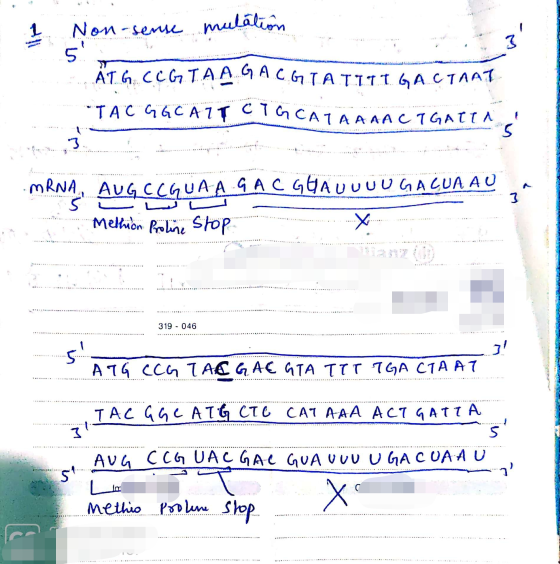
In case I which is a case of non-sense mutation a type of point mutation which makes no change in the amino acid sequence as we can see the amino acid formed in normal and mutated mRNA like the amino acids form before and after substitution is same without causing any change to the amino acid sequence.
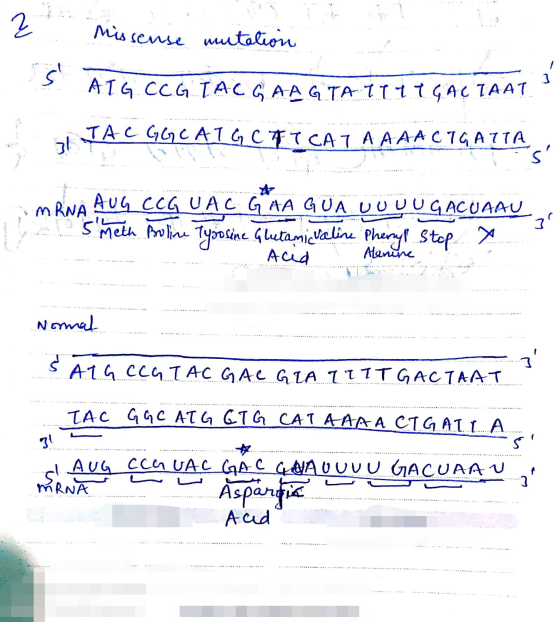
In the second case which is a situation of missense mutation a type of point mutation results in a change in amino acid by substituting adenine in place of cytosine changing the amino acid from Aspartic acid to Glutamic acid after the substitution.
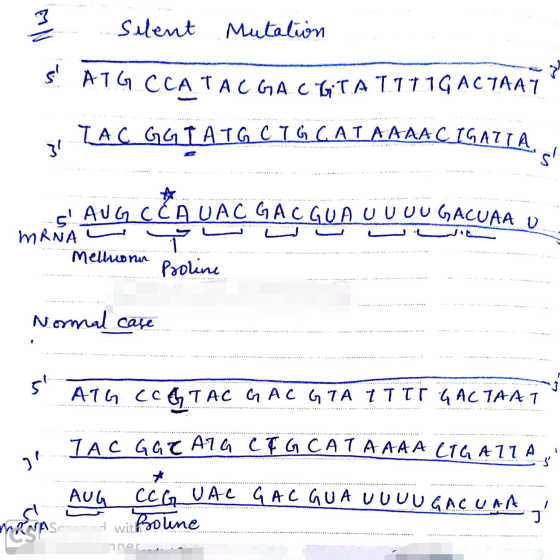
In the third case which is a silent mutation which does not result in a change in amino acid but the sequence is changed by substituting Adenine in place guanine but the resultant amino acid still remains the same so this shows no change in amino acid sequence so-called as silent mutation.
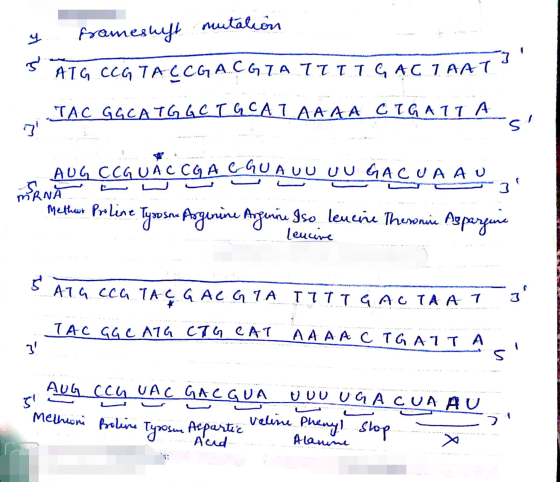
The fourth case is an example of a frameshift mutation in which cytosine is added in the third codon which changes the amino acid sequence completely after the addition.
Add Answer to:
D) Consider that during replication of the cell. the following mutations were generated within the gene...
1 pts Question 4 Consider the following translated genetic sequence in the coding region of an...
 1 pts Question 4 Consider the following translated genetic sequence in the coding region of an gene: AUG[start]-CUU-GGC-UGU-CGG-AGC-UGA[stop] A point mutation occurs that results in the following: AUG[start]-CUU-GGC-UGC-CGG-AGC-UGA[stop) If there is any change in the amino acid, then the result is deleterious. Given the following table, is this mutation deleterious? UGU Cysteine UGC Cysteine UGA Stop UGG Tryptophan There is not enough information to determine if it is neutral No, the point mutation codes for the same amino acid. Yes,...
4. (4 pts) in premature termination of translation. These mutations are not as rare as you...
 4. (4 pts) in premature termination of translation. These mutations are not as rare as you might think. For example, there are 8 different sense codons that can be changed to the stop codon UAG by a single point mutation (base change). Nonsense mutations are mutations that introduce a STOP codon in place of a sense codon, and result Using the codon table in the textbook, list these 8 sense codons (and their corresponding amino acid) Consider the following introduction...
A mutation is a permanent change in the sequence of nucleotide bases in a cell's DNA....
 A mutation is a permanent change in the sequence of nucleotide bases in a cell's DNA. Most mutations happen during DNA replication, but their effects are not seen until transcription and translation. Even a small mutation that changes a single nucleotide can have a major impact on the resulting proteins that are made in the cell. с The table following the amino acid chart lists a segment of a normal gene. Type in the corresponding mRNA strand and the amino...
11. Match each type of mutation with the corresponding description. (4 points) Missense An insertion or...
 11. Match each type of mutation with the corresponding description. (4 points) Missense An insertion or deletion of nucleotides that are not in multiples of 3. Nonsense A mutation that does not alter the protein sequence. Silent A mutation that confers an amino acid substitution. Frameshift A mutation that confers a premature stop codon.
The template strand of a given gene includes the sequence 3'-GCCACGTATCAG-5'. For each one, be sure...
 The template strand of a given gene includes the sequence 3'-GCCACGTATCAG-5'. For each one, be sure to indicate 5' and 3' ends (DNA & RNA) and N and C termini (polypeptide). What is the sequence of the nontemplate strand (a), mRNA sequence made (b) and polypeptide made (c)? Hint: They are aligned in a way that you don't have to worry about the direction, because polynucleotides grow from 5' to 3' direction. (7 pts) Second base of RNA codon 000...
1) Which of the following mutations could result in a frameshift? A) a base insertion B)...
1) Which of the following mutations could result in a frameshift? A) a base insertion B) a base deletion C) a base substitution D) either A or B E) A, B, and C 2) Which of the following point mutations would be most likely to result in a non-functioning protein? A) a single base substitution in an intron B) a single base deletion near the end of the coding sequence C) a single base deletion in the codon following the...
Follow the instructions below to answer questions about Replication, Transcription & Translation. 3’- T A C...
 Follow the instructions below to answer questions about
Replication, Transcription & Translation.
3’- T A C A
C C G G
T C A G
G T G A T C
-5’
A. Imagine that the sequence shown represents one strand of a
gene sequence. What would be the sequence of the complementary
strand of DNA? Write out your answer, indicating correct
polarity (5' and 3' ends) on your new strand. (1.5
points)
B. Now imagine that the new strand...
Follow the instructions below to answer questions about
Replication, Transcription & Translation.
3’- T A C A
C C G G
T C A G
G T G A T C
-5’
A. Imagine that the sequence shown represents one strand of a
gene sequence. What would be the sequence of the complementary
strand of DNA? Write out your answer, indicating correct
polarity (5' and 3' ends) on your new strand. (1.5
points)
B. Now imagine that the new strand...
Week 14- Chapter 21 Homework Problem 21.72 < 52 of 58 Review Constants| Periodic Table Part A How does a point mutation for an enzyme affect the order of amino acids in that protein? Drag the term...
 Week 14- Chapter 21 Homework Problem 21.72 < 52 of 58 Review Constants| Periodic Table Part A How does a point mutation for an enzyme affect the order of amino acids in that protein? Drag the terms on the left to the appropriate blanks on the right to complete the sentences. Reset Help then the order of amino acids will change in the of the polypeptide chain If the resulting codon still codes for the same amino acid, If the...
It is common for scientists to work backwards to find a Rene of interest.
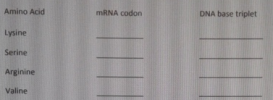 4. It is common for scientists to work backwards to find a Rene of interest. They stan determining the sequence of amino acids in a protein that interests them. From the amino acid sequence, they can determine possible mRNA codons and then determine the possible DNA sequence for the gene of interest. They can then construct the gene and express it in a plant or microbe so that they can produce larger quantities of the protein. Indicate one possible mRNA...
1 of Constants i Periodk Table order of DNA nucieotides What is the anino acid order...
 1 of Constants i Periodk Table order of DNA nucieotides What is the anino acid order produced from this mRNA? Express your answer as a sequence of three-Jetter amino acid 5 UCU AAG GCA UUC 3 Part B What is the amino acid order if a point mutation changes UCU to CCU? Express your answer as a sequence of three-letter amino acid abbreviations s respectively (e.g., Tyr-Val... .le STOP). eparated by dashes and type START and STOP for start and...
 1 pts Question 4 Consider the following translated genetic sequence in the coding region of an gene: AUG[start]-CUU-GGC-UGU-CGG-AGC-UGA[stop] A point mutation occurs that results in the following: AUG[start]-CUU-GGC-UGC-CGG-AGC-UGA[stop) If there is any change in the amino acid, then the result is deleterious. Given the following table, is this mutation deleterious? UGU Cysteine UGC Cysteine UGA Stop UGG Tryptophan There is not enough information to determine if it is neutral No, the point mutation codes for the same amino acid. Yes,...
 4. (4 pts) in premature termination of translation. These mutations are not as rare as you might think. For example, there are 8 different sense codons that can be changed to the stop codon UAG by a single point mutation (base change). Nonsense mutations are mutations that introduce a STOP codon in place of a sense codon, and result Using the codon table in the textbook, list these 8 sense codons (and their corresponding amino acid) Consider the following introduction...
 A mutation is a permanent change in the sequence of nucleotide bases in a cell's DNA. Most mutations happen during DNA replication, but their effects are not seen until transcription and translation. Even a small mutation that changes a single nucleotide can have a major impact on the resulting proteins that are made in the cell. с The table following the amino acid chart lists a segment of a normal gene. Type in the corresponding mRNA strand and the amino...
 11. Match each type of mutation with the corresponding description. (4 points) Missense An insertion or deletion of nucleotides that are not in multiples of 3. Nonsense A mutation that does not alter the protein sequence. Silent A mutation that confers an amino acid substitution. Frameshift A mutation that confers a premature stop codon.
 The template strand of a given gene includes the sequence 3'-GCCACGTATCAG-5'. For each one, be sure to indicate 5' and 3' ends (DNA & RNA) and N and C termini (polypeptide). What is the sequence of the nontemplate strand (a), mRNA sequence made (b) and polypeptide made (c)? Hint: They are aligned in a way that you don't have to worry about the direction, because polynucleotides grow from 5' to 3' direction. (7 pts) Second base of RNA codon 000...
 Follow the instructions below to answer questions about
Replication, Transcription & Translation.
3’- T A C A
C C G G
T C A G
G T G A T C
-5’
A. Imagine that the sequence shown represents one strand of a
gene sequence. What would be the sequence of the complementary
strand of DNA? Write out your answer, indicating correct
polarity (5' and 3' ends) on your new strand. (1.5
points)
B. Now imagine that the new strand...
Follow the instructions below to answer questions about
Replication, Transcription & Translation.
3’- T A C A
C C G G
T C A G
G T G A T C
-5’
A. Imagine that the sequence shown represents one strand of a
gene sequence. What would be the sequence of the complementary
strand of DNA? Write out your answer, indicating correct
polarity (5' and 3' ends) on your new strand. (1.5
points)
B. Now imagine that the new strand...
 Week 14- Chapter 21 Homework Problem 21.72 < 52 of 58 Review Constants| Periodic Table Part A How does a point mutation for an enzyme affect the order of amino acids in that protein? Drag the terms on the left to the appropriate blanks on the right to complete the sentences. Reset Help then the order of amino acids will change in the of the polypeptide chain If the resulting codon still codes for the same amino acid, If the...
 1 of Constants i Periodk Table order of DNA nucieotides What is the anino acid order produced from this mRNA? Express your answer as a sequence of three-Jetter amino acid 5 UCU AAG GCA UUC 3 Part B What is the amino acid order if a point mutation changes UCU to CCU? Express your answer as a sequence of three-letter amino acid abbreviations s respectively (e.g., Tyr-Val... .le STOP). eparated by dashes and type START and STOP for start and...
Most questions answered within 3 hours.
-
Where is the error in this code sequence?
String s1 = "Hello";
String s2 = "ello";...
asked 11 months ago -
Financial data for Joel de Paris, Inc., for last year
follow:
Joel de Paris, Inc.
Balance...
asked 11 months ago -
Consider this reaction:
Al2(SO4)3 (aq)+ BaCl3
(aq) Al2Cl6 (aq)- +
3BaSO4(s) . What is the...
asked 11 months ago -
Suppose that Savneet is considering increasing her
recent random sample from 20 car rentals to 40...
asked 11 months ago -
Trucks arrive at an unloading terminal at an average rate of 120
per hour.
Trucks arrive...
asked 11 months ago -
Why are methanol and ethanol completely soluble in water while
octanol is not very little soluble....
asked 11 months ago -
A facilities manager at a university reads in a research report
that the mean amount of...
asked 11 months ago -
When the CuSO4 is rehydrated by adding water to the anhydrous
compound, is this an endothermic...
asked 11 months ago -
A ray of sunlight is passing from diamond into crown glass; the
angle of incidence is...
asked 11 months ago -
A block of mass 0.249 kg is placed on top of a light, vertical
spring of...
asked 11 months ago -
how do the kidneys compensate in the presences of acidosis
a) trigger hyperventilate
b) reserve acid...
asked 11 months ago -
Question 501 pts
The rental rate of capital to the firm increases. Which of the
following...
asked 11 months ago