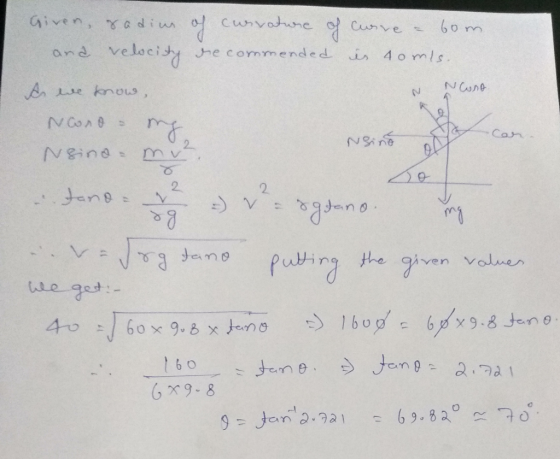
As you know, banking a highway curve can help keep cars from skidding. Suppose that the...
Homework Answers
Add Answer to:
As
you know, banking a highway curve can help keep cars from skidding.
Suppose that the...
7. A highway curve with a radius of R metres is banked so that cars moving at v m/s around the curve do not have to rely on friction when taking the turn. IWPS 7. No.4] 7.1 Show (from first principle...
 7. A highway curve with a radius of R metres is banked so that cars moving at v m/s around the curve do not have to rely on friction when taking the turn. IWPS 7. No.4] 7.1 Show (from first principles) that the angle, 6, at which, the road should be banked is given by: 0 arctan 7.2 A particular banked highway curve with a radius of 200 m is designed for traffic moving at 60 km/h. On a rainy...
Highway curves are "banked" inward, so gravity assists the car's traction. Suppose another highway curve has...
Highway curves are "banked" inward, so gravity assists the car's traction. Suppose another highway curve has a radius of curvature of 500m. It is banked so that traffic moving at 30m/s can travel around the curve without needing any help from friction. a) Draw a force diagram for a car traveling around this curve at a constant speed. Draw the diagram so that you are looking at the rear of the car. Do not tilt your coordinate axes for this...
An engineer must design a curved exit ramp for a highway in such a way that...
An engineer must design a curved exit ramp for a highway in such a way that a car, exiting at the posted speed limit of 17.88 m/s (40 mi/hr), does not depend on friction to round the curve without skidding. The radius of the curve is 230 m. At what angle with respect to the horizontal must the curve be banked (in degrees)?
A highway curve of radius 70 m is banked at a 15° angle. At what speed...
 A highway curve of radius 70 m is banked at a 15° angle. At what speed vo can a car take this curve without assistance from friction?
Suppose that a particular highway offramp with a curve radius of 56 m is banked at...
Suppose that a particular highway offramp with a curve radius of 56 m is banked at 10˚ and was originally designed to include a coefficient of static friction of 0.25 between tires and road. If the DoT wants to repost the speed limit so that the curve is correctly banked when including a friction coefficient of only 0.1, what new speed should be posted?
A curve in a highway has radius of curvature 130 m and is banked at 3.4°....
A curve in a highway has radius of curvature 130 m and is banked at 3.4°. The coefficients of friction are μs= 0.28 and μk = 0.15. What is the fastest safe speed to drive this curve? You must take into account the coefficient of friction for this problem. The answer is not 8.70 m/s nor 27.37 m/s. Thank you for your help.
Curved portions of highways are always banked (tilted) to prevent cars from sliding off the highway....
Curved portions of highways are always banked (tilted) to prevent cars from sliding off the highway. A car of mass m moves at a constant speed v around a banked circular track of radius R as shown in the figure. If the frictional force from the track is negligible, what bank angle Ѳ prevents sliding.
A car is driving around a banked curve, with the road surface at an angle of...
A car is driving around a banked curve, with the road surface at an angle of 10.0º. If the radius of curvature of the road is 30.0 m and the coefficient of static friction between the tires of the car and the road is 0.65, what is the maximum speed (in km/hr) the car can go without skidding?
highway curves are often banked, so the normal force provides the centripetal force and cars don’t...
highway curves are often banked, so the normal force provides the centripetal force and cars don’t have to rely on friction. After having responded to an emergency call in the middle of a snowstorm, an ambulance is speeding back towards the hospital along a slippery curved road. Your job is to inform the ambulance driver of the maximum speed at which he can travel around this curve without slipping up the bank. You are told that the curve has a...
A concrete highway curve of radius 70.0 m is banked at a 19.0° angle
A concrete highway curve of radius 70.0 m is banked at a 19.0° angle. What is the maximum speed with which a 1900 kg rubber-tired car can take this curve without sliding? (Take the static coefficient of friction of rubber on concrete to be 1.0.)
 7. A highway curve with a radius of R metres is banked so that cars moving at v m/s around the curve do not have to rely on friction when taking the turn. IWPS 7. No.4] 7.1 Show (from first principles) that the angle, 6, at which, the road should be banked is given by: 0 arctan 7.2 A particular banked highway curve with a radius of 200 m is designed for traffic moving at 60 km/h. On a rainy...
 A highway curve of radius 70 m is banked at a 15° angle. At what speed vo can a car take this curve without assistance from friction?
Most questions answered within 3 hours.
-
Where is the error in this code sequence?
String s1 = "Hello";
String s2 = "ello";...
asked 10 months ago -
Financial data for Joel de Paris, Inc., for last year
follow:
Joel de Paris, Inc.
Balance...
asked 10 months ago -
Consider this reaction:
Al2(SO4)3 (aq)+ BaCl3
(aq) Al2Cl6 (aq)- +
3BaSO4(s) . What is the...
asked 10 months ago -
Suppose that Savneet is considering increasing her
recent random sample from 20 car rentals to 40...
asked 10 months ago -
Trucks arrive at an unloading terminal at an average rate of 120
per hour.
Trucks arrive...
asked 10 months ago -
Why are methanol and ethanol completely soluble in water while
octanol is not very little soluble....
asked 10 months ago -
A facilities manager at a university reads in a research report
that the mean amount of...
asked 10 months ago -
When the CuSO4 is rehydrated by adding water to the anhydrous
compound, is this an endothermic...
asked 10 months ago -
A ray of sunlight is passing from diamond into crown glass; the
angle of incidence is...
asked 10 months ago -
A block of mass 0.249 kg is placed on top of a light, vertical
spring of...
asked 10 months ago -
how do the kidneys compensate in the presences of acidosis
a) trigger hyperventilate
b) reserve acid...
asked 10 months ago -
Question 501 pts
The rental rate of capital to the firm increases. Which of the
following...
asked 10 months ago