
Homework Answers
Screenshot
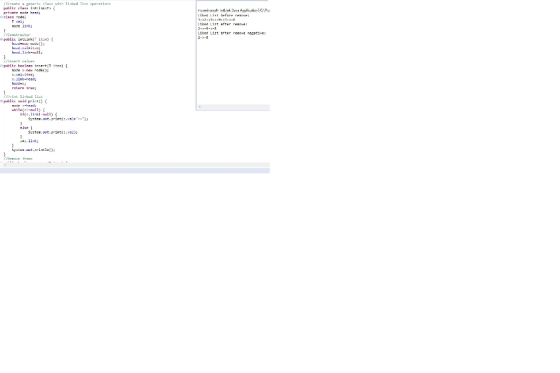
-----------------------------------
Program
//Create a generic class with linked list operations
public class intLink<T> {
private node head;
class node{
T val;
node link;
}
//Constructor
public intLink(T item) {
head=new node();
head.val=item;
head.link=null;
}
//insert values
public boolean insert(T item) {
node x=new node();
x.val=item;
x.link=head;
head=x;
return true;
}
//Print linked list
public void print() {
node z=head;
while(z!=null) {
if(z.link!=null) {
System.out.print(z.val+"->");
}
else {
System.out.print(z.val);
}
z=z.link;
}
System.out.println();
}
//Remove items
public boolean remove(T item) {
int flag=0;
if(item==head.val) {
head=head.link;
flag=1;
}
node x=head;
node y=head.link;
while(true) {
if(y==null)
{
break;
}
else
if(y.val==item) {
x.link=y.link;
x=y;
y=x.link;
flag=1;
}
else {
x=y;
y=x.link;
}
}
if(flag==1) {
return
true;
}
else {
return
false;
}
}
//Remove negative
public void removeFirstNegative() {
if(Integer.parseInt(head.val.toString())<0) {
head=head.link;
return;
}
else {
node x=head;
node y=head.link;
while(true) {
if(y==null||Integer.parseInt(y.val.toString())<0) {
break;
}
else {
x=y;
y=x.link;
}
}
if(y!=null) {
x.link=y.link;
return ;
}
}
}
//Test method
public static void main(String[] args) {
//Create linked list
intLink intlink=new intLink(-8);
intlink.insert(3);
intlink.insert(-9);
intlink.insert(3);
intlink.insert(2);
intlink.insert(3);
//Print
System.out.println("Liked List before remove:");
intlink.print();
//Remove all 3's and print
intlink.remove(3);
System.out.println("Liked List after remove:");
intlink.print();
//Remove negative and print
intlink.removeFirstNegative();
System.out.println("Liked List after remove
negative:");
intlink.print();
}
}
---------------------------------------
Output
Liked List before remove:
3->2->3->-9->3->-8
Liked List after remove:
2->-9->-8
Liked List after remove negative:
2->-8
Add Answer to:
in java programing language
3 b. Add a non-recursive method: public boolean remove( T item )...
Write a recursive method remove(int target, LLNode list) that removes all occurrences of target from list...
Write a recursive method remove(int target, LLNode list) that removes all occurrences of target from list and returns a reference to the new list. For our example list the statement values = remove(6, values); would result in values referencing the list containing 3 9 12 15 18 19 19 and 20. If target is not contained in list then the list remains unchanged. Please also add a driver class to demonstrate that the method is working correctly. LLNode.java //---------------------------------------------------------------------------- //...
Please use Java programming: Modify both ArrayList and LinkedList classes and add the following method to...
Please use Java programming: Modify both ArrayList and LinkedList classes and add the following method to both classes: public void reverseThisList(), This method will reverse the lists. When testing the method: print out the original list, call the new method, then print out the list again ------------------------------------------------------------------------- //ARRAY LIST class: public class ArrayList<E> implements List<E> { /** Array of elements in this List. */ private E[] data; /** Number of elements currently in this List. */ private int size; /**...
JAVA language Add a recursive method to the program shown in the previous section that states...
JAVA language Add a recursive method to the program shown in the previous section that states how many times a particular value appears on the stack. Code: class Stack { protected Node top; Stack() { top = null; } boolean isEmpty() { return( top == null); } void push(int v) { Node tempPointer; tempPointer = new Node(v); tempPointer.nextNode = top; top = tempPointer; } int pop() { int tempValue; tempValue = top.value; top = top.nextNode; return tempValue; } void printStack()...
JAVA // TO DO: add your implementation and JavaDoc public class SmartArray<T>{ private static final...
JAVA // TO DO: add your implementation and JavaDoc public class SmartArray<T>{ private static final int DEFAULT_CAPACITY = 2; //default initial capacity / minimum capacity private T[] data; //underlying array // ADD MORE PRIVATE MEMBERS HERE IF NEEDED! @SuppressWarnings("unchecked") public SmartArray(){ //constructor //initial capacity of the array should be DEFAULT_CAPACITY } @SuppressWarnings("unchecked") public SmartArray(int initialCapacity){ // constructor // set the initial capacity of...
Java you are required to add a public Object get( Object key) method into the Hashtable...
Java you are required to add a public Object get( Object key) method into the Hashtable class. As defined in the Java documentation, the get() method returns the value with which the specified key is associated, or null if this hash table contains no record for the key. More formally, if this hash table contains a mapping from a key k to a value v such that (key.equals(k)), then this method returns v; otherwise it returns null. (There can be...
USE JAVA: Given the Interface Code and the Interface Implementation Code; Write Junit Tests to test...
USE JAVA: Given the Interface Code and the Interface Implementation Code; Write Junit Tests to test all fuctionality. ------------- Interface code: public interface CustomList { /** * This method should add a new item into the CustomList and should * return true if it was successfully able to insert an item. * @param item the item to be added to the CustomList * @return true if item was successfully added, false if the item was not successfully added (note: it...
Complete LinkedListSet.java in java programming language. package Homework3; public class LinkedListSet extends LinkedListCollection { LinkedListSet() {...
Complete LinkedListSet.java in java programming language. package Homework3; public class LinkedListSet extends LinkedListCollection { LinkedListSet() { } public boolean add(T element) { // Code here return true; } } Below is the LinkedListCollection.java code. Use to complete LinkedListSet.java. public class LinkedListCollection <T> { protected Node<T> head = null; public LinkedListCollection() { } public boolean isEmpty() { return head == null; } public int size() { int counter = 0; Node<T> cursor = head; while (cursor != null) { cursor =...
JAVA - Circular Doubly Linked List Does anybody could help me with this method below(previous)? public...
 JAVA - Circular Doubly Linked
List
Does anybody could help me with this method below(previous)?
public E previous() {
// Returns the previous Element
return null;
}
Explanation:
We have this class with these two implemented
inferfaces:
The interfaces are:
package edu.ics211.h04;
/**
* Interface for a List211.
*
* @author Cam Moore
* @param the generic type of the Lists.
*/
public interface IList211 {
/**
* Gets the item at the given index.
* @param index the index....
JAVA - Circular Doubly Linked
List
Does anybody could help me with this method below(previous)?
public E previous() {
// Returns the previous Element
return null;
}
Explanation:
We have this class with these two implemented
inferfaces:
The interfaces are:
package edu.ics211.h04;
/**
* Interface for a List211.
*
* @author Cam Moore
* @param the generic type of the Lists.
*/
public interface IList211 {
/**
* Gets the item at the given index.
* @param index the index....
In Java. How would this method look? LinkedBinaryTree.java import java.util.Iterator; public class LinkedBinaryTree implements BinaryTreeADT {...
 In Java. How would this method look?
LinkedBinaryTree.java
import java.util.Iterator;
public class LinkedBinaryTree implements BinaryTreeADT {
private BinaryTreeNode root;
/**
* Creates an empty binary tree.
*/
public LinkedBinaryTree() {
root = null;
}
/**
* Creates a binary tree from an existing root.
*/
public LinkedBinaryTree(BinaryTreeNode root) {
this.root = root;
}
/**
* Creates a binary tree with the specified element...
In Java. How would this method look?
LinkedBinaryTree.java
import java.util.Iterator;
public class LinkedBinaryTree implements BinaryTreeADT {
private BinaryTreeNode root;
/**
* Creates an empty binary tree.
*/
public LinkedBinaryTree() {
root = null;
}
/**
* Creates a binary tree from an existing root.
*/
public LinkedBinaryTree(BinaryTreeNode root) {
this.root = root;
}
/**
* Creates a binary tree with the specified element...
In the first exercise, you will override the add method in a subclass in order to...
In the first exercise, you will override the add method in a subclass in order to improve its performance. In the second exercise, you will implement an Iterator for your new linked list class. Exercise 1 The add method of the linked list class discussed during lecture performs in O(N) time. What can be done to improve its performance to O(1)? What are the boundary cases? Define a new class that inherits from the CS20bLinkedList class introduced during the lecture....
 JAVA - Circular Doubly Linked
List
Does anybody could help me with this method below(previous)?
public E previous() {
// Returns the previous Element
return null;
}
Explanation:
We have this class with these two implemented
inferfaces:
The interfaces are:
package edu.ics211.h04;
/**
* Interface for a List211.
*
* @author Cam Moore
* @param the generic type of the Lists.
*/
public interface IList211 {
/**
* Gets the item at the given index.
* @param index the index....
JAVA - Circular Doubly Linked
List
Does anybody could help me with this method below(previous)?
public E previous() {
// Returns the previous Element
return null;
}
Explanation:
We have this class with these two implemented
inferfaces:
The interfaces are:
package edu.ics211.h04;
/**
* Interface for a List211.
*
* @author Cam Moore
* @param the generic type of the Lists.
*/
public interface IList211 {
/**
* Gets the item at the given index.
* @param index the index....
 In Java. How would this method look?
LinkedBinaryTree.java
import java.util.Iterator;
public class LinkedBinaryTree implements BinaryTreeADT {
private BinaryTreeNode root;
/**
* Creates an empty binary tree.
*/
public LinkedBinaryTree() {
root = null;
}
/**
* Creates a binary tree from an existing root.
*/
public LinkedBinaryTree(BinaryTreeNode root) {
this.root = root;
}
/**
* Creates a binary tree with the specified element...
In Java. How would this method look?
LinkedBinaryTree.java
import java.util.Iterator;
public class LinkedBinaryTree implements BinaryTreeADT {
private BinaryTreeNode root;
/**
* Creates an empty binary tree.
*/
public LinkedBinaryTree() {
root = null;
}
/**
* Creates a binary tree from an existing root.
*/
public LinkedBinaryTree(BinaryTreeNode root) {
this.root = root;
}
/**
* Creates a binary tree with the specified element...
Most questions answered within 3 hours.
-
Where is the error in this code sequence?
String s1 = "Hello";
String s2 = "ello";...
asked 10 months ago -
Financial data for Joel de Paris, Inc., for last year
follow:
Joel de Paris, Inc.
Balance...
asked 10 months ago -
Consider this reaction:
Al2(SO4)3 (aq)+ BaCl3
(aq) Al2Cl6 (aq)- +
3BaSO4(s) . What is the...
asked 10 months ago -
Suppose that Savneet is considering increasing her
recent random sample from 20 car rentals to 40...
asked 10 months ago -
Trucks arrive at an unloading terminal at an average rate of 120
per hour.
Trucks arrive...
asked 10 months ago -
Why are methanol and ethanol completely soluble in water while
octanol is not very little soluble....
asked 10 months ago -
A facilities manager at a university reads in a research report
that the mean amount of...
asked 10 months ago -
When the CuSO4 is rehydrated by adding water to the anhydrous
compound, is this an endothermic...
asked 10 months ago -
A ray of sunlight is passing from diamond into crown glass; the
angle of incidence is...
asked 10 months ago -
A block of mass 0.249 kg is placed on top of a light, vertical
spring of...
asked 10 months ago -
how do the kidneys compensate in the presences of acidosis
a) trigger hyperventilate
b) reserve acid...
asked 10 months ago -
Question 501 pts
The rental rate of capital to the firm increases. Which of the
following...
asked 10 months ago