A 1m3 air tank is initially at 100 kPa and 17 degrees Celsius. It is to...
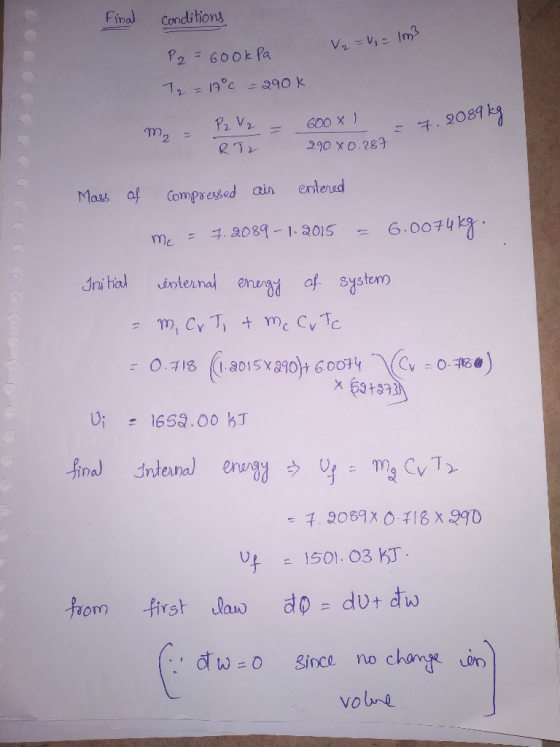
A 1m3 air tank is initially at 100 kPa and 17 degrees Celsius. It is to be filled by a compressor that delivers air at 700 kPa and 52 degrees Celsius. When the tank is filled it is allowed to reach thermal equilibrium and the tank is at 17 degrees Celsius and 600 kPa.
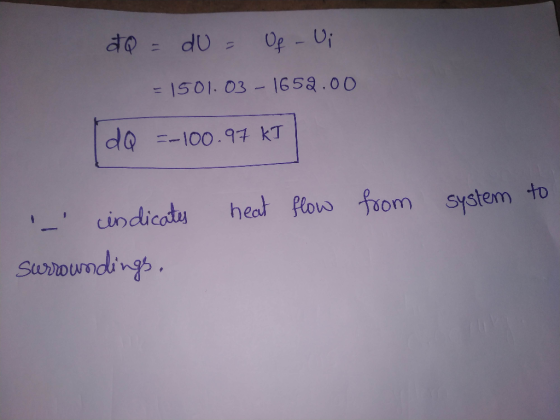
Determine the amount and direction of heat transfer between the tank and surroundings. (Hint: first find the initial mass of air in the tank, the final mass of air in the tank, and the mass of air that entered the tank. Remember the ideal gas law applies to this scenario.)
Homework Answers

Add Answer to:
A 1m3 air tank is initially at 100 kPa and 17 degrees
Celsius. It is to...
Air enters a compressor operating at steady state at a pressure of 100 kPa, a temperature...
 Air enters a compressor operating at steady state at a pressure of 100 kPa, a temperature of 290 K, and with a mass flow rate of 0.72 kg/s. At the exit, the pressure is 700 kPa and the temperature is 450 K. Heat transfer from the compressor to its surroundings occurs at a rate of 3 kW. Kinetic and potential energy changes can be ignored. Determine the power input to the compressor, in kW. Assume that the air is an...
A 2.2-m3 rigid tank initially contains air at 100 kPa and 22°C. The tank is connected...
 A 2.2-m3 rigid tank initially contains air at 100 kPa and 22°C. The tank is connected to a supply line through a valve. Air is flowing in the supply line at 600 kPa and 22°C. The valve is opened, and air is allowed to enter the tank until the pressure in the tank reaches the line pressure, at which point the valve is closed. A thermometer placed in the tank indicates that the air temperature at the final state is...
Air is contained in a 100 liter rigid tank and is initially at 40 oC and...
Air is contained in a 100 liter rigid tank and is initially at 40 oC and 900 kPa. The air is cooled until the pressure drops to 400 kPa. Find the final temperature and the amount of heat transfer during the process. Consider air as ideal gas with constant specific heat.
4) Volume 2.5 m^3 air in a rigid tank with initial pressure 100 kPa and temperature...
 4) Volume 2.5 m^3 air in a rigid tank with initial pressure 100 kPa and temperature 25°C There. It is applied to the tank feed line by a valve. Pressure of air flowing through the supply line 600 kPa and temperature is 25°C. By opening the valve, the pressure of the air in the tank is air entering the tank until it is equal to the pressure of the air It is closed. A thermometer placed in the tank lasts...
Problem 6.149 A rigid tank is filled initially with 5.0 kg of air at a pressure...
 Problem 6.149 A rigid tank is filled initially with 5.0 kg of air at a pressure of 0.4MPa and a temperature of 500 K. The air is allowed to discharge through a turbine into the atmosphere, developing work until the pressure in the tank has fallen to the atmospheric level of 0.1 MPa. Employing the ideal gas model for the air, determine the maximum theoretical amount of work that could be developed, in kJ. Ignore heat transfer with the atmosphere...
A rigid copper tank, initially containing 1 m^3 of air at 295K, 5 bar, is connected...
A rigid copper tank, initially containing 1 m^3 of air at 295K, 5 bar, is connected by a valve to a large supply line carrying air at 295K, 15 bar. The valve is opened only as long as required to fill the tank with air to a pressure of 15 bar. Finally, the air in the tank is at 310 K. The copper tank, which has a mass of 20 kg, is at the same temperature as the air in...
6.50 m A closed, rigid tank contains 5 kg of air initially at 300 K, 1...
 6.50 m A closed, rigid tank contains 5 kg of air initially at 300 K, 1 bar. As illustrated in Fig. P6.50, the tank is in contact with a thermal reservoir at 600 K and heat transfer occurs at the boundary where the temperature is 600 K. A stirring rod transfers 600 kJ of energy to the air. The final temperature is 600 K. The air can be modeled as an ideal gas with cy = 0.733 kJ/kg . K...
6.) A closed, rigid tank contains 5 kg of air initially at 300 K, 1 bar....
 6.) A closed, rigid tank contains 5 kg of air initially at 300 K, 1 bar. The diagram below shows a tank in contact with a thermal reservoir at 600 K and heat transfer occurs at the boundary where the temperature is 600 K. A stirring rod transfers 600 kJ of energy to the air. The final temperature is 600 K. The air can be modeled as an ideal gas with c 0.733 k.J/kg K and kinetic and potential energy...
1. A rigid (constant volume) tank sealed by a valve initially contains 100 kg of air...
 1. A rigid (constant volume) tank sealed by a valve initially contains 100 kg of air at a pressure of 100 kPa and 300 K. At time t = 0, the valve for the air tank is opened in a controlled manner and air leaks out isothermally (constant temperature) of the tank at a constant mass flow rate of 1 kg/s. The valve is closed after 75 seconds. Answer the following questions: Assuming air is an ideal gas, what is...
(20%) Q2. A piston-cylinder assembly initially has 100 kPa pressure and 2 liters of air at...
 (20%) Q2. A piston-cylinder assembly initially has 100 kPa pressure and 2 liters of air at 25°C. The air is then compressed to 600 kPa pressure and 150°C temperature. Useful work input for compression is 1.2 kJ. Assuming that the ambient pressure and temperature are 100 kPa and 25°C respectively, calculate a) the exergy of the air in the first and last states, b) the minimum work required for the compression process, c) the second law efficiency of the state...
 Air enters a compressor operating at steady state at a pressure of 100 kPa, a temperature of 290 K, and with a mass flow rate of 0.72 kg/s. At the exit, the pressure is 700 kPa and the temperature is 450 K. Heat transfer from the compressor to its surroundings occurs at a rate of 3 kW. Kinetic and potential energy changes can be ignored. Determine the power input to the compressor, in kW. Assume that the air is an...
 A 2.2-m3 rigid tank initially contains air at 100 kPa and 22°C. The tank is connected to a supply line through a valve. Air is flowing in the supply line at 600 kPa and 22°C. The valve is opened, and air is allowed to enter the tank until the pressure in the tank reaches the line pressure, at which point the valve is closed. A thermometer placed in the tank indicates that the air temperature at the final state is...
 4) Volume 2.5 m^3 air in a rigid tank with initial pressure 100 kPa and temperature 25°C There. It is applied to the tank feed line by a valve. Pressure of air flowing through the supply line 600 kPa and temperature is 25°C. By opening the valve, the pressure of the air in the tank is air entering the tank until it is equal to the pressure of the air It is closed. A thermometer placed in the tank lasts...
 Problem 6.149 A rigid tank is filled initially with 5.0 kg of air at a pressure of 0.4MPa and a temperature of 500 K. The air is allowed to discharge through a turbine into the atmosphere, developing work until the pressure in the tank has fallen to the atmospheric level of 0.1 MPa. Employing the ideal gas model for the air, determine the maximum theoretical amount of work that could be developed, in kJ. Ignore heat transfer with the atmosphere...
 6.50 m A closed, rigid tank contains 5 kg of air initially at 300 K, 1 bar. As illustrated in Fig. P6.50, the tank is in contact with a thermal reservoir at 600 K and heat transfer occurs at the boundary where the temperature is 600 K. A stirring rod transfers 600 kJ of energy to the air. The final temperature is 600 K. The air can be modeled as an ideal gas with cy = 0.733 kJ/kg . K...
 6.) A closed, rigid tank contains 5 kg of air initially at 300 K, 1 bar. The diagram below shows a tank in contact with a thermal reservoir at 600 K and heat transfer occurs at the boundary where the temperature is 600 K. A stirring rod transfers 600 kJ of energy to the air. The final temperature is 600 K. The air can be modeled as an ideal gas with c 0.733 k.J/kg K and kinetic and potential energy...
 1. A rigid (constant volume) tank sealed by a valve initially contains 100 kg of air at a pressure of 100 kPa and 300 K. At time t = 0, the valve for the air tank is opened in a controlled manner and air leaks out isothermally (constant temperature) of the tank at a constant mass flow rate of 1 kg/s. The valve is closed after 75 seconds. Answer the following questions: Assuming air is an ideal gas, what is...
 (20%) Q2. A piston-cylinder assembly initially has 100 kPa pressure and 2 liters of air at 25°C. The air is then compressed to 600 kPa pressure and 150°C temperature. Useful work input for compression is 1.2 kJ. Assuming that the ambient pressure and temperature are 100 kPa and 25°C respectively, calculate a) the exergy of the air in the first and last states, b) the minimum work required for the compression process, c) the second law efficiency of the state...
Most questions answered within 3 hours.
-
Where is the error in this code sequence?
String s1 = "Hello";
String s2 = "ello";...
asked 11 months ago -
Financial data for Joel de Paris, Inc., for last year
follow:
Joel de Paris, Inc.
Balance...
asked 11 months ago -
Consider this reaction:
Al2(SO4)3 (aq)+ BaCl3
(aq) Al2Cl6 (aq)- +
3BaSO4(s) . What is the...
asked 11 months ago -
Suppose that Savneet is considering increasing her
recent random sample from 20 car rentals to 40...
asked 11 months ago -
Trucks arrive at an unloading terminal at an average rate of 120
per hour.
Trucks arrive...
asked 11 months ago -
Why are methanol and ethanol completely soluble in water while
octanol is not very little soluble....
asked 11 months ago -
A facilities manager at a university reads in a research report
that the mean amount of...
asked 11 months ago -
When the CuSO4 is rehydrated by adding water to the anhydrous
compound, is this an endothermic...
asked 11 months ago -
A ray of sunlight is passing from diamond into crown glass; the
angle of incidence is...
asked 11 months ago -
A block of mass 0.249 kg is placed on top of a light, vertical
spring of...
asked 11 months ago -
how do the kidneys compensate in the presences of acidosis
a) trigger hyperventilate
b) reserve acid...
asked 11 months ago -
Question 501 pts
The rental rate of capital to the firm increases. Which of the
following...
asked 11 months ago