
Homework Answers
1. the III 3 is the carrier for disease - Tt (heterozygous)
2. the III 2 is normal - TT ( homozygous dominant)
the probability that their child will have Tay-Sachs which is the homozygous recessive disorder = tt
| T | t | |
| T | TT | Tt |
| T | TT | Tt |
so according to Punnett square
- the child will have Tay-Sachs ( tt) = 0 %
- the child with carrier = 50 %
- normal child = 50 %
Add Answer to:
BATO manner. This diseaSe is inherited in an autosomal recessive (15 pts) Tay-Sachs disease is a...
hemophilia is inherited as an Xlinked recessive mutation. Tay Sachs disease (ts) is inherited as an...
hemophilia is inherited as an Xlinked recessive mutation. Tay Sachs disease (ts) is inherited as an autosomal recessive. A hemophilic man is heterozygous for the ts allele . what fraction of his sperm will carry the recessive ts allele and hemophilia allele together ?
Tay-Sachs disease is an autosomal recessive disorder caused by a mutation in the HEXA gene that...
Tay-Sachs disease is an autosomal recessive disorder caused by a mutation in the HEXA gene that results in progressive deterioration of the nervous system. Affected indivisuals usually die by age 4. Let D represent the wildtype allele and d the disease-causing allele. Because the Tay-Sachs disease allele has been observed at relatively high frequencies in several human populations, it has ocassionally been suggested that this locus may be subject to balancing selection due to heterozygote advantage. Here we will explore...
9 % of a small sect are born with the lethal autosomal recessive trait of Tay-Sachs...
 9 % of a small sect are born with the lethal autosomal recessive trait of Tay-Sachs - 1. What is the frequency of the recessive gene in this population? -2. What is the frequency of the dominant gene? -3. What is the frequency of the heterozyous in this population? -4-5. What is the probability that the first born child of a healthy couple who are members of the sect, will have Tay-Sachs?
Please provide answers with explanations for these questions. 1. Tay Sachs disease is an inherited disorder....
 Please provide answers with explanations for these
questions.
1. Tay Sachs disease is an inherited disorder. Children who are born with Tay Sachs have progressive neurological problems and typically die before age 4. It is inherited in an autosomal recessive manner Below are pedigrees from two families where some members of a family have Tay Sachs disease. Neither Hillary nor Justin have Tay Sachs disease. If Hillary and Justin have a child, what is the chance this child will have...
Please provide answers with explanations for these
questions.
1. Tay Sachs disease is an inherited disorder. Children who are born with Tay Sachs have progressive neurological problems and typically die before age 4. It is inherited in an autosomal recessive manner Below are pedigrees from two families where some members of a family have Tay Sachs disease. Neither Hillary nor Justin have Tay Sachs disease. If Hillary and Justin have a child, what is the chance this child will have...
16.Tay-Sachs is an autosomal recessive disease. A couple (Jack & Jill) is worried about having a...
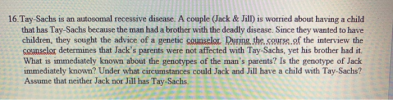 16.Tay-Sachs is an autosomal recessive disease. A couple (Jack & Jill) is worried about having a child that has Tay-Sachs because the man had a brother with the deadly disease. Since they wanted to have children, they sought the advice of a genetic counselor. During the course of the interview the sounselor determines that Jack's parents were not affected with Tay-Sachs, yet his brother had it. What is immediately known about the genotypes of the man's parents? Is the genotype...
2) Tay-Sachs disease is an autosomal recessive neurological disorder that is fatal in infancy. Despite its...
2) Tay-Sachs disease is an autosomal recessive neurological disorder that is fatal in infancy. Despite its invariably lethal effect, Tay-Sachs disease occurs at very high frequency in some Central and Eastern European (Ashkenazi) Jewish populations. In certain Ashkenazi populations, 1 in 1000 infants has Tay-Sachs disease. Population biologists believe the high frequency is a consequence of genetic bottlenecks caused by pogroms (genocide) that have reduced the population multiple times in the last several hundred years. a) In the population described,...
6.Tay-Sachs disease is an autosomal recessive disorder that causes degeneration of nerve tissue in infants. Infants...
6.Tay-Sachs disease is an autosomal recessive disorder that causes degeneration of nerve tissue in infants. Infants with Tay-Sachs disease develop blindness, paralysis, and die at an early age. The gene for this disorder is located on chromosome 15. Sickle cell anemia is another autosomal recessive disorder. A person who is homozygous recessive for the sickle cell allele will have an abnormal hemoglobin protein which causes the red blood cells to have a sickle shape. The misshapen blood cells block capillaries...
1. Tay-Sachs is an autosomal recessive disorder, which is the inability for infants to breakdown gangliosides in the CNS, which overtime build-up and destroy neurons. As the disease progresses, the ch...
1. Tay-Sachs is an autosomal recessive disorder, which is the inability for infants to breakdown gangliosides in the CNS, which overtime build-up and destroy neurons. As the disease progresses, the child loses muscle control. Eventually, this leads to blindness, paralysis and death. If you have a family history of Tay-Sachs disease or if you're a member of a high-risk group and plan to have children, doctors strongly recommend genetic testing and genetic counseling. Scott and Tina are a young couple...
Use the information presented below to answer questions 6 - 8. Tay-Sachs disease is a recessive...
 Use the information presented below to answer questions 6 - 8. Tay-Sachs disease is a recessive hereditary abnormality causing death within the first few years of life in individuals with the genotype tt. These individuals never reach sexual maturity. Individuals with the genotype T do not become diseased. Abnormally shortened fingers (brachyphalangy) are due to the presence of alleles in the heterozygous condition (Bb) located at a different locus. Geneticists observed that brachyphalangy was conveyed by the dominant allele and...
Ques 30-31. Tay-Sachs disease is caused by an allele, t, that is recessive to the normal...
Ques 30-31. Tay-Sachs disease is caused by an allele, t, that is recessive to the normal allele, T. A normal man and normal woman have three children, a normal son, a normal daughter, and a daughter with the disease. 30. The genotype of the normal woman is a) TT b) Tt c) tt d) a or b are possible e) b or c are possible 31. The probability that the normal son is a Tt carrier of the disease is...
 9 % of a small sect are born with the lethal autosomal recessive trait of Tay-Sachs - 1. What is the frequency of the recessive gene in this population? -2. What is the frequency of the dominant gene? -3. What is the frequency of the heterozyous in this population? -4-5. What is the probability that the first born child of a healthy couple who are members of the sect, will have Tay-Sachs?
 Please provide answers with explanations for these
questions.
1. Tay Sachs disease is an inherited disorder. Children who are born with Tay Sachs have progressive neurological problems and typically die before age 4. It is inherited in an autosomal recessive manner Below are pedigrees from two families where some members of a family have Tay Sachs disease. Neither Hillary nor Justin have Tay Sachs disease. If Hillary and Justin have a child, what is the chance this child will have...
Please provide answers with explanations for these
questions.
1. Tay Sachs disease is an inherited disorder. Children who are born with Tay Sachs have progressive neurological problems and typically die before age 4. It is inherited in an autosomal recessive manner Below are pedigrees from two families where some members of a family have Tay Sachs disease. Neither Hillary nor Justin have Tay Sachs disease. If Hillary and Justin have a child, what is the chance this child will have...
 16.Tay-Sachs is an autosomal recessive disease. A couple (Jack & Jill) is worried about having a child that has Tay-Sachs because the man had a brother with the deadly disease. Since they wanted to have children, they sought the advice of a genetic counselor. During the course of the interview the sounselor determines that Jack's parents were not affected with Tay-Sachs, yet his brother had it. What is immediately known about the genotypes of the man's parents? Is the genotype...
 Use the information presented below to answer questions 6 - 8. Tay-Sachs disease is a recessive hereditary abnormality causing death within the first few years of life in individuals with the genotype tt. These individuals never reach sexual maturity. Individuals with the genotype T do not become diseased. Abnormally shortened fingers (brachyphalangy) are due to the presence of alleles in the heterozygous condition (Bb) located at a different locus. Geneticists observed that brachyphalangy was conveyed by the dominant allele and...
Most questions answered within 3 hours.
-
Where is the error in this code sequence?
String s1 = "Hello";
String s2 = "ello";...
asked 11 months ago -
Financial data for Joel de Paris, Inc., for last year
follow:
Joel de Paris, Inc.
Balance...
asked 11 months ago -
Consider this reaction:
Al2(SO4)3 (aq)+ BaCl3
(aq) Al2Cl6 (aq)- +
3BaSO4(s) . What is the...
asked 11 months ago -
Suppose that Savneet is considering increasing her
recent random sample from 20 car rentals to 40...
asked 11 months ago -
Trucks arrive at an unloading terminal at an average rate of 120
per hour.
Trucks arrive...
asked 11 months ago -
Why are methanol and ethanol completely soluble in water while
octanol is not very little soluble....
asked 11 months ago -
A facilities manager at a university reads in a research report
that the mean amount of...
asked 11 months ago -
When the CuSO4 is rehydrated by adding water to the anhydrous
compound, is this an endothermic...
asked 11 months ago -
A ray of sunlight is passing from diamond into crown glass; the
angle of incidence is...
asked 11 months ago -
A block of mass 0.249 kg is placed on top of a light, vertical
spring of...
asked 11 months ago -
how do the kidneys compensate in the presences of acidosis
a) trigger hyperventilate
b) reserve acid...
asked 11 months ago -
Question 501 pts
The rental rate of capital to the firm increases. Which of the
following...
asked 11 months ago