
Homework Answers
Add Answer to:
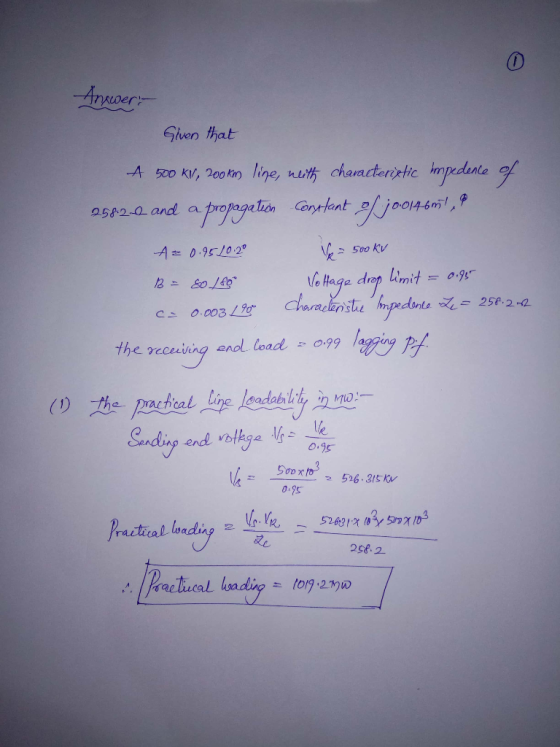
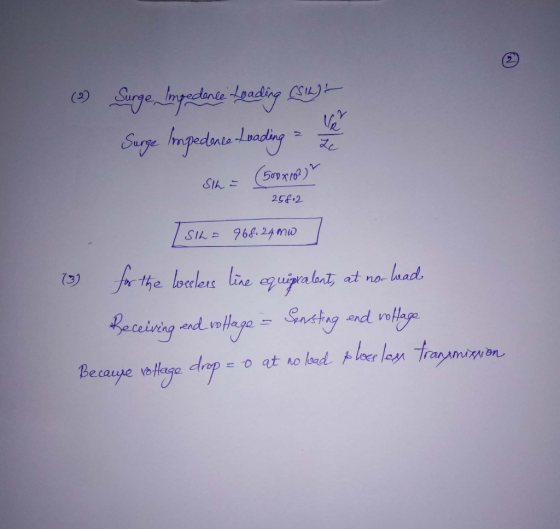
and a m line, with characteristic impedance of 258.2 , B 80<80°, С 0.003<90". The receiving...
4. A 500 km, 500kV,60 Hz three-phase transmission line has a positive sequence series impedance z...
 4. A 500 km, 500kV,60 Hz three-phase transmission line has a positive sequence series impedance z =j 0.38.2/km and a shunt admittance y =j 4.0 x 10⁻⁶S/km. Line losses are neglected. a. Calculate the line's characteristic impedance Zc, the propagation constant y and the exact ABCD parameters of the line... b. Calculate the surge impedance loading (SIL) in MW and the maximum power that the line can deliver at rated voltage C. At full load the line delivers 1000 M...
Show the solution for the following problem 1. A short, 230 kV transmission line has an...
Show the solution for the following problem 1. A short, 230 kV transmission line has an impedance of 5 cis 78 ohms. The load at the receiving end is 100 MW at 230 kV, 85% lagging power factor. What is the voltage at the sending end? a. 235.43 kV b. 226.3 kV c. 231.78 kV d. 238.21 kV 2. A 66 kv medium length transmission line delivers a load of 10 MW at 66 kv and 80% lagging P.F. the...
Q2. Draw the nominal π circuit that is used to represent the medium-length transmission line model with total series impedance Z and total shunt admittance Y. Then derive the equations to express the...
 Q2. Draw the nominal π circuit that is used to represent the medium-length transmission line model with total series impedance Z and total shunt admittance Y. Then derive the equations to express the ABCD parameters (a) 20% (b)A 200 km, 230 kV, 50 Hz three-phase overhead transmission line has a positive-sequence series impedance z (0.08 + j0.48) Ω/km, and a positive-sequence shunt admittance y-j3.33 x 10T° S/km. At full load, the line delivers 250 MW at 0.99 power factor lagging...
4 A three-phase, 765-kV, 50-Hz transposed line is composed of four ACSR 1,510,500, 54/19 Parrot conductors per phas...
 4 A three-phase, 765-kV, 50-Hz transposed line is composed of four ACSR 1,510,500, 54/19 Parrot conductors per phase with flat horizontal spacing of 16 m. The conductors have a diameter of 3.8252 cm and a GMR of 1.5453 cm. The bundle spacing is 40 cm. The line is Km long, and for the purpose of this problem, a lossless line is assumed (a) Determine the transmission line surge impedance Zc, phase constant p, wave surge impedance loading SIL, and the...
A 200-km, 230-kV, 60-Hz three-phase line has a positive-sequence series impedance ?=0.08+?0.48 Ω/km and a positive-sequence...
 A 200-km, 230-kV, 60-Hz three-phase line has a positive-sequence
series impedance ?=0.08+?0.48 Ω/km and a positive-sequence shunt
admittance ?=?3.33×10⁻⁶ S/km. At full load, the line delivers 250
MW at 0.99 pf lagging and at 220 kV. Using the nominal ? circuit,
calculate:
a. The ABCD parameters,
b. The sending-end voltage and current,
c. The percent voltage regulation.
A 200-km, 230-kV, 60-Hz three-phase line has a positive-sequence
series impedance ?=0.08+?0.48 Ω/km and a positive-sequence shunt
admittance ?=?3.33×10⁻⁶ S/km. At full load, the line delivers 250
MW at 0.99 pf lagging and at 220 kV. Using the nominal ? circuit,
calculate:
a. The ABCD parameters,
b. The sending-end voltage and current,
c. The percent voltage regulation.
A lossless transmission line with characteristic impedance of 75Ω measures 1.4λ at a certain working frequency....
A lossless transmission line with characteristic impedance of 75Ω measures 1.4λ at a certain working frequency. The line is powered by a generator with negligible impedance and an open circuit voltage of Vg=10∠0° [V]. A load of 50-i50Ω is connected at the end of the line. Find a) The reflection coefficient. b)The stationary wave ratio. c)The input impedance of the line. d)The voltage at the entrance of the line. e)The voltage at the load. f)The average power delivered to the...
A 345 kV, three phase transmission line is 130 km long. The series impedance is z...
A 345 kV, three phase transmission line is 130 km long. The series impedance is z = 0.036 + j0.3 Ω per phase/km and the shunt admittance is y = j4.22 x 10-6 S per phase/km. The sending end voltage is 345 kV and the sending end current is 400 A at 0.95 power factor lagging. Find the voltage, current and power at the receiving end and the voltage regulation.
Question 4 (a) The input impedance of a lossless air-core transmission line with characteristic impedance Ro. phase constant B and length I terminated in an impedance Z, is given by R,+Z, tan( i....
 Question 4 (a) The input impedance of a lossless air-core transmission line with characteristic impedance Ro. phase constant B and length I terminated in an impedance Z, is given by R,+Z, tan( i. Determine the length of an open circuit 50Ω line required to create a 0.1 nH inductor at a frequency of 10 GHz. (6 marks) ii. Determine the input impedance of the line in part () if the open circuit is changed to a short circuit. (3 marks)...
A three-phase transmission line is 370 km long. The series impedance of the line is 0.524angle79.4 Ω/km and the susceptance is j3.17x10^-6 S/km. The voltage at the sending end is 400 kV. (i) Find the sending end current and the receiving end voltage when
A three-phase transmission line is 370 km long. The series impedance of the line is0.524angle79.4 Ω/km and the susceptance is j3.17x10^-6 S/km. The voltage at thesending end is 400 kV. (i) Find the sending end current and the receiving end voltagewhen there is no load on the line. (ii) Determine the maximum permissible line lengthif the receiving end no-load voltage is not to exceed 430 kV.
The per-phase impedance of a short transmission line is (0.3+j0.4) Ω. The sending end line-to-line voltage is 3300V, and the load at the receiving end is 300 kiloWatts per phase at 0.8 power factor la...
The per-phase impedance of a short transmission line is (0.3+j0.4) Ω. The sending end line-to-line voltage is 3300V, and the load at the receiving end is 300 kiloWatts per phase at 0.8 power factor lagging. Calculate: (a) The receiving end voltage (b) The line current (c) The sending end power factor (d) The power loss.
 4. A 500 km, 500kV,60 Hz three-phase transmission line has a positive sequence series impedance z =j 0.38.2/km and a shunt admittance y =j 4.0 x 10⁻⁶S/km. Line losses are neglected. a. Calculate the line's characteristic impedance Zc, the propagation constant y and the exact ABCD parameters of the line... b. Calculate the surge impedance loading (SIL) in MW and the maximum power that the line can deliver at rated voltage C. At full load the line delivers 1000 M...
 Q2. Draw the nominal π circuit that is used to represent the medium-length transmission line model with total series impedance Z and total shunt admittance Y. Then derive the equations to express the ABCD parameters (a) 20% (b)A 200 km, 230 kV, 50 Hz three-phase overhead transmission line has a positive-sequence series impedance z (0.08 + j0.48) Ω/km, and a positive-sequence shunt admittance y-j3.33 x 10T° S/km. At full load, the line delivers 250 MW at 0.99 power factor lagging...
 4 A three-phase, 765-kV, 50-Hz transposed line is composed of four ACSR 1,510,500, 54/19 Parrot conductors per phase with flat horizontal spacing of 16 m. The conductors have a diameter of 3.8252 cm and a GMR of 1.5453 cm. The bundle spacing is 40 cm. The line is Km long, and for the purpose of this problem, a lossless line is assumed (a) Determine the transmission line surge impedance Zc, phase constant p, wave surge impedance loading SIL, and the...
 A 200-km, 230-kV, 60-Hz three-phase line has a positive-sequence
series impedance ?=0.08+?0.48 Ω/km and a positive-sequence shunt
admittance ?=?3.33×10⁻⁶ S/km. At full load, the line delivers 250
MW at 0.99 pf lagging and at 220 kV. Using the nominal ? circuit,
calculate:
a. The ABCD parameters,
b. The sending-end voltage and current,
c. The percent voltage regulation.
A 200-km, 230-kV, 60-Hz three-phase line has a positive-sequence
series impedance ?=0.08+?0.48 Ω/km and a positive-sequence shunt
admittance ?=?3.33×10⁻⁶ S/km. At full load, the line delivers 250
MW at 0.99 pf lagging and at 220 kV. Using the nominal ? circuit,
calculate:
a. The ABCD parameters,
b. The sending-end voltage and current,
c. The percent voltage regulation.
 Question 4 (a) The input impedance of a lossless air-core transmission line with characteristic impedance Ro. phase constant B and length I terminated in an impedance Z, is given by R,+Z, tan( i. Determine the length of an open circuit 50Ω line required to create a 0.1 nH inductor at a frequency of 10 GHz. (6 marks) ii. Determine the input impedance of the line in part () if the open circuit is changed to a short circuit. (3 marks)...
Most questions answered within 3 hours.
-
Where is the error in this code sequence?
String s1 = "Hello";
String s2 = "ello";...
asked 11 months ago -
Financial data for Joel de Paris, Inc., for last year
follow:
Joel de Paris, Inc.
Balance...
asked 11 months ago -
Consider this reaction:
Al2(SO4)3 (aq)+ BaCl3
(aq) Al2Cl6 (aq)- +
3BaSO4(s) . What is the...
asked 11 months ago -
Suppose that Savneet is considering increasing her
recent random sample from 20 car rentals to 40...
asked 11 months ago -
Trucks arrive at an unloading terminal at an average rate of 120
per hour.
Trucks arrive...
asked 11 months ago -
Why are methanol and ethanol completely soluble in water while
octanol is not very little soluble....
asked 11 months ago -
A facilities manager at a university reads in a research report
that the mean amount of...
asked 11 months ago -
When the CuSO4 is rehydrated by adding water to the anhydrous
compound, is this an endothermic...
asked 11 months ago -
A ray of sunlight is passing from diamond into crown glass; the
angle of incidence is...
asked 11 months ago -
A block of mass 0.249 kg is placed on top of a light, vertical
spring of...
asked 11 months ago -
how do the kidneys compensate in the presences of acidosis
a) trigger hyperventilate
b) reserve acid...
asked 11 months ago -
Question 501 pts
The rental rate of capital to the firm increases. Which of the
following...
asked 11 months ago