A. 0.001 uL B. 0.01 uL C. 0.1 uL D. 1.0 uL You have performed...
|
You have performed a 10-fold serial dilution of your phage sample from 100 to 10-4. You have been transferring 10 uL of sample from one tube to the next. How many microliters of the original 100 sample are in the 10-4 tube?
Homework Answers
Disclaimer: Read the whole answer.
Look at the following table -
|
Sample Concentration |
100 | 10 | 1 | 10^-1 | 10^-2 | 10^-3 | 10^-4 |
| Number of dilution (fold) | 0 (no dilution) | 1 | 2 | 3 | 4 | 5 | 6 |
Thus we have done 6 ten fold dilutions to go from 100 to 10^-4
It is given that 10uL of sample is used for serial dilutions which means 10uL is taken from the sample and added to 90uL of solvent. Then 10uL is taken from this dilution and is added in another 90uL of solvent and so on. Total 6 such dilutions are done. Now look at the following table -
| Number of dilution | 1 | 2 | 3 | 4 | 5 | 6 |
| Amount of original sample in that dilution | 10uL | 1uL | 0.1uL | 0.01uL | 0.001uL | 0.0001uL |
Clearly there is no option of 0.0001uL. I think that the initail concentration is 10^0 and not 100. Hence if I consider initial population as 10^0 = 1 we get the following table -
| Sample concentration | 10^0 = 1 | 10^-1 | 10^-2 | 10^-3 | 10^-4 |
| Number of dilution (folds) | 0 | 1 | 2 | 3 | 4 |
| Amount of original sample | NA | 10uL | 1uL | 0.1uL | 0.01uL |
Hence the answer is B. 0.01uL
Hope this helped!
2) You are given a bacterial culture with the following serial dilutions: 1 ml 0.1 ml...
 2) You are given a bacterial culture with the following serial dilutions: 1 ml 0.1 ml 1 ml Original culture 9 ml media 9.9 ml media 9 ml media B a) what is the final dilution in tube C? (1 pt) b) if you plated 100 ul of the bacterial dilution in tube B, incubated and counted 114 colonies the next day, what would the CFU/ml be of the original bacterial culture? (show work and units- 2 pts)
You have performed a serial dilution of a sample with an unknown concentration of microorganisms. You...
You have performed a serial dilution of a sample with an unknown concentration of microorganisms. You counted 55 CFU on a countable plate inoculated with 0.1 mL of a 10-3 dilution. What was the population density of the original sample per milliliter? Many of the quantitative methods discussed are popular because they enable the microbiology researcher to selectively count live cells only. Why do you think this might be an important or desirable feature in a medical or environmental research...
You have performed a serial dilution of an unknown sample and counted 73 CFU on a...
You have performed a serial dilution of an unknown sample and counted 73 CFU on a countable plate that was marked as a 10-4 dilution and you used 0.1ml to inoculate the plate. What is the population density of the original sample? Please Show Work.....
17. A sample of a culture of bacteria is subjected to 10-fold serial dilution; 0.1 mL...
 17. A sample of a culture of bacteria is subjected to 10-fold serial dilution; 0.1 mL aliquots of the dilutions are grown on agar plates and the number of colonies counted: Dilution: Number of colonies: 10- Too many to count 10-6 10- 2 0 -3 Too many 249 to count 10-4 24 2 10-5 0 BIOT 5021-SP2 Assuming that one cell gives rise to one colony, how many cells were there per mL of the original culture?
dilutions dilutions What are the resulting dilutions? Notice units of measurement. a) b) c) 500 L...
 dilutions
What are the resulting dilutions? Notice units of measurement. a) b) c) 500 L of serum is diluted to 2.0 mL 50 uL of whole blood is pipetted into 0.95 mL of diluent 500 mL of liquid K is added to 4.5 L of water 7. If 10 uL of urine is added to 90 uL of water, and the resulting solution is brought to a final volume of 0.50 mL with water, what is the final dilution...
dilutions
dilutions
What are the resulting dilutions? Notice units of measurement. a) b) c) 500 L of serum is diluted to 2.0 mL 50 uL of whole blood is pipetted into 0.95 mL of diluent 500 mL of liquid K is added to 4.5 L of water 7. If 10 uL of urine is added to 90 uL of water, and the resulting solution is brought to a final volume of 0.50 mL with water, what is the final dilution...
14. Analyze the following serial dilution experiment and answer the questions, each (a and b) worth...
 14. Analyze the following serial dilution experiment and answer the questions, each (a and b) worth 10 pts. Given: One ml of the original bacterial culture (tube 0) was added to experiment tube 1, containing 9 ml of media. 7 more experiment tubes were serially diluted in order, the same way, for a total of 8. Each originally contained 9 ml of media, and each received 1 ml from the tube number preceeding it. Two drops from tube #8 were...
Serial dilution problem You have a stock of 5% SDS. You take some of that stock...
Serial dilution problem You have a stock of 5% SDS. You take some of that stock and dilute it 4-fold in tube #1. the tubes hold 1.5ml. give an example of how much 5% stock and how much water you would use to make 4 fold dilution - volume of 5% stock ? - volume of water? - How much volume transferred? - if you took a sample out of tube 2 and did another 4 fold dilution, what concentration...
You have a stock of an E. coli cell culture of an unknown concentration. You want...
You have a stock of an E. coli cell culture of an unknown concentration. You want to set up a serial dilution experiment so that you can count the viable colonies and determine the concentration of the stock in cells/ml. In tube A, you add 1 ml of the stock to 999 ml of media. In tube B, you add 1 ml of the material from tube A to 24 ml of media. In tube C, you add 50 microliters...
You are given a 1 gram soil sample of unknown bacterial load. After doing 10-fold serial...
You are given a 1 gram soil sample of unknown bacterial load. After doing 10-fold serial dilutions of the soil in sterile water, 100 uL volumes are taken from each dilution for preparation of pour plates. Following incubation, each half of the 10-8 plate has 46 colonies. a) What was the dilution factor? b) How many bacteria were present in the soil?
If you have 1.0 x 10 molecules in a tube and perform a 10-4 dilution, how...
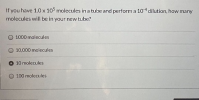 If you have 1.0 x 10 molecules in a tube and perform a 10-4 dilution, how many molecules will be in your new tube? 1000 molecules 10,000 molecules • 10 molecules 100 molecules
 2) You are given a bacterial culture with the following serial dilutions: 1 ml 0.1 ml 1 ml Original culture 9 ml media 9.9 ml media 9 ml media B a) what is the final dilution in tube C? (1 pt) b) if you plated 100 ul of the bacterial dilution in tube B, incubated and counted 114 colonies the next day, what would the CFU/ml be of the original bacterial culture? (show work and units- 2 pts)
 17. A sample of a culture of bacteria is subjected to 10-fold serial dilution; 0.1 mL aliquots of the dilutions are grown on agar plates and the number of colonies counted: Dilution: Number of colonies: 10- Too many to count 10-6 10- 2 0 -3 Too many 249 to count 10-4 24 2 10-5 0 BIOT 5021-SP2 Assuming that one cell gives rise to one colony, how many cells were there per mL of the original culture?
 dilutions
What are the resulting dilutions? Notice units of measurement. a) b) c) 500 L of serum is diluted to 2.0 mL 50 uL of whole blood is pipetted into 0.95 mL of diluent 500 mL of liquid K is added to 4.5 L of water 7. If 10 uL of urine is added to 90 uL of water, and the resulting solution is brought to a final volume of 0.50 mL with water, what is the final dilution...
dilutions
dilutions
What are the resulting dilutions? Notice units of measurement. a) b) c) 500 L of serum is diluted to 2.0 mL 50 uL of whole blood is pipetted into 0.95 mL of diluent 500 mL of liquid K is added to 4.5 L of water 7. If 10 uL of urine is added to 90 uL of water, and the resulting solution is brought to a final volume of 0.50 mL with water, what is the final dilution...
 14. Analyze the following serial dilution experiment and answer the questions, each (a and b) worth 10 pts. Given: One ml of the original bacterial culture (tube 0) was added to experiment tube 1, containing 9 ml of media. 7 more experiment tubes were serially diluted in order, the same way, for a total of 8. Each originally contained 9 ml of media, and each received 1 ml from the tube number preceeding it. Two drops from tube #8 were...
 If you have 1.0 x 10 molecules in a tube and perform a 10-4 dilution, how many molecules will be in your new tube? 1000 molecules 10,000 molecules • 10 molecules 100 molecules
Most questions answered within 3 hours.
-
Where is the error in this code sequence?
String s1 = "Hello";
String s2 = "ello";...
asked 11 months ago -
Financial data for Joel de Paris, Inc., for last year
follow:
Joel de Paris, Inc.
Balance...
asked 11 months ago -
Consider this reaction:
Al2(SO4)3 (aq)+ BaCl3
(aq) Al2Cl6 (aq)- +
3BaSO4(s) . What is the...
asked 11 months ago -
Suppose that Savneet is considering increasing her
recent random sample from 20 car rentals to 40...
asked 11 months ago -
Trucks arrive at an unloading terminal at an average rate of 120
per hour.
Trucks arrive...
asked 11 months ago -
Why are methanol and ethanol completely soluble in water while
octanol is not very little soluble....
asked 11 months ago -
A facilities manager at a university reads in a research report
that the mean amount of...
asked 11 months ago -
When the CuSO4 is rehydrated by adding water to the anhydrous
compound, is this an endothermic...
asked 11 months ago -
A ray of sunlight is passing from diamond into crown glass; the
angle of incidence is...
asked 11 months ago -
A block of mass 0.249 kg is placed on top of a light, vertical
spring of...
asked 11 months ago -
how do the kidneys compensate in the presences of acidosis
a) trigger hyperventilate
b) reserve acid...
asked 11 months ago -
Question 501 pts
The rental rate of capital to the firm increases. Which of the
following...
asked 11 months ago