1.Summarize four different types of DNA –protein interactions and their functional consequences using the table below....
1.Summarize four different types of DNA –protein interactions and their functional consequences using the table below.
|
# |
Type of DNA-protein interaction |
Functional Consequences |
|
1 |
||
|
2 |
||
|
3 |
||
|
4 |
||
Homework Answers
DNA-protein interactions can be specific or non-specific. Specific interactions take place by means of specialized domains which are found in interacting proteins such as transcription factors. Some of the domains involved in DNA-protein interactions are:
1) Helix-turn-helix - This motif consists of two alpha helices seprated by a short (four amino acid) peptide sequene that forms a beta turn. Transcription factors which play an important role in early embryo development in Drosophila contain this motif.
2) Zinc finger - The zinc finger is a loop of 12 amino acids with two cysteines and two Histidines at the base of the loop that tetrahedrally coordinate a Zinc ion.TFIIIA contain Zinc fingers.
3) Leucine zippers - This motif contains a leucine every seventh amino acid in the primary sequence and forms an alpha helix with the leucines presented on the same side of the helix every second turn, giving a hydrophobic surface.
4) Activation domains - There are certain domains of amino acids which are not sequence specific DNA binding domain but carry out some function. Glutamine-rich domains for example are found in SP1 transcription factors.
Add Answer to:
1.Summarize four different types of DNA
–protein interactions and their functional consequences using the
table below....
Which types of mutations in DNA can lead to the translation of a non-functional protein product?...
Which types of mutations in DNA can lead to the translation of a non-functional protein product? Missense Nonsense Antisense Silent Frameshift P.S. can be up to 3 options correct if applicable
4. Now consider the sequence that results for a different mutant protein. Using the DNA coding...
 4. Now consider the sequence that results for a different mutant protein. Using the DNA coding and sequence provided, predict the sequences of the DNA template strand, mRNA, and polypeptide for the mutant gene. DNA coding strand for mutant gene 3: 5'ACTGCCCATGGTGGTACCT GAC TCC TGAGGAG 3' On the line above, write the sequence for the template DNA strand. On the line below, write the sequence for the mRNA for mutant protein: On the line below, write the sequence for the...
3. Now consider the sequence that results for a different mutant protein. Using the DNA coding...
 3. Now consider the sequence that results for a different mutant protein. Using the DNA coding strand sequence provided, predict the sequences of the DNA template strand, mRNA, and polypeptide for the mutant gene. DNA coding strand for mutant gene 2: S'ACTGCCCLATGGTGTAG CTG ACTCCTGAGGAG13 On the line above, write the sequence for the template DNA strand, On the line below, write the sequence for the mRNA for mutant protein: On the line below, write the sequence for the Polypeptide for...
You are interested in the interactions of histone deacetylase (HDAC) with nucleosomes. Using a DNA template...
 You are interested in the interactions of histone deacetylase
(HDAC) with nucleosomes. Using a DNA template that is end labelled
with 32P and has two nucleosomes already bound to it, you perform a
gel-shift experiment with HDAC and the chromatin from above. You
also assemble chromatin with nucleosomes that have been methylated
at a particular amino acid residue of Histone H4. The results are
below. Based on the data, (A) explain the autoradiogram below –
what are all the bands?...
You are interested in the interactions of histone deacetylase
(HDAC) with nucleosomes. Using a DNA template that is end labelled
with 32P and has two nucleosomes already bound to it, you perform a
gel-shift experiment with HDAC and the chromatin from above. You
also assemble chromatin with nucleosomes that have been methylated
at a particular amino acid residue of Histone H4. The results are
below. Based on the data, (A) explain the autoradiogram below –
what are all the bands?...
1 ) Using factors and concepts of protein interactions, describe protein-ligand binding as fully as possible,...
1 ) Using factors and concepts of protein interactions, describe protein-ligand binding as fully as possible, including the role it plays in the body's physiology, using some of the examples of soluble proteins. 2 ) Describe the structural and functional aspects of a transporting epithelium, including the specific proteins involved that generate the characteristics of this type of epithelium. 3 ) Picture the following fluid replacement therapy: A solution of 0.45% NaCl, 3.3% dextrose (glucose), 100mM urea, and 100mM Albumin...
QUESTION 8 The following situations (1-4) involve different types of gene regulation in prokaryotic cells as shown. OFF...
 QUESTION 8 The following situations (1-4) involve different types of gene regulation in prokaryotic cells as shown. OFF and ON reter to whether the gene is transcribed or not. Draw clearly-labelled regulatory proteins and effector molecules in each diagram to explain how the regulation works in each case. The first one has been done for you as an example a) (6 marks) Type of Regulation Regulatory protein effector molecule 1 DNA X negative inducible OFF ON 2 negative repressible DNA...
In-Class Activity #12, Protein Tratlicking Worksheet 1. You are interested in four different proteins in a...
 In-Class Activity #12, Protein Tratlicking Worksheet 1. You are interested in four different proteins in a yeast cell: • protein 1 is a cytosolic protein protein 2 is a secreted protein • protein 3 is a nuclear protein protein 4 is a cell surface membrane protein with N-terminal end in extra-cellular space. a. You plan to study how the proteins are localized to their specific destination by creating the following mutations in the genes encoding proteins 1-4. Indicate how the...
1. Describe a typical protein-protein interface, and what is required to allow for protein interactions. 2....
1. Describe a typical protein-protein interface, and what is required to allow for protein interactions. 2. Are NAD- and ATP-binding domains generally conserved or unique? Why? 3. Why do proteins have cofactors (what role do they serve)? 4. Describe the two ways proteins can interact with DNA, and the differences between both. Which is similar to the RNA recognition motif? 5. How do proteins differentiate between ssRNA, dsRNA, DNA-RNA hybrids, and dsDNA?
Consider the table and four functional dependencies below. Which of these dependencies hold on the table...
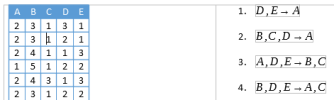 Consider the table and four functional dependencies below. Which
of these dependencies hold on the table and which not?
E 1. D,E- A 1 B,C,D-A A B C D | 2|3|1| 3 2 3 1 2 2 4 1 1 1 5 1 2 2 4 3 1 2 3 1 2 1 3 2 3 2 3. A,D,E-B,C 4. B,D,E-A,C
Consider the table and four functional dependencies below. Which
of these dependencies hold on the table and which not?
E 1. D,E- A 1 B,C,D-A A B C D | 2|3|1| 3 2 3 1 2 2 4 1 1 1 5 1 2 2 4 3 1 2 3 1 2 1 3 2 3 2 3. A,D,E-B,C 4. B,D,E-A,C
A few different types of electromagnetic radiation are listed in the table below. Complete the table...
 A few different types of electromagnetic radiation are listed in the table below. Complete the table by ordering these types of radiation by increasing frequency, wavelength, and energy per photon. For example, select "1" in the second column for the type of radiation with the lowest frequency,"2" for the type of radiation with the next higher frequency, and so forth. type of radiation order of frequency blue light Infrared radiation (Choose one) 1 (lowest 2 3 4 (highest) (Choose one)...
 4. Now consider the sequence that results for a different mutant protein. Using the DNA coding and sequence provided, predict the sequences of the DNA template strand, mRNA, and polypeptide for the mutant gene. DNA coding strand for mutant gene 3: 5'ACTGCCCATGGTGGTACCT GAC TCC TGAGGAG 3' On the line above, write the sequence for the template DNA strand. On the line below, write the sequence for the mRNA for mutant protein: On the line below, write the sequence for the...
 3. Now consider the sequence that results for a different mutant protein. Using the DNA coding strand sequence provided, predict the sequences of the DNA template strand, mRNA, and polypeptide for the mutant gene. DNA coding strand for mutant gene 2: S'ACTGCCCLATGGTGTAG CTG ACTCCTGAGGAG13 On the line above, write the sequence for the template DNA strand, On the line below, write the sequence for the mRNA for mutant protein: On the line below, write the sequence for the Polypeptide for...
 You are interested in the interactions of histone deacetylase
(HDAC) with nucleosomes. Using a DNA template that is end labelled
with 32P and has two nucleosomes already bound to it, you perform a
gel-shift experiment with HDAC and the chromatin from above. You
also assemble chromatin with nucleosomes that have been methylated
at a particular amino acid residue of Histone H4. The results are
below. Based on the data, (A) explain the autoradiogram below –
what are all the bands?...
You are interested in the interactions of histone deacetylase
(HDAC) with nucleosomes. Using a DNA template that is end labelled
with 32P and has two nucleosomes already bound to it, you perform a
gel-shift experiment with HDAC and the chromatin from above. You
also assemble chromatin with nucleosomes that have been methylated
at a particular amino acid residue of Histone H4. The results are
below. Based on the data, (A) explain the autoradiogram below –
what are all the bands?...
 QUESTION 8 The following situations (1-4) involve different types of gene regulation in prokaryotic cells as shown. OFF and ON reter to whether the gene is transcribed or not. Draw clearly-labelled regulatory proteins and effector molecules in each diagram to explain how the regulation works in each case. The first one has been done for you as an example a) (6 marks) Type of Regulation Regulatory protein effector molecule 1 DNA X negative inducible OFF ON 2 negative repressible DNA...
 In-Class Activity #12, Protein Tratlicking Worksheet 1. You are interested in four different proteins in a yeast cell: • protein 1 is a cytosolic protein protein 2 is a secreted protein • protein 3 is a nuclear protein protein 4 is a cell surface membrane protein with N-terminal end in extra-cellular space. a. You plan to study how the proteins are localized to their specific destination by creating the following mutations in the genes encoding proteins 1-4. Indicate how the...
 Consider the table and four functional dependencies below. Which
of these dependencies hold on the table and which not?
E 1. D,E- A 1 B,C,D-A A B C D | 2|3|1| 3 2 3 1 2 2 4 1 1 1 5 1 2 2 4 3 1 2 3 1 2 1 3 2 3 2 3. A,D,E-B,C 4. B,D,E-A,C
Consider the table and four functional dependencies below. Which
of these dependencies hold on the table and which not?
E 1. D,E- A 1 B,C,D-A A B C D | 2|3|1| 3 2 3 1 2 2 4 1 1 1 5 1 2 2 4 3 1 2 3 1 2 1 3 2 3 2 3. A,D,E-B,C 4. B,D,E-A,C
 A few different types of electromagnetic radiation are listed in the table below. Complete the table by ordering these types of radiation by increasing frequency, wavelength, and energy per photon. For example, select "1" in the second column for the type of radiation with the lowest frequency,"2" for the type of radiation with the next higher frequency, and so forth. type of radiation order of frequency blue light Infrared radiation (Choose one) 1 (lowest 2 3 4 (highest) (Choose one)...
Most questions answered within 3 hours.
-
Where is the error in this code sequence?
String s1 = "Hello";
String s2 = "ello";...
asked 10 months ago -
Financial data for Joel de Paris, Inc., for last year
follow:
Joel de Paris, Inc.
Balance...
asked 10 months ago -
Consider this reaction:
Al2(SO4)3 (aq)+ BaCl3
(aq) Al2Cl6 (aq)- +
3BaSO4(s) . What is the...
asked 10 months ago -
Suppose that Savneet is considering increasing her
recent random sample from 20 car rentals to 40...
asked 10 months ago -
Trucks arrive at an unloading terminal at an average rate of 120
per hour.
Trucks arrive...
asked 10 months ago -
Why are methanol and ethanol completely soluble in water while
octanol is not very little soluble....
asked 10 months ago -
A facilities manager at a university reads in a research report
that the mean amount of...
asked 10 months ago -
When the CuSO4 is rehydrated by adding water to the anhydrous
compound, is this an endothermic...
asked 10 months ago -
A ray of sunlight is passing from diamond into crown glass; the
angle of incidence is...
asked 10 months ago -
A block of mass 0.249 kg is placed on top of a light, vertical
spring of...
asked 10 months ago -
how do the kidneys compensate in the presences of acidosis
a) trigger hyperventilate
b) reserve acid...
asked 10 months ago -
Question 501 pts
The rental rate of capital to the firm increases. Which of the
following...
asked 10 months ago