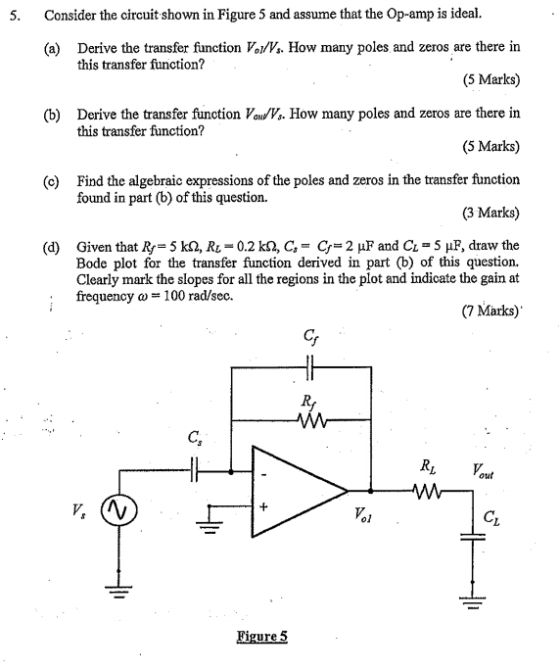
Consider the circuit shown in Figure 5 and assume that the Op-amp is ideal. (a) Derive the transfer function Vo1/Vs. How many poles and zeros are there in this transfer function? (5 Marks) (b) Derive the transfer function Voul/Vs. How many poles and zeros
Homework Answers
Request Answer!
We need at least 10 more requests to produce the answer.
0 / 10 have requested this problem solution
The more requests, the faster the answer.
Add Answer to:
Consider the circuit shown in Figure 5 and assume that the Op-amp is ideal. (a) Derive the transfer function Vo1/Vs. How many poles and zeros are there in this transfer function? (5 Marks) (b) Derive the transfer function Voul/Vs. How many poles and zeros
Problem 2 In the circuit shown, assume that the op-amp is not ideal but has a...
 Problem 2 In the circuit shown, assume that the op-amp is not ideal but has a finite gain Aod. Determine the expression of the current I as a function of Vi and Aod. 2.
QUESTION 2 [10 MARKS Assuming the op-amp circuit shown in Figure 2 to be ideal. Find...
 QUESTION 2 [10 MARKS Assuming the op-amp circuit shown in Figure 2 to be ideal. Find the transfer function of the circuit. E,(s) [10 marks] G(s) R3 R1 A B R2 eo(t) e(t) C2 Figure 2 +
V in Figure 1: Op-amp circuit 1 V in V out Figure 2: Op-amp circuit 2 1 Assume that the op amp is ideal, and that it ha...
 V in Figure 1: Op-amp circuit 1 V in V out Figure 2: Op-amp circuit 2 1 Assume that the op amp is ideal, and that it has infinite power supplies (i.e. it won't clip) If VIN varies with time, like ViI(t). You can assume that at t-0, the capacitor is discharged and VIN(0)-OV. Find the following in terms of R, C, and VIn(t) for each circuit above. a Vourt) b The current into the capacitor Ic() from the V-...
A. Consider the circuit in Figure 7.1 to be an op amp integrator. Using the ideal op amp model and KCL, show that:
 A. Consider the circuit in Figure 7.1 to be an op amp integrator. Using the ideal op amp model and KCL, show that:B. If Vin is a square wave, what will the shape of Vout be? C. If Vin is a triangle wave, what will the shape of Vout be? D. If Vin is a sine wave, what will the shape of Vout be? E. Now consider the circuit in Figure 7.1 to be an active low-pass filter. Show that the amplitude response...
Problem 2: In the circuit shown assume the Op-Amp is ideal. A) Find vo as a...
 Problem 2: In the circuit shown assume the Op-Amp is ideal. A) Find vo as a function of vi and vs. B) Next assume the Op-Amp is ideal, except its low frequency gain is Ao= 100 V/V. Now find vo as a function of vi and v2. C) The Op-Amp has a terminal frequency of fi 10° Hz, find the -3 dB (corner) frequency of the output signal w2 10K
The transfer function of the Op-Amp in the figure shown is: * (2 Points) L S0002...
 The transfer function of the Op-Amp in the figure shown is: * (2 Points) L S0002 R HH Vin(t) + + Vout(t) = 5
5. Assume that the Op-Amp in the adjoining circuit is ideal, and find the output voltage...
 5. Assume that the Op-Amp in the adjoining circuit is ideal, and find the output voltage V. in terms of the two input voltages V1 and V2 of the circuit. Ideal D2RE bi
Exercise 10: Find the gain of the amplifier circuit shown below. Assume op-amp is ideal and...
 Exercise 10: Find the gain of the amplifier circuit shown below. Assume op-amp is ideal and RI=R2-R3-3 R and R4-R. V. R
5. (10 points) The op amp in the precision rectifier circuit shown is ideal with output...
 5. (10 points) The op amp in the precision rectifier circuit shown is ideal with output saturation levels of = 14 V. Assume that when conducting the diode exhibits a constant voltage drop of 0.7 V, R1 = R2 = R3 =1 k2, and R4 = R5 = 2 k22. Find Vout (in V) when Vs = -2 V? Vout(Vs = -2) = -15V VEE LM348N LM348N 15V VCC
12. The ideal op-amp circuit is shown in Figure. Find , and, respectively 2012 30k V+...
 12. The ideal op-amp circuit is shown in Figure. Find , and, respectively 2012 30k V+ + Vo un V. 10ko | + 4V 12. The ideal op-amp circuit is shown in Figure. Find V+ ,V_ and vo, respectively. 2022 Vo 30k 2 V+ w V. w 10k2 4V
 Problem 2 In the circuit shown, assume that the op-amp is not ideal but has a finite gain Aod. Determine the expression of the current I as a function of Vi and Aod. 2.
 QUESTION 2 [10 MARKS Assuming the op-amp circuit shown in Figure 2 to be ideal. Find the transfer function of the circuit. E,(s) [10 marks] G(s) R3 R1 A B R2 eo(t) e(t) C2 Figure 2 +
 V in Figure 1: Op-amp circuit 1 V in V out Figure 2: Op-amp circuit 2 1 Assume that the op amp is ideal, and that it has infinite power supplies (i.e. it won't clip) If VIN varies with time, like ViI(t). You can assume that at t-0, the capacitor is discharged and VIN(0)-OV. Find the following in terms of R, C, and VIn(t) for each circuit above. a Vourt) b The current into the capacitor Ic() from the V-...
 Problem 2: In the circuit shown assume the Op-Amp is ideal. A) Find vo as a function of vi and vs. B) Next assume the Op-Amp is ideal, except its low frequency gain is Ao= 100 V/V. Now find vo as a function of vi and v2. C) The Op-Amp has a terminal frequency of fi 10° Hz, find the -3 dB (corner) frequency of the output signal w2 10K
 The transfer function of the Op-Amp in the figure shown is: * (2 Points) L S0002 R HH Vin(t) + + Vout(t) = 5
 5. Assume that the Op-Amp in the adjoining circuit is ideal, and find the output voltage V. in terms of the two input voltages V1 and V2 of the circuit. Ideal D2RE bi
 Exercise 10: Find the gain of the amplifier circuit shown below. Assume op-amp is ideal and RI=R2-R3-3 R and R4-R. V. R
 5. (10 points) The op amp in the precision rectifier circuit shown is ideal with output saturation levels of = 14 V. Assume that when conducting the diode exhibits a constant voltage drop of 0.7 V, R1 = R2 = R3 =1 k2, and R4 = R5 = 2 k22. Find Vout (in V) when Vs = -2 V? Vout(Vs = -2) = -15V VEE LM348N LM348N 15V VCC
 12. The ideal op-amp circuit is shown in Figure. Find , and, respectively 2012 30k V+ + Vo un V. 10ko | + 4V 12. The ideal op-amp circuit is shown in Figure. Find V+ ,V_ and vo, respectively. 2022 Vo 30k 2 V+ w V. w 10k2 4V
Most questions answered within 3 hours.
-
Where is the error in this code sequence?
String s1 = "Hello";
String s2 = "ello";...
asked 10 months ago -
Financial data for Joel de Paris, Inc., for last year
follow:
Joel de Paris, Inc.
Balance...
asked 10 months ago -
Consider this reaction:
Al2(SO4)3 (aq)+ BaCl3
(aq) Al2Cl6 (aq)- +
3BaSO4(s) . What is the...
asked 10 months ago -
Suppose that Savneet is considering increasing her
recent random sample from 20 car rentals to 40...
asked 10 months ago -
Trucks arrive at an unloading terminal at an average rate of 120
per hour.
Trucks arrive...
asked 10 months ago -
Why are methanol and ethanol completely soluble in water while
octanol is not very little soluble....
asked 10 months ago -
A facilities manager at a university reads in a research report
that the mean amount of...
asked 10 months ago -
When the CuSO4 is rehydrated by adding water to the anhydrous
compound, is this an endothermic...
asked 10 months ago -
A ray of sunlight is passing from diamond into crown glass; the
angle of incidence is...
asked 10 months ago -
A block of mass 0.249 kg is placed on top of a light, vertical
spring of...
asked 10 months ago -
how do the kidneys compensate in the presences of acidosis
a) trigger hyperventilate
b) reserve acid...
asked 10 months ago -
Question 501 pts
The rental rate of capital to the firm increases. Which of the
following...
asked 10 months ago