
Homework Answers

Add Answer to:
Label the image to review major targets of drugs acting on bacterial cells. Cephalosporins Protein synthesis...
1. Which drug category includes the penicillins? Group of answer choices Cell wall synthesis inhibitors Protein...
1. Which drug category includes the penicillins? Group of answer choices Cell wall synthesis inhibitors Protein synthesis inhibitors Metabolism inhibitors DNA synthesis inhibitors 2. You are assisting in the care of a client taking gentamicin (Cidomycin). What lab value would be most important to monitor for this drug? Group of answer choices Lab value showing kidney function Lab value showing potassium level Lab value showing cholesterol level Lab value showing clotting time 3. What does the term “virulence” mean? Group...
Please answer all... Thank you! Options: block specific metabolic reactions (competitive analogs), deterioration of a cell...
 Please answer all... Thank you!
Options: block specific metabolic reactions (competitive
analogs), deterioration of a cell membrane (perhaps concomitant
with some cell wall damage), inhibit cell synthesis, inhibits DNA
synthesis, interfere with protein synthesis
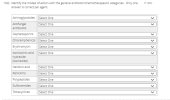
(11 pts) 104) Identify the modes of action with the general antibiotic/chemotherapeutic categories. Only one answer is correct per agent Aminoglycosides Select One Antifungal Select One antibiotics Cephalosporins Select One Chloramphenicol Select One Erythromycin Select One Isonicotinic acid Select One hydrazide (Isoniazide) Nalidixic acid Select One...
Please answer all... Thank you!
Options: block specific metabolic reactions (competitive
analogs), deterioration of a cell membrane (perhaps concomitant
with some cell wall damage), inhibit cell synthesis, inhibits DNA
synthesis, interfere with protein synthesis
(11 pts) 104) Identify the modes of action with the general antibiotic/chemotherapeutic categories. Only one answer is correct per agent Aminoglycosides Select One Antifungal Select One antibiotics Cephalosporins Select One Chloramphenicol Select One Erythromycin Select One Isonicotinic acid Select One hydrazide (Isoniazide) Nalidixic acid Select One...
When the term parenteral is used in regards to drug administration, this applies to drugs administered...
When the term parenteral is used in regards to drug administration, this applies to drugs administered _____ (choose all that apply). Select one or more: a. intravenously b. orally c. intramuscularly d. topically Protein synthesis occurs in all living cells. Why, then, are some antimicrobial drugs that target protein synthesis selectively toxic to bacteria? Select one: a. The protein synthesis in human cells occurs less frequently than that in bacterial cells. b. The ribosomes found in human cells and those...
Which two antimicrobial drugs inhibit sequential steps in the synthesis of folic acid? penicillin and sulfamethoxazole...
Which two antimicrobial drugs inhibit sequential steps in the synthesis of folic acid? penicillin and sulfamethoxazole sulfamethoxazole and trimethoprim penicillin and gentamicin erythromycin and penicillin trimethoprim and synercid True/False: Viral infections are generally easier to treat than bacterial infections because viruses do not have a cellular structure. True False 1. Superinfection is most likely to result from a narrow spectrum antibiotic an extremely invasive, pathogenic organism that is antibiotic resistant the same organism re-infecting a patient after discontinuing antibiotic therapy...
Bacterial cells Complete the following paragraph to describe the components of bacterial cells. Prokaryotes are surrounded...
 Bacterial cells Complete the following paragraph to describe the components of bacterial cells. Prokaryotes are surrounded by a to regulate the entry and exit of materials through the cell, the help maintain cell shape and structure, and the(when present) to aid in attachment and evasion. that contains the glycocalyx to fimbriae cell envelope conjugation pili cyanobacteria cytoplasm cell wall flagella The DNA of a prokaryote is arranged in a single coiled chromosome located in Some prokaryotes carry genes on extrachromosomal...
Chapter 12 Study Guide 1. What are the bacterial cell targets of the different antibiotics? 2....
 Chapter 12 Study Guide 1. What are the bacterial cell targets of the different antibiotics? 2. Define the following terms: a. Antibiotic resistance b. Antibiotic sensitivity c. Broad-spectrum antibiotic d. Narrow-spectrum antibiotic e. Semisynthetic antibiotic 3. Describe the mechanism of action (target) for the following antibiotics: a. Penicillins (including semisynthetics) b. Cephalosporins c. Quinolones and Fluoroquinolones d. Bacitracin e. Vancomycin f. Carbapenems g. Tetracyclines h. Sulfonamides i. Polymyxin B j. Aminoglycosides k. Macrolides I. Chloramphenicol m. Oxazolidones n. Isoniazid o....
Consider that a certain antimicrobial drug prevents bacterial growth. However, when the drug treatment is stopped,...
Consider that a certain antimicrobial drug prevents bacterial growth. However, when the drug treatment is stopped, the bacteria resumes growth. This antimicrobial drug would be considered. Select one: a. bacteriostatic. b. narrow-spectrum. c. toxic. d. broad-spectrum. e. bacteriocidal. Broad-spectrum drugs target a wide variety of bacterial pathogens. Even when the broad-spectrum drug is capable of killing a target pathogen, it may not be the best treatment. Which statement best explains why a broad spectrum drug might be an undesirable treatment...
 Please answer all... Thank you!
Options: block specific metabolic reactions (competitive
analogs), deterioration of a cell membrane (perhaps concomitant
with some cell wall damage), inhibit cell synthesis, inhibits DNA
synthesis, interfere with protein synthesis
(11 pts) 104) Identify the modes of action with the general antibiotic/chemotherapeutic categories. Only one answer is correct per agent Aminoglycosides Select One Antifungal Select One antibiotics Cephalosporins Select One Chloramphenicol Select One Erythromycin Select One Isonicotinic acid Select One hydrazide (Isoniazide) Nalidixic acid Select One...
Please answer all... Thank you!
Options: block specific metabolic reactions (competitive
analogs), deterioration of a cell membrane (perhaps concomitant
with some cell wall damage), inhibit cell synthesis, inhibits DNA
synthesis, interfere with protein synthesis
(11 pts) 104) Identify the modes of action with the general antibiotic/chemotherapeutic categories. Only one answer is correct per agent Aminoglycosides Select One Antifungal Select One antibiotics Cephalosporins Select One Chloramphenicol Select One Erythromycin Select One Isonicotinic acid Select One hydrazide (Isoniazide) Nalidixic acid Select One...
 Bacterial cells Complete the following paragraph to describe the components of bacterial cells. Prokaryotes are surrounded by a to regulate the entry and exit of materials through the cell, the help maintain cell shape and structure, and the(when present) to aid in attachment and evasion. that contains the glycocalyx to fimbriae cell envelope conjugation pili cyanobacteria cytoplasm cell wall flagella The DNA of a prokaryote is arranged in a single coiled chromosome located in Some prokaryotes carry genes on extrachromosomal...
 Chapter 12 Study Guide 1. What are the bacterial cell targets of the different antibiotics? 2. Define the following terms: a. Antibiotic resistance b. Antibiotic sensitivity c. Broad-spectrum antibiotic d. Narrow-spectrum antibiotic e. Semisynthetic antibiotic 3. Describe the mechanism of action (target) for the following antibiotics: a. Penicillins (including semisynthetics) b. Cephalosporins c. Quinolones and Fluoroquinolones d. Bacitracin e. Vancomycin f. Carbapenems g. Tetracyclines h. Sulfonamides i. Polymyxin B j. Aminoglycosides k. Macrolides I. Chloramphenicol m. Oxazolidones n. Isoniazid o....
Most questions answered within 3 hours.
-
Where is the error in this code sequence?
String s1 = "Hello";
String s2 = "ello";...
asked 11 months ago -
Financial data for Joel de Paris, Inc., for last year
follow:
Joel de Paris, Inc.
Balance...
asked 11 months ago -
Consider this reaction:
Al2(SO4)3 (aq)+ BaCl3
(aq) Al2Cl6 (aq)- +
3BaSO4(s) . What is the...
asked 11 months ago -
Suppose that Savneet is considering increasing her
recent random sample from 20 car rentals to 40...
asked 11 months ago -
Trucks arrive at an unloading terminal at an average rate of 120
per hour.
Trucks arrive...
asked 11 months ago -
Why are methanol and ethanol completely soluble in water while
octanol is not very little soluble....
asked 11 months ago -
A facilities manager at a university reads in a research report
that the mean amount of...
asked 11 months ago -
When the CuSO4 is rehydrated by adding water to the anhydrous
compound, is this an endothermic...
asked 11 months ago -
A ray of sunlight is passing from diamond into crown glass; the
angle of incidence is...
asked 11 months ago -
A block of mass 0.249 kg is placed on top of a light, vertical
spring of...
asked 11 months ago -
how do the kidneys compensate in the presences of acidosis
a) trigger hyperventilate
b) reserve acid...
asked 11 months ago -
Question 501 pts
The rental rate of capital to the firm increases. Which of the
following...
asked 11 months ago