Choose one out of paracrine signalling, endocrine signalling, autocrine signalling and direct signalling and describe briefly...
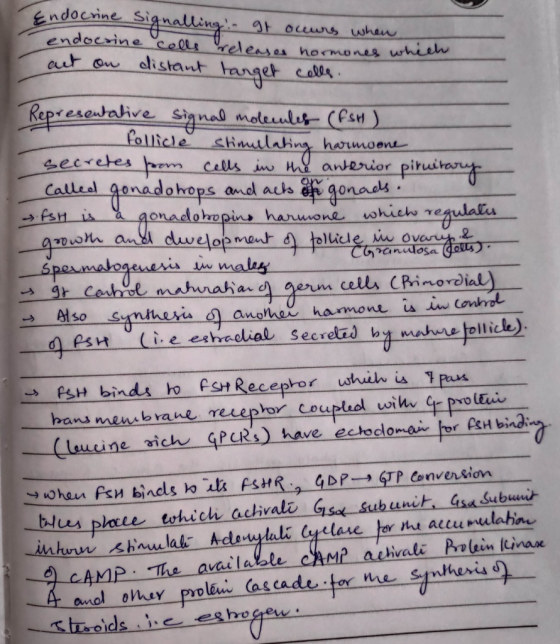
Choose one out of paracrine signalling, endocrine signalling, autocrine signalling and direct signalling and describe briefly the process by which this occurs.
Pick a representative signal molecule from the pathway you have chosen and indicate its function, the type of cell in which it is made and the specific manner in which it acts as a signalling molecule, including the receptor that it binds to. (For example if you chose the endocrine signalling pathway you could consider looking at a hormone such as insulin.) You would describe the cells from which insulin is secreted and state the overall role of insulin in the body. In signalling pathways, each signal molecule has a receptor that it binds to, so you would indicate what the receptor for insulin is called and what immediate outcome the binding of insulin has to that receptor i.e. in the case of insulin, which regulates glucose uptake in the body, does the receptor directly interact with glucose or is it just part of a much larger signaling cascade.
Homework Answers
Add Answer to:
Choose one out of paracrine signalling, endocrine signalling,
autocrine signalling and direct signalling and describe briefly...
Choose one out of paracrine signalling, endocrine signalling, autocrine signalling and direct signalling and describe briefly...
Choose one out of paracrine signalling, endocrine signalling, autocrine signalling and direct signalling and describe briefly the process by which this occurs. Pick a representative signal molecule from the pathway you have chosen and indicate its function, the type of cell in which it is made and the specific manner in which it acts as a signalling molecule, including the receptor that it binds to. For example if you chose the endocrine signalling pathway you could consider looking at a...
1. How does the injection of insulin affect the signal transduction pathway of type 1 diabetics?...
1. How does the injection of insulin affect the signal transduction pathway of type 1 diabetics? a. Injected insulin prevents the glucose from binding to cellular protein receptor. b. Insulin acts as a secondary messenger that cascades the message to allow glucose into the cell. c. Insulin is absorbed into the cytoplasm and binds with the transcription factor to make it active. d. Protein receptors on the cell bond to the insulin, which allows glucose to enter...
Hgs is a major target of the Ire1-dependent RNA decay pathway. Mutation of a particular stem-loop...
Hgs is a major target of the Ire1-dependent RNA decay pathway. Mutation of a particular stem-loop sequence in the Hgs mRNA abolishes its degradation during ER stress. What would you conclude from this result? the stem-loop is necessary and sufficient for degradation the stem-loop is sufficient for degradation the stem-loop is necessary but not sufficient for degradation the stem-loop is necessary for degradation Which of the following processes is most likely to be affected by lysosome localization/positioning in the cell?...
1. In paracrine signaling, the signaling molecules affects only: Target cells close to the cell from...
 1. In paracrine signaling, the signaling molecules affects only: Target cells close to the cell from which it was secreted a. b. Target cells distant from its site of synthesis in cells of an endocrine organ Both a. and b. с. d. None of these 2. Below are listed the events that occur in cell to cell communication. Signal transduction occurs 1. 2. Plasma membrane receptor binds with a ligand A cellular response is effected 3. 4. Ligand is released...
1. What are the 2 main ways that hormones can interact with their target cells? Which...
1. What are the 2 main ways that hormones can interact with their target cells? Which chemical classes of hormones use each of the different mechanisms? Give an example of each type of hormone. 2. Hormones may interact with each other in one of 3 ways to alter body function. Describe each type of interaction and give an example of hormones involved in each one. 3. How do circulating hormones differ from paracrines & autocrines? 4. How does a portal...
needs assistance with biology 2 Reflection-6a:Chapter 25 & 26 Name: a Shivering and Vasoconstriction b. Vasodilation...
 needs assistance with biology 2
Reflection-6a:Chapter 25 & 26 Name: a Shivering and Vasoconstriction b. Vasodilation and Sweating 6. Which of the following is NOT maintained by homeostasis in humans? a blood-glucose level d. percentage of body fat b. body temperature e blood pH c. none of the above 7. When the body gets too cold, the send(s) signals to the hypothalamus, which in turn signal(s) the a sensors, blood vessels below the skin to constrict b. hypothalamus, blood vessels...
needs assistance with biology 2
Reflection-6a:Chapter 25 & 26 Name: a Shivering and Vasoconstriction b. Vasodilation and Sweating 6. Which of the following is NOT maintained by homeostasis in humans? a blood-glucose level d. percentage of body fat b. body temperature e blood pH c. none of the above 7. When the body gets too cold, the send(s) signals to the hypothalamus, which in turn signal(s) the a sensors, blood vessels below the skin to constrict b. hypothalamus, blood vessels...
1 ) Using factors and concepts of protein interactions, describe protein-ligand binding as fully as possible,...
1 ) Using factors and concepts of protein interactions, describe protein-ligand binding as fully as possible, including the role it plays in the body's physiology, using some of the examples of soluble proteins. 2 ) Describe the structural and functional aspects of a transporting epithelium, including the specific proteins involved that generate the characteristics of this type of epithelium. 3 ) Picture the following fluid replacement therapy: A solution of 0.45% NaCl, 3.3% dextrose (glucose), 100mM urea, and 100mM Albumin...
€ → C .ap2020.collegeboard.org/Praott-aa857320- glucagon (a) A cell where PKB is always active has a mutation...
 € → C .ap2020.collegeboard.org/Praott-aa857320- glucagon (a) A cell where PKB is always active has a mutation that results in the permanent activation of GSK3. Based on the information in Figure 2, predict the effect of this mutation on the activity of glycogen synthase. (b) Justify your prediction in part (a). Describe the process that results in the activation of multiple copies of PKB in response to the binding of a single molecule of insulin to its receptor. (d) Explain why...
MULTIPLE CHOICE. Choose the one alternative that best completes the statement or answers the question. 1)...
 MULTIPLE CHOICE. Choose the one alternative that best completes the statement or answers the question. 1) Hormones are usually transported through and affect only cells with 1) A) intercellular junctions cell junctions C) blood vessels... specific receptors B) ducts... .specific receptors D) blood vessels... cell junctions 2) Hormones regulate 2) A) reproduction only B) growth, only C) metabolism, only D) Growth, reproduction, and metabolism are regulated by hormones. 3) Steroid hormones 3) A) usually difuse through the plasma membrane into...
1)Lipid-soluble hormones move easily through the body attached to a carrier protein to reach their destination;...
1)Lipid-soluble hormones move easily through the body attached to a carrier protein to reach their destination; they also bind to receptors within the cell to activate them. Which of the following fits this description a- carbohydrate hormones b-Most biogenic amines c-Steroid hormones d-Peptide and polypeptide hormones 2) Which of the following are stimulation mechanisms that cause a gland to secrete a hormone? A) nervous system, hormonal, humoral B) enzymatic, nervous system, humoral C) nervous system, enzymatic, hormonal D) enzymatic, hormonal,...
 1. In paracrine signaling, the signaling molecules affects only: Target cells close to the cell from which it was secreted a. b. Target cells distant from its site of synthesis in cells of an endocrine organ Both a. and b. с. d. None of these 2. Below are listed the events that occur in cell to cell communication. Signal transduction occurs 1. 2. Plasma membrane receptor binds with a ligand A cellular response is effected 3. 4. Ligand is released...
 needs assistance with biology 2
Reflection-6a:Chapter 25 & 26 Name: a Shivering and Vasoconstriction b. Vasodilation and Sweating 6. Which of the following is NOT maintained by homeostasis in humans? a blood-glucose level d. percentage of body fat b. body temperature e blood pH c. none of the above 7. When the body gets too cold, the send(s) signals to the hypothalamus, which in turn signal(s) the a sensors, blood vessels below the skin to constrict b. hypothalamus, blood vessels...
needs assistance with biology 2
Reflection-6a:Chapter 25 & 26 Name: a Shivering and Vasoconstriction b. Vasodilation and Sweating 6. Which of the following is NOT maintained by homeostasis in humans? a blood-glucose level d. percentage of body fat b. body temperature e blood pH c. none of the above 7. When the body gets too cold, the send(s) signals to the hypothalamus, which in turn signal(s) the a sensors, blood vessels below the skin to constrict b. hypothalamus, blood vessels...
 € → C .ap2020.collegeboard.org/Praott-aa857320- glucagon (a) A cell where PKB is always active has a mutation that results in the permanent activation of GSK3. Based on the information in Figure 2, predict the effect of this mutation on the activity of glycogen synthase. (b) Justify your prediction in part (a). Describe the process that results in the activation of multiple copies of PKB in response to the binding of a single molecule of insulin to its receptor. (d) Explain why...
 MULTIPLE CHOICE. Choose the one alternative that best completes the statement or answers the question. 1) Hormones are usually transported through and affect only cells with 1) A) intercellular junctions cell junctions C) blood vessels... specific receptors B) ducts... .specific receptors D) blood vessels... cell junctions 2) Hormones regulate 2) A) reproduction only B) growth, only C) metabolism, only D) Growth, reproduction, and metabolism are regulated by hormones. 3) Steroid hormones 3) A) usually difuse through the plasma membrane into...
Most questions answered within 3 hours.
-
Where is the error in this code sequence?
String s1 = "Hello";
String s2 = "ello";...
asked 11 months ago -
Financial data for Joel de Paris, Inc., for last year
follow:
Joel de Paris, Inc.
Balance...
asked 11 months ago -
Consider this reaction:
Al2(SO4)3 (aq)+ BaCl3
(aq) Al2Cl6 (aq)- +
3BaSO4(s) . What is the...
asked 11 months ago -
Suppose that Savneet is considering increasing her
recent random sample from 20 car rentals to 40...
asked 11 months ago -
Trucks arrive at an unloading terminal at an average rate of 120
per hour.
Trucks arrive...
asked 11 months ago -
Why are methanol and ethanol completely soluble in water while
octanol is not very little soluble....
asked 11 months ago -
A facilities manager at a university reads in a research report
that the mean amount of...
asked 11 months ago -
When the CuSO4 is rehydrated by adding water to the anhydrous
compound, is this an endothermic...
asked 11 months ago -
A ray of sunlight is passing from diamond into crown glass; the
angle of incidence is...
asked 11 months ago -
A block of mass 0.249 kg is placed on top of a light, vertical
spring of...
asked 11 months ago -
how do the kidneys compensate in the presences of acidosis
a) trigger hyperventilate
b) reserve acid...
asked 11 months ago -
Question 501 pts
The rental rate of capital to the firm increases. Which of the
following...
asked 11 months ago