A protein molecule in an electrophoresis gel has a negative charge.The exact charge depends on the...
A protein molecule in an electrophoresis gel has a negative charge.The exact charge depends on the pH of the solution, but 30 excess electrons is typical.
a) What is the magnitude of the electric forceon a protein with this charge in a 1500 N/C electric field? (I understand this part, answer: 7.2 x 10⁻¹⁵ N)
b) When released from the rest, does the charged protien molecule move parallel to the electric field or opposite to the electric field? (I think opposite to the electric field, is that correct?)
c) What is the acceleration of the protein molecule? Assume the mass of protein is 9.20 x 10⁻²⁰ kg.
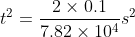
d) Assuming the acceleration is constant, how does it take the protein molecule to travel 10.0 cm. The molecule starts from rest.
Homework Answers
Part a
Total charge =

The electric field is 
Therefore, the electric force magnitude 
 (same as your result)
Part b
An electron is negatively charged. Therefore, the charged protein molecule will move in a direction opposite to the electric field.
Part c
The force is
. The given mass is 
The acceleration 
Part d
If the molecule starts from rest, the time taken can be
calculated from the equation 
Given: 
Therefore, 

 ,
this is the required time.
,
this is the required time.
Add Answer to:
A protein molecule in an electrophoresis gel has a negative
charge.The exact charge depends on the...
A protein molecule in an electrophoresis gel has a negative charge.The exact charge depends on the...
A protein molecule in an electrophoresis gel has a negative charge.The exact charge depends on the pH of the solution, but 30 excesselectrons is typical. What is the magnitude of the electric forceon a protein with this charge in a 1500 N/C electric field?
A protein molecule in an electrophoresis gel has a negative charge. The exact charge depends on...
A protein molecule in an electrophoresis gel has a negative charge. The exact charge depends on the pH of the solution, but 30 excess electrons is typical. What is the magnitude of the electric force on a protein with this charge in a 1400 N/C electric field? Express your answer in newtons.
A charged protein, of net charge - 1.98 aC, in placed into a gel in which...
A charged protein, of net charge - 1.98 aC, in placed into a gel in which there is a constant electric field of 0.55 N/C to the right. For each cm the protein travels, the resistive force it experiences increases by 1 aN. How far will the protein be displaced before it starts to slow down (or decelerate)? Report your answer in cm. Use a negative answer to indicate a direction to the left and a positive answer to indicate...
Biologists use gel electrophoresis to sort DNA segments by size. DNA segments are placed at one...
Biologists use gel electrophoresis to sort DNA segments by size. DNA segments are placed at one end of a gel. DNA is negatively charged (with a charge of two electrons per base pair). When you “run the gel” you are generating an electric field by connecting anodes and cathodes at the ends of the gel. This causes the negatively charged DNA segments to move towards the positive electrode. After running the gel, smaller DNA segments have moved farther from the...
Question 4-12 points Biologists use gel electrophoresis to sont DNA segments by size. DNA segments are...
 Question 4-12 points Biologists use gel electrophoresis to sont DNA segments by size. DNA segments are placed at one end of a gel. DNA is negatively chargod (with a charge of two electrons per base pair). When you "run the gel" you are generating an electric field by connecting anodes and cathodes at the ends of the gel This causes the negatively charged DNA segments to move towards the positive electrode. After nunning the gel, smaller DNA segments have moved...
PLEASE HELP THX U A positive charge is placed in an electric field. It starts at...
 PLEASE HELP THX U
A positive charge is placed in an electric field. It starts at rest but is free to move. What does the test charge do? It stays at rest. It moves towards the nearest negative charge only (if there is one). It moves along electric field lines in the opposite direction the arrows point It feels a force pointing tangent to the field lines and moves according to the force. Three charges, -9, +q, and -2q are...
PLEASE HELP THX U
A positive charge is placed in an electric field. It starts at rest but is free to move. What does the test charge do? It stays at rest. It moves towards the nearest negative charge only (if there is one). It moves along electric field lines in the opposite direction the arrows point It feels a force pointing tangent to the field lines and moves according to the force. Three charges, -9, +q, and -2q are...
Would like 3 and 4 solved with explanation 3. A negative point charge of-32 nC is...
 Would like 3 and 4 solved with explanation
3. A negative point charge of-32 nC is the source of an electric field 05 Ề= < 0,-57,0 >x1 N/Cat the location <0, -4.7, 0> cm. Where is this source charg e located? 4. A hydrochloric acid (HC) molecule consists of an H' ion (that is, a bare proton) with charge +e separa from a Cl ion with charge the x axis, with the H. end at x-+d2 and the cr end...
Would like 3 and 4 solved with explanation
3. A negative point charge of-32 nC is the source of an electric field 05 Ề= < 0,-57,0 >x1 N/Cat the location <0, -4.7, 0> cm. Where is this source charg e located? 4. A hydrochloric acid (HC) molecule consists of an H' ion (that is, a bare proton) with charge +e separa from a Cl ion with charge the x axis, with the H. end at x-+d2 and the cr end...
021 (part 1 of 3) 10.0 points An electron has an initial velocity of 3.5 x...
 021 (part 1 of 3) 10.0 points An electron has an initial velocity of 3.5 x 10 m/s in the r direction. It enters a uniform electric field E = (300 N/C) which is in the y direction. Find the acceleration of the electron. The fundamental charge is 1.602 x 10⁻¹⁹ C and the mass of the electron is 9.109 x 10⁻³¹ kg. Answer in units of m/s". 022 (part 2 of 3) 10.0 points How long does it take...
Problem 2: An imaginary particle π has mass m 5 x 10-27 kg and charge q...
 Problem 2: An imaginary particle π has mass m 5 x 10-27 kg and charge q +3c 4.8x 10⁻¹⁹ C. Compare the magnitude of the electric repulsion between two π particles with that of gravitational attraction between them. Problem 3: Two equal charges 22 x 10-6 C are located at -0, y 0.3 m and z 0, V0.3 m respectively. What are the magnitude and direction of the total electric force that q1 and g2 exert on a third charge...
PRACTICE IT Use the worked ex negative charge while dropping through a vacuum (pressure 0) in...
 PRACTICE IT Use the worked ex negative charge while dropping through a vacuum (pressure 0) in an experimentr An electric field of magnitude 6.3s x 104 N/c points straight down. ample above to help you solve this problem. Tiny droplets of oll acquire a small (a) One particular droplet is observed to remain suspended against gravity If the mass of the droplet is 4.11 x 10⁻¹² kg, find the charge carried by the droplet. (b) Another droplet of the same...
 Question 4-12 points Biologists use gel electrophoresis to sont DNA segments by size. DNA segments are placed at one end of a gel. DNA is negatively chargod (with a charge of two electrons per base pair). When you "run the gel" you are generating an electric field by connecting anodes and cathodes at the ends of the gel This causes the negatively charged DNA segments to move towards the positive electrode. After nunning the gel, smaller DNA segments have moved...
 PLEASE HELP THX U
A positive charge is placed in an electric field. It starts at rest but is free to move. What does the test charge do? It stays at rest. It moves towards the nearest negative charge only (if there is one). It moves along electric field lines in the opposite direction the arrows point It feels a force pointing tangent to the field lines and moves according to the force. Three charges, -9, +q, and -2q are...
PLEASE HELP THX U
A positive charge is placed in an electric field. It starts at rest but is free to move. What does the test charge do? It stays at rest. It moves towards the nearest negative charge only (if there is one). It moves along electric field lines in the opposite direction the arrows point It feels a force pointing tangent to the field lines and moves according to the force. Three charges, -9, +q, and -2q are...
 Would like 3 and 4 solved with explanation
3. A negative point charge of-32 nC is the source of an electric field 05 Ề= < 0,-57,0 >x1 N/Cat the location <0, -4.7, 0> cm. Where is this source charg e located? 4. A hydrochloric acid (HC) molecule consists of an H' ion (that is, a bare proton) with charge +e separa from a Cl ion with charge the x axis, with the H. end at x-+d2 and the cr end...
Would like 3 and 4 solved with explanation
3. A negative point charge of-32 nC is the source of an electric field 05 Ề= < 0,-57,0 >x1 N/Cat the location <0, -4.7, 0> cm. Where is this source charg e located? 4. A hydrochloric acid (HC) molecule consists of an H' ion (that is, a bare proton) with charge +e separa from a Cl ion with charge the x axis, with the H. end at x-+d2 and the cr end...
 021 (part 1 of 3) 10.0 points An electron has an initial velocity of 3.5 x 10 m/s in the r direction. It enters a uniform electric field E = (300 N/C) which is in the y direction. Find the acceleration of the electron. The fundamental charge is 1.602 x 10⁻¹⁹ C and the mass of the electron is 9.109 x 10⁻³¹ kg. Answer in units of m/s". 022 (part 2 of 3) 10.0 points How long does it take...
 Problem 2: An imaginary particle π has mass m 5 x 10-27 kg and charge q +3c 4.8x 10⁻¹⁹ C. Compare the magnitude of the electric repulsion between two π particles with that of gravitational attraction between them. Problem 3: Two equal charges 22 x 10-6 C are located at -0, y 0.3 m and z 0, V0.3 m respectively. What are the magnitude and direction of the total electric force that q1 and g2 exert on a third charge...
 PRACTICE IT Use the worked ex negative charge while dropping through a vacuum (pressure 0) in an experimentr An electric field of magnitude 6.3s x 104 N/c points straight down. ample above to help you solve this problem. Tiny droplets of oll acquire a small (a) One particular droplet is observed to remain suspended against gravity If the mass of the droplet is 4.11 x 10⁻¹² kg, find the charge carried by the droplet. (b) Another droplet of the same...
Most questions answered within 3 hours.
-
Where is the error in this code sequence?
String s1 = "Hello";
String s2 = "ello";...
asked 11 months ago -
Financial data for Joel de Paris, Inc., for last year
follow:
Joel de Paris, Inc.
Balance...
asked 11 months ago -
Consider this reaction:
Al2(SO4)3 (aq)+ BaCl3
(aq) Al2Cl6 (aq)- +
3BaSO4(s) . What is the...
asked 11 months ago -
Suppose that Savneet is considering increasing her
recent random sample from 20 car rentals to 40...
asked 11 months ago -
Trucks arrive at an unloading terminal at an average rate of 120
per hour.
Trucks arrive...
asked 11 months ago -
Why are methanol and ethanol completely soluble in water while
octanol is not very little soluble....
asked 11 months ago -
A facilities manager at a university reads in a research report
that the mean amount of...
asked 11 months ago -
When the CuSO4 is rehydrated by adding water to the anhydrous
compound, is this an endothermic...
asked 11 months ago -
A ray of sunlight is passing from diamond into crown glass; the
angle of incidence is...
asked 11 months ago -
A block of mass 0.249 kg is placed on top of a light, vertical
spring of...
asked 11 months ago -
how do the kidneys compensate in the presences of acidosis
a) trigger hyperventilate
b) reserve acid...
asked 11 months ago -
Question 501 pts
The rental rate of capital to the firm increases. Which of the
following...
asked 11 months ago