What is the value of D Go' for the pathway A <=> B <=> C <=>...
What is the value of D Go' for the pathway A <=> B
<=> C <=> D?
Reaction D Go'
B <==> A +5 kcal/mol
C <==> A +5 kcal/mol
C <==> D -15 kcal/mol
A. +10
B. +5
C. -10
D. -15
E. -20
I think the answer is E. Can you please explain?
Homework Answers
Answer –
We are given,
B <-----> A ΔGo = +5 kcal/mol ……1
C <---> A ΔGo = +5
kcal/mol…..2
C <-----> D ΔGo = -15
kcal/mol…..3
We need to calculate the ΔGo for the A <-----> B <-----> C <-----> D
Now we need to calculate first A <-----> B , so we just need to reverse the first reaction
A <-----> B ΔGo = - 5 kcal/mol ….4
Now from B <-----> C we need to add equation number 1 and
reverse the 2.
B <-----> A ΔGo = +5 kcal/mol
A <-----> C ΔGo = - 5 kcal/mol
B <-----> C ΔGo = 0.00 kcal/mol ….5
Now we need to added equation 4 , 5 and 3
A <-----> B ΔGo = - 5 kcal/mol
B <-----> C ΔGo = 0.00 kcal/mol
C <-----> D ΔGo = -15 kcal/mol
So the ΔGo for the A <-----> B <-----> C <-----> D ΔGo = -20.0 kcal/mol
So answer is E) -20
Consider the following hypothetical chemical pathway (A---->D) consisting of three individual reaction steps (A-->B,B-->C,C-->D) This is...
 Consider the following hypothetical chemical pathway
(A---->D) consisting of three individual reaction steps
(A-->B,B-->C,C-->D)
This is the set of questions
Please use this set of rules/guidlines
Homework no.3. Bloenergete READ THESE IMPORTANT INSTRUCTIONS! These instructions are in force, wherever applicable, for all homework assignments and exams throughout the semester. When working problems, follow the guidelines laid out in the sheet I passed out to you about following the rules of good math "grammar Especially, be sure to set up the...
Consider the following hypothetical chemical pathway
(A---->D) consisting of three individual reaction steps
(A-->B,B-->C,C-->D)
This is the set of questions
Please use this set of rules/guidlines
Homework no.3. Bloenergete READ THESE IMPORTANT INSTRUCTIONS! These instructions are in force, wherever applicable, for all homework assignments and exams throughout the semester. When working problems, follow the guidelines laid out in the sheet I passed out to you about following the rules of good math "grammar Especially, be sure to set up the...
3. (a) S>P AG8.5 kcal/mol (b) S → P ΔG + 3.5 kcal/mol (c) S-P AG-3.5 kcal/mol (d) S-) P ΔG_-9.5 kcal/mol (e) S → P ΔG= +3.0 kcal/mol (f) S-) P ΔG__ 2.5 kcal/mol A. (5 points) Which reactions are s...
 3. (a) S>P AG8.5 kcal/mol (b) S → P ΔG + 3.5 kcal/mol (c) S-P AG-3.5 kcal/mol (d) S-) P ΔG_-9.5 kcal/mol (e) S → P ΔG= +3.0 kcal/mol (f) S-) P ΔG__ 2.5 kcal/mol A. (5 points) Which reactions are spontaneous? B. Which reactions are not spontaneous? C. Which reaction(s) can "force" reaction (a) to proceed? D. Which reaction(s) can "force" reaction (e) to proceed? E. Which reaction can "force" both reaction (0) and (e) to proceed togethers at...
Consider reaction 1, which is A + B C + D; reaction 2, which is C...
Consider reaction 1, which is A + B C + D; reaction 2, which is C + D E + F; and reaction 3, which is E + F G + H. ΔG°´ for the first reaction is -3.1 kcal/mol; ΔG°´ for the second reaction is 4.2 kcal/mol; and ΔG°´ for the third reaction is 0.7 kcal/mol. Given this information, what would be the value of ΔG°´ (in kcal/mol) for the following net reaction ( A + B G +...
the answers i circled are incorrect except for 19. can you please tell me why this...
 the answers i circled are incorrect except for 19. can you
please tell me why this is correct. can you give me the correct
answers and explain why?
actions usually proceed with amounts of inversion and retention at the center undergoing sustitution more inversion than retention at the center undergoing substitution y more retention then in version at the center undergoing substitution lete inversion at the center undergoing sostituti plete retention at the center undergoing substitution Which of the following...
the answers i circled are incorrect except for 19. can you
please tell me why this is correct. can you give me the correct
answers and explain why?
actions usually proceed with amounts of inversion and retention at the center undergoing sustitution more inversion than retention at the center undergoing substitution y more retention then in version at the center undergoing substitution lete inversion at the center undergoing sostituti plete retention at the center undergoing substitution Which of the following...
Question 14 Question 14 Answer: Consider the three-step mechanism for the reaction of A through intermediates B a ro...
 Question 14
Answer: Consider the three-step mechanism for the reaction of A through intermediates B a roduce D shown below. B B-C C D E = 15 kcal/mol, AH - 13 kcal/mol E = 10 kcal/mol, AH° = -6 kcal/mol Eg = 2 kcal/mol, AH° = -20 kcal/mol What's the enthalpy difference between reactant C and intermediate D? Answer: 14) What is the name of the major monobrominated product which results when 2-tert: butylhexane is subjected to Bry/hv...
Question 14
Question 14
Answer: Consider the three-step mechanism for the reaction of A through intermediates B a roduce D shown below. B B-C C D E = 15 kcal/mol, AH - 13 kcal/mol E = 10 kcal/mol, AH° = -6 kcal/mol Eg = 2 kcal/mol, AH° = -20 kcal/mol What's the enthalpy difference between reactant C and intermediate D? Answer: 14) What is the name of the major monobrominated product which results when 2-tert: butylhexane is subjected to Bry/hv...
BO D Which of ten The reaction of A to B. B) The reaction of B...
 BO D Which of ten The reaction of A to B. B) The reaction of B to C. C) The reaction of C to D. D) All three steps occur at the same rate: there is no rate-limiting step. E) The most exothermic step is rate-limiting. esaretim Rank the following carbocations in order of stability. (The most stable is first.) > III II B) II > > III C) III > > II I > Il > III D 36)...
1) A decrease in entropy is associated with which type of reaction? A) dehydration B) catabolic...
 1) A decrease in entropy is associated with which type of reaction? A) dehydration B) catabolic C) depolymerization D) hydrolysis 2) Which of the following statements is an important consequence of the first law of thermodynamics for a living organism? A) The energy content of an organism is constant. B) An organism ultimately must obtain all of the necessary energy for life from its environment. C) The entropy of an organism decreases with time as the organism grows in complexity....
25 20 15 B Free Energy (kcal/mol) 10 tions A 5 e 0 Reaction progress Use...
 25 20 15 B Free Energy (kcal/mol) 10 tions A 5 e 0 Reaction progress Use the reaction energy diagram above to answer the following questions. Calculate the activation energy, AG #, for the step B to C. Include algebraic sign.[ kcal/mol Calculate the overall energy change, AGO, for the process A to B. Include algebraic sign. kcal/mol Which step is faster, (a) C to B or (b) B to A?
The answer is C. I want to know the pathway!! Thanks~ 61. Which amount of ATP...
 The
answer is C.
I want to know the pathway!! Thanks~
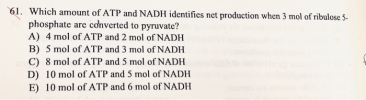
61. Which amount of ATP and NADH identifies net production when 3 mol of ribulose 5- phosphate are converted to pyruvate? A) 4 mol of ATP and 2 mol of NADH B) 5 mol of ATP and 3 mol of NADH C) 8 mol of ATP and 5 mol of NADH D) 10 mol of ATP and 5 mol of NADH E) 10 mol of ATP and 6 mol...
The
answer is C.
I want to know the pathway!! Thanks~
61. Which amount of ATP and NADH identifies net production when 3 mol of ribulose 5- phosphate are converted to pyruvate? A) 4 mol of ATP and 2 mol of NADH B) 5 mol of ATP and 3 mol of NADH C) 8 mol of ATP and 5 mol of NADH D) 10 mol of ATP and 5 mol of NADH E) 10 mol of ATP and 6 mol...
D ⇌ E + F DeltaG = -100 kCal mol-1; Activation energy = 5 kCal mol-1...
D ⇌ E + F DeltaG = -100 kCal mol-1; Activation energy = 5 kCal mol-1 A+ B ⇌ F DeltaG = +30 kCal mol-1; Activation energy = 10 kCal mol-1 We can couple these two reactions to carry out the overall reaction. What is the overall reaction and What is the change in free energy of the overall reaction?
 Consider the following hypothetical chemical pathway
(A---->D) consisting of three individual reaction steps
(A-->B,B-->C,C-->D)
This is the set of questions
Please use this set of rules/guidlines
Homework no.3. Bloenergete READ THESE IMPORTANT INSTRUCTIONS! These instructions are in force, wherever applicable, for all homework assignments and exams throughout the semester. When working problems, follow the guidelines laid out in the sheet I passed out to you about following the rules of good math "grammar Especially, be sure to set up the...
Consider the following hypothetical chemical pathway
(A---->D) consisting of three individual reaction steps
(A-->B,B-->C,C-->D)
This is the set of questions
Please use this set of rules/guidlines
Homework no.3. Bloenergete READ THESE IMPORTANT INSTRUCTIONS! These instructions are in force, wherever applicable, for all homework assignments and exams throughout the semester. When working problems, follow the guidelines laid out in the sheet I passed out to you about following the rules of good math "grammar Especially, be sure to set up the...
 3. (a) S>P AG8.5 kcal/mol (b) S → P ΔG + 3.5 kcal/mol (c) S-P AG-3.5 kcal/mol (d) S-) P ΔG_-9.5 kcal/mol (e) S → P ΔG= +3.0 kcal/mol (f) S-) P ΔG__ 2.5 kcal/mol A. (5 points) Which reactions are spontaneous? B. Which reactions are not spontaneous? C. Which reaction(s) can "force" reaction (a) to proceed? D. Which reaction(s) can "force" reaction (e) to proceed? E. Which reaction can "force" both reaction (0) and (e) to proceed togethers at...
 the answers i circled are incorrect except for 19. can you
please tell me why this is correct. can you give me the correct
answers and explain why?
actions usually proceed with amounts of inversion and retention at the center undergoing sustitution more inversion than retention at the center undergoing substitution y more retention then in version at the center undergoing substitution lete inversion at the center undergoing sostituti plete retention at the center undergoing substitution Which of the following...
the answers i circled are incorrect except for 19. can you
please tell me why this is correct. can you give me the correct
answers and explain why?
actions usually proceed with amounts of inversion and retention at the center undergoing sustitution more inversion than retention at the center undergoing substitution y more retention then in version at the center undergoing substitution lete inversion at the center undergoing sostituti plete retention at the center undergoing substitution Which of the following...
 Question 14
Answer: Consider the three-step mechanism for the reaction of A through intermediates B a roduce D shown below. B B-C C D E = 15 kcal/mol, AH - 13 kcal/mol E = 10 kcal/mol, AH° = -6 kcal/mol Eg = 2 kcal/mol, AH° = -20 kcal/mol What's the enthalpy difference between reactant C and intermediate D? Answer: 14) What is the name of the major monobrominated product which results when 2-tert: butylhexane is subjected to Bry/hv...
Question 14
Question 14
Answer: Consider the three-step mechanism for the reaction of A through intermediates B a roduce D shown below. B B-C C D E = 15 kcal/mol, AH - 13 kcal/mol E = 10 kcal/mol, AH° = -6 kcal/mol Eg = 2 kcal/mol, AH° = -20 kcal/mol What's the enthalpy difference between reactant C and intermediate D? Answer: 14) What is the name of the major monobrominated product which results when 2-tert: butylhexane is subjected to Bry/hv...
 BO D Which of ten The reaction of A to B. B) The reaction of B to C. C) The reaction of C to D. D) All three steps occur at the same rate: there is no rate-limiting step. E) The most exothermic step is rate-limiting. esaretim Rank the following carbocations in order of stability. (The most stable is first.) > III II B) II > > III C) III > > II I > Il > III D 36)...
 1) A decrease in entropy is associated with which type of reaction? A) dehydration B) catabolic C) depolymerization D) hydrolysis 2) Which of the following statements is an important consequence of the first law of thermodynamics for a living organism? A) The energy content of an organism is constant. B) An organism ultimately must obtain all of the necessary energy for life from its environment. C) The entropy of an organism decreases with time as the organism grows in complexity....
 25 20 15 B Free Energy (kcal/mol) 10 tions A 5 e 0 Reaction progress Use the reaction energy diagram above to answer the following questions. Calculate the activation energy, AG #, for the step B to C. Include algebraic sign.[ kcal/mol Calculate the overall energy change, AGO, for the process A to B. Include algebraic sign. kcal/mol Which step is faster, (a) C to B or (b) B to A?
 The
answer is C.
I want to know the pathway!! Thanks~
61. Which amount of ATP and NADH identifies net production when 3 mol of ribulose 5- phosphate are converted to pyruvate? A) 4 mol of ATP and 2 mol of NADH B) 5 mol of ATP and 3 mol of NADH C) 8 mol of ATP and 5 mol of NADH D) 10 mol of ATP and 5 mol of NADH E) 10 mol of ATP and 6 mol...
The
answer is C.
I want to know the pathway!! Thanks~
61. Which amount of ATP and NADH identifies net production when 3 mol of ribulose 5- phosphate are converted to pyruvate? A) 4 mol of ATP and 2 mol of NADH B) 5 mol of ATP and 3 mol of NADH C) 8 mol of ATP and 5 mol of NADH D) 10 mol of ATP and 5 mol of NADH E) 10 mol of ATP and 6 mol...
Most questions answered within 3 hours.
-
Where is the error in this code sequence?
String s1 = "Hello";
String s2 = "ello";...
asked 11 months ago -
Financial data for Joel de Paris, Inc., for last year
follow:
Joel de Paris, Inc.
Balance...
asked 11 months ago -
Consider this reaction:
Al2(SO4)3 (aq)+ BaCl3
(aq) Al2Cl6 (aq)- +
3BaSO4(s) . What is the...
asked 11 months ago -
Suppose that Savneet is considering increasing her
recent random sample from 20 car rentals to 40...
asked 11 months ago -
Trucks arrive at an unloading terminal at an average rate of 120
per hour.
Trucks arrive...
asked 11 months ago -
Why are methanol and ethanol completely soluble in water while
octanol is not very little soluble....
asked 11 months ago -
A facilities manager at a university reads in a research report
that the mean amount of...
asked 11 months ago -
When the CuSO4 is rehydrated by adding water to the anhydrous
compound, is this an endothermic...
asked 11 months ago -
A ray of sunlight is passing from diamond into crown glass; the
angle of incidence is...
asked 11 months ago -
A block of mass 0.249 kg is placed on top of a light, vertical
spring of...
asked 11 months ago -
how do the kidneys compensate in the presences of acidosis
a) trigger hyperventilate
b) reserve acid...
asked 11 months ago -
Question 501 pts
The rental rate of capital to the firm increases. Which of the
following...
asked 11 months ago