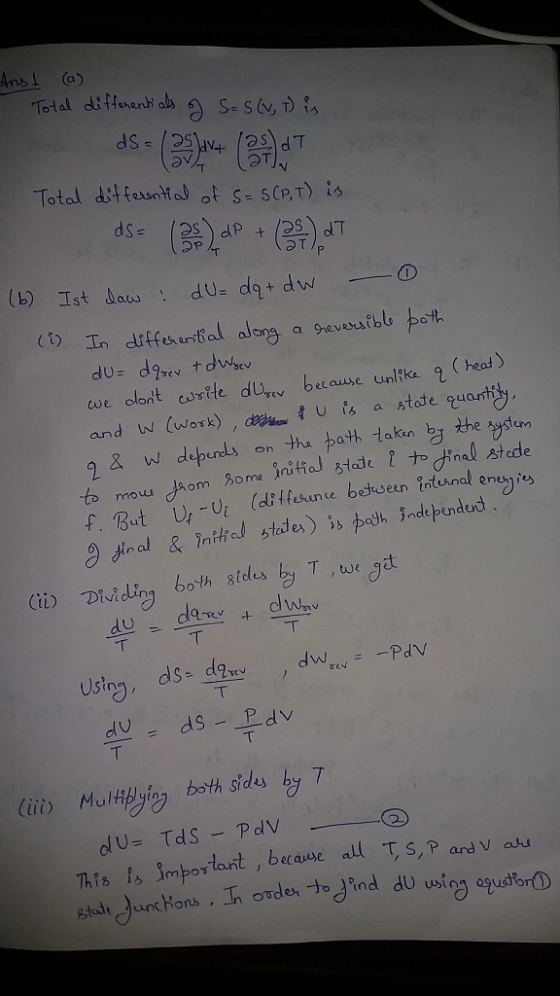
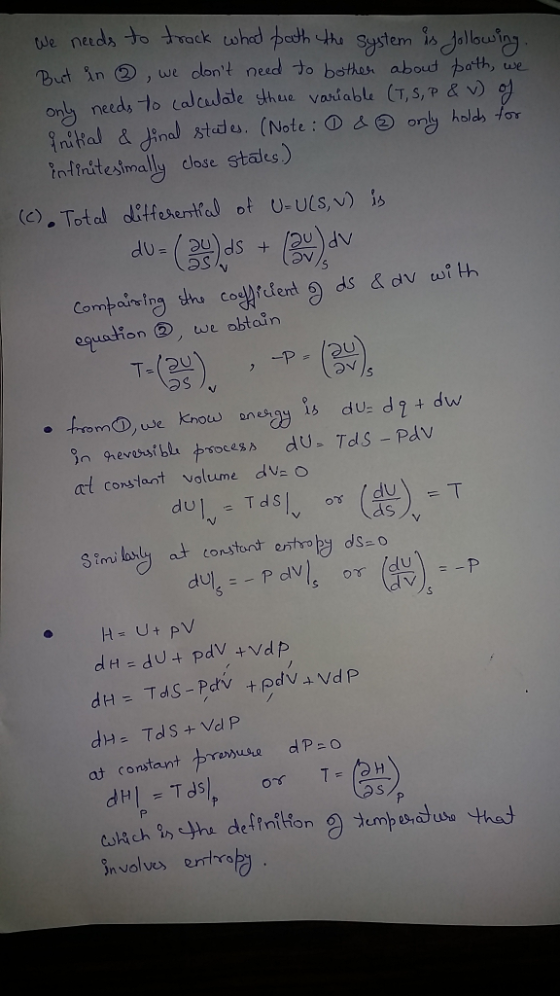
![1. (a) Write the total differentials of s-S(V, T),S- S(P, T). Get used to it. This is the first step in many derivations in thermodynamics. Well actually come back to these particular ones in the next lecture or so. (b) Now, from the 1st law we know that du dq+ dw. () Take the differential along a reversible path: dU - dgrev+ dwre. [Question: why dont we write dUrev? Yes, you must answer this and the other questions in blue.] (ü) Next, divide both sides by T, then substitute the 2nd law definition of entropy, ds -dare/T and for dwrev-PdV (li) Multiply by T. dU should now be expressed entirely in terms of state functions (S, T, P, and Finally, identify the partial derivatives as (e) Tand() -P, a thermodynamic such as(5) V) or their differentials. Why is this important? (c) Now find the total differential of U-u(s,v). Equate dU from part (b) to dU from part (c). avis definition of temperature and pressure. Can you rationalize why temperature and pressure can be defined as partial derivatives of energy with respect to entropy and volume, respectively? Do you think you could find a route another definition of temperature that involves enthalp ,-T? such as T)](http://img.homeworklib.com/questions/f8c13710-b0fb-11eb-a559-bde79800d50f.png?x-oss-process=image/resize,w_560)
Homework Answers
Add Answer to:
1. (a) Write the total differentials of s-S(V, T),S- S(P, T). Get used to it. This...
By considering the volume V and entropy S as the two independent variables in the thermodynamic equation dE = TdS−PdV , derive the Maxwell relation between the derivatives ∂T/ ∂V and ∂P/ ∂S .
By considering the volume V and entropy S as the two independent variables in the thermodynamic equation dE = TdS−PdV , derive the Maxwell relation between the derivatives ∂T/ ∂V and ∂P/ ∂S .
Many times it is useful re-writing partial differential thermodynamic expressions in different forms using the total...
 Many times it is useful re-writing partial differential thermodynamic expressions in different forms using the total differentials for E, H, F. and G. The total differentials of E, H, F, and G are: dE = TDS – PdV + udn dH = TDS + VDP + udn dF = -SDT – PdV + udn dG = -SDT + VdP + udn - Part A Rewrite the following expression in terms of S, T, P, V.1, 11, Q, CAm, and/or Cvm,...
4. (25 pts) The Gibb's free energy of a system of N particles is given by,...
 4. (25 pts) The Gibb's free energy of a system of N particles is given by, G(T,p)=-Nk T In“- (a) dG = ? (write in differential form similar to dU = TDS - pdV) (b) Find expressions for S and V written as partial derivatives with respect to G. (c) Compute the constant pressure heat capacity Cp of the system: C=T(dS/dT), Hint: Use your expression for S derived in (b) above, 3333333 (d) Extract the equation of state for this...
P-v and T-s diagram
Represent in coordinates p-v and T-s the transformation for which a system receives heat but lowers its temperature. Explain why this is possible.
The Sackur-Tetrode Equation gives the entropy of a sample of n moles of monatomic ideal gas...
 The Sackur-Tetrode Equation gives the entropy of a sample of n moles of monatomic ideal gas as a function of its internal energy U and volume V S(U, V) = 5/2 n R + n R In (V/n N_A(4piM U/3nN^2_Ah^2)^3/2) In the equation, R is the gas constant, M is the molar mass, N_4 is Avogadro's number, and h is Plank's constant. The equation can be derived using S = k ln W and directly computing W, the number of...
An isolated system contains an ideal gas with state parameters: U, T, S, P, V, M,...
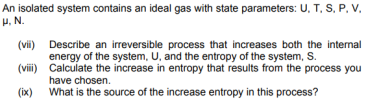 An isolated system contains an ideal gas with state parameters: U, T, S, P, V, M, N. (vii) (viii) Describe an irreversible process that increases both the internal energy of the system, U, and the entropy of the system, S. Calculate the increase in entropy that results from the process you have chosen. What is the source of the increase entropy in this process? (ix)
Question 10 Statistical thermodynamics may be used to find the radiation pressure P for cavity (or...
 Question 10 Statistical thermodynamics may be used to find the radiation pressure P for cavity (or black body) radiation in terms of the energy per unit volume u. (a) An ideal quantum gas comprises non-interacting identical particles with discrete quantum states labelled 1, 2, ...,r ,....The partition function is given by Z (T,V,N)- > exp(-B(n,&, + п,&, +...)} пп. (i) Define the symbols n1, n2,...,n,...and 81, 82, ..., Er,... (iiExplain why, for photons, the partition function may be expressed as:...
The amount of heat needed to raise the temperature of 1 mole of a substance by...
The amount of heat needed to raise the temperature of 1 mole of a substance by one Celsius degree (or, equivalently, one kelvin) is called the molar heat capacity of the system, denoted by the letter C. If a small amount of heat dQ is put into n moles of a substance, and the resulting change in temperature for the system is dT, then C=1ndQdT. This is the definition of molar heat capacity--the amount of heat Q added per infinitesimal...
QUESTION 2 a) (5 p) Interpret the rocket equation dv(OM(t)=-udMO [EQ.1) within the framework of the...
 QUESTION 2 a) (5 p) Interpret the rocket equation dv(OM(t)=-udMO [EQ.1) within the framework of the law of momentum conservation, written in a closed system, here Mt) is the rocket mass, time t, whereas M(t) is by definition, dM(t)=M(t+dt)-M(t): -dM(t)-dM(t), is the mass of the gas thrown by the rocket through the infinitely small period of time dt: on the other hand, dv(t) is, still by definition, dv(t)v(t+dt)-vít), i.e. the increase in the velocity of the rocket through the period...
1 The Gibbs Paradox Consider N particles, each of mass m, in a 3-dimensional volume V at temperature T. Each particle i...
 1 The Gibbs Paradox Consider N particles, each of mass m, in a 3-dimensional volume V at temperature T. Each particle i has momentum pi. Assume that the particles are non-interacting (ideal gas) and distinguishable. a) (2P) Calculate the canonical partition function N P for the N-particle system. Make sure to work out the integral. b) (2P) Calculate the free energy F--kBTlnZ from the partition function Z. Is F an extensive quantity? c) (2P) Calculate the entropy S F/oT from...
 Many times it is useful re-writing partial differential thermodynamic expressions in different forms using the total differentials for E, H, F. and G. The total differentials of E, H, F, and G are: dE = TDS – PdV + udn dH = TDS + VDP + udn dF = -SDT – PdV + udn dG = -SDT + VdP + udn - Part A Rewrite the following expression in terms of S, T, P, V.1, 11, Q, CAm, and/or Cvm,...
 4. (25 pts) The Gibb's free energy of a system of N particles is given by, G(T,p)=-Nk T In“- (a) dG = ? (write in differential form similar to dU = TDS - pdV) (b) Find expressions for S and V written as partial derivatives with respect to G. (c) Compute the constant pressure heat capacity Cp of the system: C=T(dS/dT), Hint: Use your expression for S derived in (b) above, 3333333 (d) Extract the equation of state for this...
 The Sackur-Tetrode Equation gives the entropy of a sample of n moles of monatomic ideal gas as a function of its internal energy U and volume V S(U, V) = 5/2 n R + n R In (V/n N_A(4piM U/3nN^2_Ah^2)^3/2) In the equation, R is the gas constant, M is the molar mass, N_4 is Avogadro's number, and h is Plank's constant. The equation can be derived using S = k ln W and directly computing W, the number of...
 An isolated system contains an ideal gas with state parameters: U, T, S, P, V, M, N. (vii) (viii) Describe an irreversible process that increases both the internal energy of the system, U, and the entropy of the system, S. Calculate the increase in entropy that results from the process you have chosen. What is the source of the increase entropy in this process? (ix)
 Question 10 Statistical thermodynamics may be used to find the radiation pressure P for cavity (or black body) radiation in terms of the energy per unit volume u. (a) An ideal quantum gas comprises non-interacting identical particles with discrete quantum states labelled 1, 2, ...,r ,....The partition function is given by Z (T,V,N)- > exp(-B(n,&, + п,&, +...)} пп. (i) Define the symbols n1, n2,...,n,...and 81, 82, ..., Er,... (iiExplain why, for photons, the partition function may be expressed as:...
 QUESTION 2 a) (5 p) Interpret the rocket equation dv(OM(t)=-udMO [EQ.1) within the framework of the law of momentum conservation, written in a closed system, here Mt) is the rocket mass, time t, whereas M(t) is by definition, dM(t)=M(t+dt)-M(t): -dM(t)-dM(t), is the mass of the gas thrown by the rocket through the infinitely small period of time dt: on the other hand, dv(t) is, still by definition, dv(t)v(t+dt)-vít), i.e. the increase in the velocity of the rocket through the period...
 1 The Gibbs Paradox Consider N particles, each of mass m, in a 3-dimensional volume V at temperature T. Each particle i has momentum pi. Assume that the particles are non-interacting (ideal gas) and distinguishable. a) (2P) Calculate the canonical partition function N P for the N-particle system. Make sure to work out the integral. b) (2P) Calculate the free energy F--kBTlnZ from the partition function Z. Is F an extensive quantity? c) (2P) Calculate the entropy S F/oT from...
Most questions answered within 3 hours.
-
Where is the error in this code sequence?
String s1 = "Hello";
String s2 = "ello";...
asked 11 months ago -
Financial data for Joel de Paris, Inc., for last year
follow:
Joel de Paris, Inc.
Balance...
asked 11 months ago -
Consider this reaction:
Al2(SO4)3 (aq)+ BaCl3
(aq) Al2Cl6 (aq)- +
3BaSO4(s) . What is the...
asked 11 months ago -
Suppose that Savneet is considering increasing her
recent random sample from 20 car rentals to 40...
asked 11 months ago -
Trucks arrive at an unloading terminal at an average rate of 120
per hour.
Trucks arrive...
asked 11 months ago -
Why are methanol and ethanol completely soluble in water while
octanol is not very little soluble....
asked 11 months ago -
A facilities manager at a university reads in a research report
that the mean amount of...
asked 11 months ago -
When the CuSO4 is rehydrated by adding water to the anhydrous
compound, is this an endothermic...
asked 11 months ago -
A ray of sunlight is passing from diamond into crown glass; the
angle of incidence is...
asked 11 months ago -
A block of mass 0.249 kg is placed on top of a light, vertical
spring of...
asked 11 months ago -
how do the kidneys compensate in the presences of acidosis
a) trigger hyperventilate
b) reserve acid...
asked 11 months ago -
Question 501 pts
The rental rate of capital to the firm increases. Which of the
following...
asked 11 months ago