you have isolated spontaneous mutations in the LEU6 gene of a haploid strain of the yeast...
- you have isolated spontaneous mutations in the LEU6 gene of a haploid strain of the yeast S. cerevisiae. Some of your mutations result in a complete loss of LEU6 gene function. You reason that this phenotype may be due to insertion of a mobile DNA element into the gene.
To test this idea, you sequence the LEU6 region ion from several of your mutants and compare the DNA to the previously determined sequence for LEU6 in the parental strain. Numerous strains do in fact carry insertions, and a quick analysis indicates that several different types of mobile DNA elements are represented in the group of mutants.
Below is the sequence of one of the insertion mutations (Some sequences from the middle of the element deleted at the // symbol.) The sequence of the parental DNA at the insertion site is also shown.
Chromosome carrying insertion (inserted DNA sequences are in capital letters):
5’…tcgcagcgcatcgccttGAGCGGGACTCTGGGTATACGGATCCC//GTTTCGTATACCCAGAGTCCCGCTCgccttctatcgccttcttgacgagttcttct…3’
Chromosomal site:
5’…tcgcagcgcatcgccttctatcgccttcttgacgagttcttct…3’
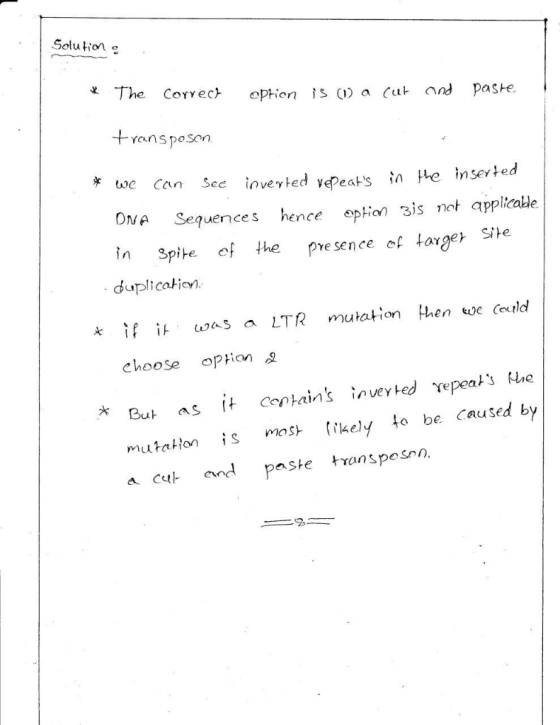
You wish to determine if the insertion mutations are caused by: (1) a cut and paste transposon or (2) a retrovirus. Based on these data, which class or classes of elements are most likely responsible for the mutation in this isolate? Briefly explain.
Homework Answers
Add Answer to:
you have isolated spontaneous mutations in the LEU6 gene of a
haploid strain of the yeast...
The yeast Saccharomyces cerevisiae can grow as haploid or diploid cells. You have two haploid yeast...
The yeast Saccharomyces cerevisiae can grow as haploid or diploid cells. You have two haploid yeast strains that each carry recessive mutations that affect regulation of the genes required for galactose metabolism. One strain has a deletion of the region of the genome on chromosome II that lies between the GAL1 and GAL10 genes (deltaUAS). The other strain carries a mutant allele of the GAL80 gene on chromosome XIII that produces no functional GAL80 protein. Which of the following correctly...
You have isolated a strain of brewer's yeast (Saccharomyces cerevisiae) in the lab for your second...
 You have isolated a strain of brewer's yeast (Saccharomyces cerevisiae) in the lab for your second job at a hip new microbrew (you make a great IPA). You find that this strain ferments more efficiently and adds a superior flavour profile to your brews. You want to clone the strain of yeast and generate a genomic library to determine the genes responsible for this finding. To do so you: 1. Obtain fragments of the whole yeast genome (DNA) through restriction...
16. You have cloned a centromere from yeast. You have also identified three genes, X, Y...
 16. You have cloned a centromere from yeast. You have also
identified three genes, X, Y and Z that code for proteins that are
a subset of the kinetochore proteins that are bound to the
centromere. None of your three genes is essential but each does
contribute to the overall efficiency of chromosomal segregation.
You raise antibodies to each of your three proteins. You also
contstruct four strains, a wild-type strain, a strain in which gene
X is deleted (XD),...
16. You have cloned a centromere from yeast. You have also
identified three genes, X, Y and Z that code for proteins that are
a subset of the kinetochore proteins that are bound to the
centromere. None of your three genes is essential but each does
contribute to the overall efficiency of chromosomal segregation.
You raise antibodies to each of your three proteins. You also
contstruct four strains, a wild-type strain, a strain in which gene
X is deleted (XD),...
You have constructed a new reporter gene to help you find novel zebrafish mutations. The reporter...
You have constructed a new reporter gene to help you find novel zebrafish mutations. The reporter gene consists of several LEG/TCF binding domains in the enhancer fused to the coding region for green fluorescent protein (GFP). Wild-type embryos that contain this transgene normally express it in the brain and eye primordia and have no developmental defects. You then mutagenize this reporter strain to look for new mutants that affect GFP expression. Which developmental pathway are these mutants likely to be...
KHomework II Practice Problem 115 Review Three haploid yeast petite mutants were isolated one from each of the thr...
 KHomework II Practice Problem 115 Review Three haploid yeast petite mutants were isolated one from each of the three classes of petite mutations-suppressive petites, neutral petites, and segregational petites. You perform the crosses shown in this table. Progeny (haploid spores) Cross 50% petite: 50% wild petite #1 x wild type type petite #2 x wild type 100% petite P petite #3 x wild type 100% wild type Se on WoL mini ferm Whic coul mutant ( will segregate in a...
Augu Q46. Below is a DNA sequence from a yeast GPCR gene. Using RNA sequencing methods...
 Augu Q46. Below is a DNA sequence from a yeast GPCR gene. Using RNA sequencing methods you have obtained the following partial 5' sequence for the MRNA transcribed from this gene: 5'-GGUCCAU... 5'GTATAAGAAGCACTCTACCTCAATGGGTCCATGGGAGAAGGTAGGCATGTGTATTTGACAAAGGGA i. What are the most likely six N-terminal amino acids for the above gene? (2 pts) Examine the other reading frames. Explain why you can exclude those other possible reading frames from consideration (one or two reasons depending upon the frame). (2 pts) Circle the portion of...
Use the following information to answer the questions below. You have isolated a gene sequence f...
Use the following information to answer the questions below. You have isolated a gene sequence from the mustard plant Arabidopsis and have BLAST searched the NCBI database. Your sequence hit several EST sequences that were identified as transcription factors. These sequences were found in E.coli, Chlamydomonas (a green algae), yeast, mice, and humans and only had a few base pair differences. What can be surmised about your transcription factor? It is unique to Arabidopsis. It is likely involved in a...
What control elements regulate expression of the mPGES-1 gene? The promoter of a gene includes the...
What control elements regulate expression of the mPGES-1 gene? The promoter of a gene includes the DNA immediately upstream of the transcription start site, but expression of the gene can also be affected by control elements. These can be thousands of base pairs upstream of the promoter, grouped in an enhancer. Because the distance and spacing of these control elements make them difficult to identify, scientists begin by deleting sections of DNA that contain possible control elements and measuring the...
What complications might arise from genetic screens targeting an organ that differentiates late in development? A....
What complications might arise from genetic screens targeting an organ that differentiates late in development? A. The DNA of late development genes is usually highly condensed and thus inaccessible for mutagenesis. b. Genes controlling adult structures can be important in earlier stages of development, and their mutations may be lethal and thus hidden from observation. c. The sequence of late development genes is highly variable, so it is difficult to obtain loss-of-function mutant phenotypes. When the S. cerevisiae genome was...
Genetics Worksheet Week 3: Gene Regulation and Epigenetics 1. Duchenne muscular dystrophy is caused by a mutation in a gene that is 2.5 million nucleotides in length and encodes a protein called dyst...
 Genetics Worksheet Week 3: Gene Regulation and Epigenetics 1. Duchenne muscular dystrophy is caused by a mutation in a gene that is 2.5 million nucleotides in length and encodes a protein called dystrophin. The dystrophin protein itself is 3684 amino acids in length. Calculate below the approximate size of the mRNA that encodes dystrophin. Approximately what percentage of the gene that encodes dystrophin is intron sequence? The human genome encodes a much greater variety and number of proteins than the...
 You have isolated a strain of brewer's yeast (Saccharomyces cerevisiae) in the lab for your second job at a hip new microbrew (you make a great IPA). You find that this strain ferments more efficiently and adds a superior flavour profile to your brews. You want to clone the strain of yeast and generate a genomic library to determine the genes responsible for this finding. To do so you: 1. Obtain fragments of the whole yeast genome (DNA) through restriction...
 16. You have cloned a centromere from yeast. You have also
identified three genes, X, Y and Z that code for proteins that are
a subset of the kinetochore proteins that are bound to the
centromere. None of your three genes is essential but each does
contribute to the overall efficiency of chromosomal segregation.
You raise antibodies to each of your three proteins. You also
contstruct four strains, a wild-type strain, a strain in which gene
X is deleted (XD),...
16. You have cloned a centromere from yeast. You have also
identified three genes, X, Y and Z that code for proteins that are
a subset of the kinetochore proteins that are bound to the
centromere. None of your three genes is essential but each does
contribute to the overall efficiency of chromosomal segregation.
You raise antibodies to each of your three proteins. You also
contstruct four strains, a wild-type strain, a strain in which gene
X is deleted (XD),...
 KHomework II Practice Problem 115 Review Three haploid yeast petite mutants were isolated one from each of the three classes of petite mutations-suppressive petites, neutral petites, and segregational petites. You perform the crosses shown in this table. Progeny (haploid spores) Cross 50% petite: 50% wild petite #1 x wild type type petite #2 x wild type 100% petite P petite #3 x wild type 100% wild type Se on WoL mini ferm Whic coul mutant ( will segregate in a...
 Augu Q46. Below is a DNA sequence from a yeast GPCR gene. Using RNA sequencing methods you have obtained the following partial 5' sequence for the MRNA transcribed from this gene: 5'-GGUCCAU... 5'GTATAAGAAGCACTCTACCTCAATGGGTCCATGGGAGAAGGTAGGCATGTGTATTTGACAAAGGGA i. What are the most likely six N-terminal amino acids for the above gene? (2 pts) Examine the other reading frames. Explain why you can exclude those other possible reading frames from consideration (one or two reasons depending upon the frame). (2 pts) Circle the portion of...
 Genetics Worksheet Week 3: Gene Regulation and Epigenetics 1. Duchenne muscular dystrophy is caused by a mutation in a gene that is 2.5 million nucleotides in length and encodes a protein called dystrophin. The dystrophin protein itself is 3684 amino acids in length. Calculate below the approximate size of the mRNA that encodes dystrophin. Approximately what percentage of the gene that encodes dystrophin is intron sequence? The human genome encodes a much greater variety and number of proteins than the...
Most questions answered within 3 hours.
-
Where is the error in this code sequence?
String s1 = "Hello";
String s2 = "ello";...
asked 10 months ago -
Financial data for Joel de Paris, Inc., for last year
follow:
Joel de Paris, Inc.
Balance...
asked 10 months ago -
Consider this reaction:
Al2(SO4)3 (aq)+ BaCl3
(aq) Al2Cl6 (aq)- +
3BaSO4(s) . What is the...
asked 10 months ago -
Suppose that Savneet is considering increasing her
recent random sample from 20 car rentals to 40...
asked 10 months ago -
Trucks arrive at an unloading terminal at an average rate of 120
per hour.
Trucks arrive...
asked 10 months ago -
Why are methanol and ethanol completely soluble in water while
octanol is not very little soluble....
asked 10 months ago -
A facilities manager at a university reads in a research report
that the mean amount of...
asked 10 months ago -
When the CuSO4 is rehydrated by adding water to the anhydrous
compound, is this an endothermic...
asked 10 months ago -
A ray of sunlight is passing from diamond into crown glass; the
angle of incidence is...
asked 10 months ago -
A block of mass 0.249 kg is placed on top of a light, vertical
spring of...
asked 10 months ago -
how do the kidneys compensate in the presences of acidosis
a) trigger hyperventilate
b) reserve acid...
asked 10 months ago -
Question 501 pts
The rental rate of capital to the firm increases. Which of the
following...
asked 10 months ago