
Homework Answers
Answer :)
The mRNA sequence is as the following:
5’ GUAUAAGAAGCACUCUACCUCAAUGGGUCCAUGGGAGAAGGUAGGCAUGUGUAUUUGACAAAGGGA 3’
Answer i:)
The amino acid chain of the above mRNA strand (based on the open reading frame mentioned in the second part of the answer):
MET GLY GLU GLY ARG HIS VAL TYR LEU THR LYS GLY
Therefore, the six terminal amino acids are VAL TYR LEU THR LYS GLY
Answer ii:)
The reading frame of the above mRNA is as bellow:
AUGGGAGAAGGUAGGCAUGUGUAUUUGACAAAGGGA
Protein sequence: MET GLY GLU GLY ARG HIS VAL TYR LEU THR LYS GLY
The protein sequence does not contain stop codon; therefore, it is a reading frame. The minimum size of an open reading frame is 100 codons. Therefore, in this reading frame, we suppose that there must be 100 codons until a stop codon does not come.
The other reading frame:
- 5’ AUGGGUCCAUGGGAGAAGGUAGGCAUGUGUAUUUGA 3’
Protein sequence: MET GLY PRO TRP GLU LYS VAL GLY MET CYS ILE STOP
We chose the reading frame from the start codon (AUG). This reading frame is started with AUG codon but contains stop codon and does not reach to minimum 100-codon length.
- AUGUGUAUUU
Protein sequence: MET CYS ILE STOP
This reading frame is too short to consider as an open reading frame.
Answer iii:)
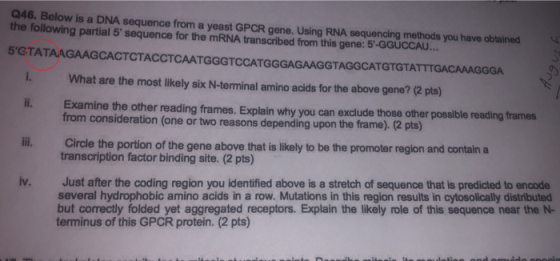
The red circle is showing the possible promoter region i.e. TATA box.
Answer iv:)
The possible amino acid sequence is MET GLY GLU GLY ARG HIS VAL TYR LEU THR LYS GLY in which the terminal amino acid Glycine supports in the flexibility of the protein.

Add Answer to:
Augu Q46. Below is a DNA sequence from a yeast GPCR gene. Using RNA sequencing methods...
The following genomic DNA sequence comes from the first exon of a human gene and contains...
 The following genomic DNA sequence comes from the first exon of a human gene and contains the 3'-end of the 5'-untranslated region and the start of a long open reading frame that codes for 200 amino acids (a.k.a. coding sequence). Note: There are no introns in this short portion and only one strand of the genomic DNA is shown. Which of the following answers lists the first three amino acids of the translated protein correctly? Seconed Position tyr ser leu...
Shown below is the anti-sense DNA sequence from a region of a gene that produces a...
Shown below is the anti-sense DNA sequence from a region of a gene that produces a specific protein. Mutations in this region of the gene cause a disease CTT TTA TAG TAG ATA CCA CAA AGG a. What is the mRNA strand that is transcribed from the DNA shown above? b. What is the amino acid sequence that would be translated from the mRNA strand you determined in part 1? c. If an individual has a G at position 15...
6. Using the answers to questions 2-5 and the below DNA sequence, predict the mRNA sequence,...
 6. Using the answers to questions 2-5 and the below DNA sequence, predict the mRNA sequence, the tRNA anticodons, and the amino acid sequences (use the three letter code) that would result from it. (3 points) DNA +1 15'GICIA I G C A A CICATI I AA GG 3' 3" CA GATA C GTIGA GIA A A IICC 5 mRNA tRNA anticodons amino acids 7. You are interested in a gene that codes for a 20 amino acid-long protein. (1.5...
ASSIGNMENT For the DNA sequence given below, write the complementary DNA sequence that would complete the...
ASSIGNMENT For the DNA sequence given below, write the complementary DNA sequence that would complete the double-strand. DNA 3’—A T T G C T T A C T T G C A T -- 5’ DNA 5’-- Does it matter which strand is the ‘code strand’? The following two sequences look identical, except one runs 3’-5’ and the other 5’-3’. For each DNA sequence given below, write the mRNA sequence that would be coded from it. Make sure you indicate the direction of each mRNA strand (i.e. 3’ and 5’ ends). Use the Universal triplet code to...
Question 36 1 pts 36. You have a population of mammalian cells growing in media containing...
 Question 36 1 pts 36. You have a population of mammalian cells growing in media containing enough growth factors. Which of the following graphs corresponds to these cells when their DNA content is analyzed 24 hours after they are induced to express high levels of a mutant form of Rb protein that cannot be phosphorylated? (Note: this cell line has its cell cycle around 22 hours) Control cells #1 #2 #3 #4 #5 #6 Cell number JAN ul. 2 2...
2. A dominant allele H reduces the number of body bristles that Drosophila flies have, giving...
2. A dominant allele H reduces the number of body bristles that Drosophila flies have, giving rise to a “hairless” phenotype. In the homozygous condition, H is lethal. An independently assorting dominant allele S has no effect on bristle number except in the presence of H, in which case a single dose of S suppresses the hairless phenotype, thus restoring the "hairy" phenotype. However, S also is lethal in the homozygous (S/S) condition. What ratio of hairy to hairless flies...
 The following genomic DNA sequence comes from the first exon of a human gene and contains the 3'-end of the 5'-untranslated region and the start of a long open reading frame that codes for 200 amino acids (a.k.a. coding sequence). Note: There are no introns in this short portion and only one strand of the genomic DNA is shown. Which of the following answers lists the first three amino acids of the translated protein correctly? Seconed Position tyr ser leu...
 6. Using the answers to questions 2-5 and the below DNA sequence, predict the mRNA sequence, the tRNA anticodons, and the amino acid sequences (use the three letter code) that would result from it. (3 points) DNA +1 15'GICIA I G C A A CICATI I AA GG 3' 3" CA GATA C GTIGA GIA A A IICC 5 mRNA tRNA anticodons amino acids 7. You are interested in a gene that codes for a 20 amino acid-long protein. (1.5...
 Question 36 1 pts 36. You have a population of mammalian cells growing in media containing enough growth factors. Which of the following graphs corresponds to these cells when their DNA content is analyzed 24 hours after they are induced to express high levels of a mutant form of Rb protein that cannot be phosphorylated? (Note: this cell line has its cell cycle around 22 hours) Control cells #1 #2 #3 #4 #5 #6 Cell number JAN ul. 2 2...
Most questions answered within 3 hours.
-
Where is the error in this code sequence?
String s1 = "Hello";
String s2 = "ello";...
asked 10 months ago -
Financial data for Joel de Paris, Inc., for last year
follow:
Joel de Paris, Inc.
Balance...
asked 10 months ago -
Consider this reaction:
Al2(SO4)3 (aq)+ BaCl3
(aq) Al2Cl6 (aq)- +
3BaSO4(s) . What is the...
asked 10 months ago -
Suppose that Savneet is considering increasing her
recent random sample from 20 car rentals to 40...
asked 10 months ago -
Trucks arrive at an unloading terminal at an average rate of 120
per hour.
Trucks arrive...
asked 10 months ago -
Why are methanol and ethanol completely soluble in water while
octanol is not very little soluble....
asked 10 months ago -
A facilities manager at a university reads in a research report
that the mean amount of...
asked 10 months ago -
When the CuSO4 is rehydrated by adding water to the anhydrous
compound, is this an endothermic...
asked 10 months ago -
A ray of sunlight is passing from diamond into crown glass; the
angle of incidence is...
asked 10 months ago -
A block of mass 0.249 kg is placed on top of a light, vertical
spring of...
asked 10 months ago -
how do the kidneys compensate in the presences of acidosis
a) trigger hyperventilate
b) reserve acid...
asked 10 months ago -
Question 501 pts
The rental rate of capital to the firm increases. Which of the
following...
asked 10 months ago