1) A road is banked at 10 degrees at a circular turn of radius 100m. a....
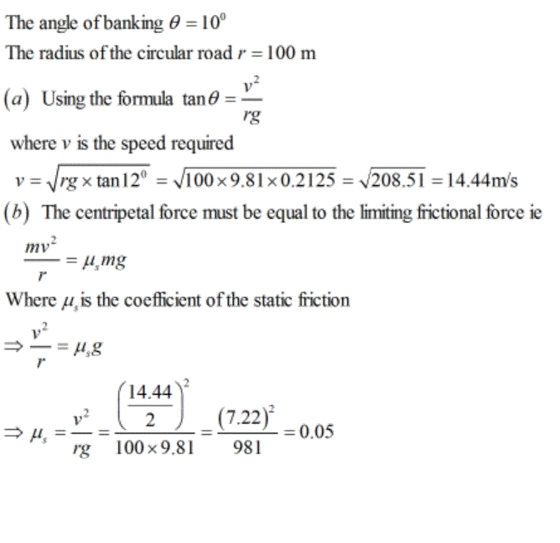
1) A road is banked at 10 degrees at a circular turn of radius 100m.
a. What is the exact speed required such that the car stays on the road when it is icy and without friction?
b. What minimum coefficeient of static friction is needed if the car travels at exactly one half the speed you found in a.
Homework Answers
Add Answer to:
1) A road is banked at 10 degrees at a circular turn of radius
100m.
a....
A car rounds a curve that is banked inward. The radius of curvature of the road...
 A car rounds a curve that is banked inward. The radius of curvature
of the road is R = 140 m, the banking angle is θ = 26°, and the
coefficient of static friction is μs = 0.39. Find the minimum speed
that the car can have without slipping.
A car rounds a curve that is banked inward. The radius of curvature of the road is R 140 m, the banking angle is 26e, and the coefficient of static minimum...
A car rounds a curve that is banked inward. The radius of curvature
of the road is R = 140 m, the banking angle is θ = 26°, and the
coefficient of static friction is μs = 0.39. Find the minimum speed
that the car can have without slipping.
A car rounds a curve that is banked inward. The radius of curvature of the road is R 140 m, the banking angle is 26e, and the coefficient of static minimum...
A car at speed v takes a turn of radius R on a banked road of...
 A car at speed v takes a turn of radius R on a banked road of
angle
. What is the angle that the road must be banked ti bit require
the driver to turn the steering wheel? For circular motion, the
centripetal acceleration is
Now the road has a coefficient of friction of
with
. What is the maximum velocity that the driver can take the
turn?
We were unable to transcribe this imageWe were unable to transcribe this...
A car at speed v takes a turn of radius R on a banked road of
angle
. What is the angle that the road must be banked ti bit require
the driver to turn the steering wheel? For circular motion, the
centripetal acceleration is
Now the road has a coefficient of friction of
with
. What is the maximum velocity that the driver can take the
turn?
We were unable to transcribe this imageWe were unable to transcribe this...
A car rounds a curve that is banked inward. The radius of curvature of the road...
A car rounds a curve that is banked inward. The radius of curvature of the road is R = 152 m, the banking angle is θ = 32°, and the coefficient of static friction is μs = 0.23. Find the minimum speed that the car can have without slipping.
A curve of radius 70 m is banked so that a 1000 kg car traveling at...
A curve of radius 70 m is banked so that a 1000 kg car traveling at 60 km/h can round it even if the road is so icy that the coefficient of static friction is approximately zero. The acceleration of gravity is 9.81 m/s 2 . a) Find the minimum speed at which a car can travel around this curve without skidding if the coefficient of static friction between the road and the tires is 0.2 b) Find the maximum...
5. (10 pts): A car of mass M goes around an icy banked turn of radius...
 5. (10 pts): A car of mass M goes around an icy banked turn of radius t at a speed v. If there is no frictional force and the car takes the turn without skidding, at what angle 0 is the turn banked?
A car goes around an icy banked curve (frictionless) at a speed that is not too...
A car goes around an icy banked curve (frictionless) at a speed that is not too fast so that the car stays on the circula path. What causes the car to follow the circular path? A car goes around an icy banked curve (frictionless) at a speed that is not too fast so that the car stays on the circula path. What causes the car to follow the circular path? the normal force from the road gravity the friction force...
A car rounds a curve that is banked inward. The radius of curvature of the road...
A car rounds a curve that is banked inward. The radius of curvature of the road is R = 142 m, the banking angle is θ = 30°, and the coefficient of static friction is μs = 0.32. Find the minimum speed that the car can have without slipping. I got 36.5196 m/s, which isn't correct.
A curve on a road has a radius of curvature of 500.0m and is banked at...
A curve on a road has a radius of curvature of 500.0m and is banked at an angle of 10.00 degrees, if a 1700.0Kg car is traveling at a speed of 27.0m/s around the curve, what is the magnitude and direction of the static frictional force needed to keep the car around the curve at this speed?
We are building a road, and at one place we need to make a turn with...
We are building a road, and at one place we need to make a turn with a radius of 30m. The coefficient of static friction between rubber and the material we are using is 0.6. Assuming that the road is flat through the turn, what is the maximum speed a car could have and safely navigate the turn without sliding off the road? Instead of keeping the road flat, let's bank the turn a little bit, giving the road an...
A car travels at a constant speed of 32.5 mi/h (14.5 m/s) on a level circular...
A car travels at a constant speed of 32.5 mi/h (14.5 m/s) on a level circular turn of radius 49.0 m, as shown in the bird's-eye view in figure a. What minimum coefficient of static friction, μs, between the tires and the roadway will allow the car to make the circular turn without sliding? 1 ) make the circular turn without sliding? 2 ) At what maximum speed can a car negotiate a turn on a wet road with coefficient...
 A car rounds a curve that is banked inward. The radius of curvature
of the road is R = 140 m, the banking angle is θ = 26°, and the
coefficient of static friction is μs = 0.39. Find the minimum speed
that the car can have without slipping.
A car rounds a curve that is banked inward. The radius of curvature of the road is R 140 m, the banking angle is 26e, and the coefficient of static minimum...
A car rounds a curve that is banked inward. The radius of curvature
of the road is R = 140 m, the banking angle is θ = 26°, and the
coefficient of static friction is μs = 0.39. Find the minimum speed
that the car can have without slipping.
A car rounds a curve that is banked inward. The radius of curvature of the road is R 140 m, the banking angle is 26e, and the coefficient of static minimum...
 A car at speed v takes a turn of radius R on a banked road of
angle
. What is the angle that the road must be banked ti bit require
the driver to turn the steering wheel? For circular motion, the
centripetal acceleration is
Now the road has a coefficient of friction of
with
. What is the maximum velocity that the driver can take the
turn?
We were unable to transcribe this imageWe were unable to transcribe this...
A car at speed v takes a turn of radius R on a banked road of
angle
. What is the angle that the road must be banked ti bit require
the driver to turn the steering wheel? For circular motion, the
centripetal acceleration is
Now the road has a coefficient of friction of
with
. What is the maximum velocity that the driver can take the
turn?
We were unable to transcribe this imageWe were unable to transcribe this...
 5. (10 pts): A car of mass M goes around an icy banked turn of radius t at a speed v. If there is no frictional force and the car takes the turn without skidding, at what angle 0 is the turn banked?
Most questions answered within 3 hours.
-
Where is the error in this code sequence?
String s1 = "Hello";
String s2 = "ello";...
asked 10 months ago -
Financial data for Joel de Paris, Inc., for last year
follow:
Joel de Paris, Inc.
Balance...
asked 10 months ago -
Consider this reaction:
Al2(SO4)3 (aq)+ BaCl3
(aq) Al2Cl6 (aq)- +
3BaSO4(s) . What is the...
asked 10 months ago -
Suppose that Savneet is considering increasing her
recent random sample from 20 car rentals to 40...
asked 10 months ago -
Trucks arrive at an unloading terminal at an average rate of 120
per hour.
Trucks arrive...
asked 10 months ago -
Why are methanol and ethanol completely soluble in water while
octanol is not very little soluble....
asked 10 months ago -
A facilities manager at a university reads in a research report
that the mean amount of...
asked 10 months ago -
When the CuSO4 is rehydrated by adding water to the anhydrous
compound, is this an endothermic...
asked 10 months ago -
A ray of sunlight is passing from diamond into crown glass; the
angle of incidence is...
asked 10 months ago -
A block of mass 0.249 kg is placed on top of a light, vertical
spring of...
asked 10 months ago -
how do the kidneys compensate in the presences of acidosis
a) trigger hyperventilate
b) reserve acid...
asked 10 months ago -
Question 501 pts
The rental rate of capital to the firm increases. Which of the
following...
asked 10 months ago