please provide an equation for the reaction of the aqueous layer with Hdl. The following experiment...
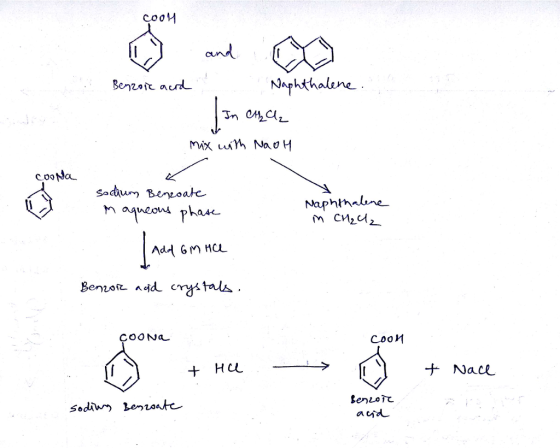
please provide an equation for the reaction of the aqueous layer with Hdl.
The following experiment was done:
add 1g of 1:1 mixture of benzoic acid and naphthalene. add 30 ml of
dichloromethane to dissolve. Add solution to a separatory funnel.
Add 15ml of NaOH, shake and separate the two layers.
with the aqueous layer, containing NaOH, combine 6M HCl until you have reached a pH of 2. ice to speed up the production of crystals.
Homework Answers
Add Answer to:
please provide an equation for the reaction of the
aqueous layer with Hdl.
The following experiment...
Draw the reaction mechanism with chemical structures in the separation of naphthalene and benzoic acid by...
Draw the reaction mechanism with chemical structures in the separation of naphthalene and benzoic acid by extraction. 1g of Naphthalene/benzoic acid mixture is dissolved in 15 mL dichloromethane, transferred to a separatory funnel where 10 mL 2.5M NaOH(aq) is added. Organic and Aqueous layers are separated, and 12M HCl(aq) is added to the aqueous layer while cooling, forming a precipitate, which is vacuum filtrated. Don't understand how to draw each chemical structure!
Would the methylene chloride layer be above or below the experiment? Justify your answer. 1. aqueous layer in today...
 Would the methylene chloride layer be above or below the experiment? Justify your answer. 1. aqueous layer in today's ium carbonate used in the isolation of caffeine? Be specific as to the 2. Why is potass chemical species the carbonate may act on. Why was sodium sulfate used? 3. 4. After introducing 1.0 g of potassium carbonate into the centri hot water extract, it was capped, shaken, and then cooled to room temperature. Following this, roug minute. Why wasn't the...
Experiment: A mixture of equal proportions of benzoic acid, ethyl 4-aminobenzoate, and 1,4-dimethoxybenzene are to be...
Experiment: A mixture of equal proportions of benzoic acid, ethyl 4-aminobenzoate, and 1,4-dimethoxybenzene are to be separated by extraction using the solvent diethyl ether. Day 1: Part A. Isolation of the basic component: In a small beaker, dissolve 3 g of the mixture (benzoic acid, ethyl 4-aminobenzoate, and 1,4-dimethoxybenzene) in 30 mL of diethyl ether and transfer the mixture to a 125- mL separatory funnel (see Fig. 1) using a little diethyl ether to complete the transfer. Add 10 mL...
The alcohol could easily be converted to a tosylate, a good leaving group, and a conventional sub...
 The alcohol could easily be converted to a tosylate, a good
leaving group, and a conventional substitution reaction could have
been performed instead of the nucleophilic aromatic substitution
(NAS) reaction. Why was the NAS reaction the preferred method?
(Hint : Look up the nucleophiles of both reactions on chemical
manufacturing site.)
Part A: Synthesis of (t)-N,N-dimethyl-3-phenyl-3-(4- trifluoromethylphenoxy)propanamine 1. To the 250-mL round-bottom flask (RBF) containing (t)-3-(dimethylamino)-1-phenylpropanol (product from Lab 6) and a magnetic stir bar, add 4 mL of 4-...
The alcohol could easily be converted to a tosylate, a good
leaving group, and a conventional substitution reaction could have
been performed instead of the nucleophilic aromatic substitution
(NAS) reaction. Why was the NAS reaction the preferred method?
(Hint : Look up the nucleophiles of both reactions on chemical
manufacturing site.)
Part A: Synthesis of (t)-N,N-dimethyl-3-phenyl-3-(4- trifluoromethylphenoxy)propanamine 1. To the 250-mL round-bottom flask (RBF) containing (t)-3-(dimethylamino)-1-phenylpropanol (product from Lab 6) and a magnetic stir bar, add 4 mL of 4-...
Extraction of solids: Experiment outlined below Draw a “roadmap” of the experiment, containing chemical structures and...
 Extraction of solids: Experiment outlined below
Draw a “roadmap” of the experiment, containing chemical
structures and “layers” (organic and aqueous). This should contain
the individual reactions occurring in each step, and show which
layer the various components are present. Make sure you think about
whether the acetaminophen, caffeine and aspirin are neutral,
protonated or deprotonated.
Preliminary separation obtain a sample (1.0g) of the mixture. weigh the sample and record it. this sample should consist of a 2:1:1 mixture (by mass)...
Extraction of solids: Experiment outlined below
Draw a “roadmap” of the experiment, containing chemical
structures and “layers” (organic and aqueous). This should contain
the individual reactions occurring in each step, and show which
layer the various components are present. Make sure you think about
whether the acetaminophen, caffeine and aspirin are neutral,
protonated or deprotonated.
Preliminary separation obtain a sample (1.0g) of the mixture. weigh the sample and record it. this sample should consist of a 2:1:1 mixture (by mass)...
we have 1.5 g final product for following experiment. how can I draw acid- base curve...
we have 1.5 g final product for following experiment. how can I draw acid- base curve for following experiment? Experimental procedure Weigh approximately 2.5 gof benzoic acid contaminated withtable salt (NaCl) as precisely as possible (record the exact quantity). Transfer the solid to a 100 mL separatory funnel and add 30 mL of ethyl acetate. In a 50 mL beaker, add 20 mL of water and 1.0 mL of 3 M hydrochloric acid. Transferthe mixtureto the separatory funnel. The solid...
How can the NMP oxalate salt be converted back to NMP? Here is the procedure: PROCEDURES...
How can the NMP oxalate salt be converted back to NMP? Here is the procedure: PROCEDURES Part A: Synthesis of (±)-N,N-dimethyl-3-phenyl-3-(4-trifluoromethylphenoxy)propanamine To the 250-mL round-bottom flask (RBF) containing (±)-3-(dimethylamino)-1-phenylpropanol (product from Lab 6) and a magnetic stir bar, add 4 mL of 4-chlorobenzotrifluoride and 30 mL of dimethylacetamide (DMA). With stirring, add to this mixture 30 mL of 1.0 M potassium tert-butoxide (caustic alkali!) in tert-butyl alcohol using a syringe. Using a simple distillation apparatus, distill the mixture slowly, with...
Propose another way of synthesizing NMP from the amino ketone hydrochloride salt starting materia...
 Propose another way of synthesizing NMP from the amino ketone
hydrochloride salt starting material you used.
Part A: Synthesis of (t)-N,N-dimethyl-3-phenyl-3-(4- trifluoromethylphenoxy)propanamine 1. To the 250-mL round-bottom flask (RBF) containing (t)-3-(dimethylamino)-1-phenylpropanol (product from Lab 6) and a magnetic stir bar, add 4 mL of 4- chlorobenzotrifluoride and 30 mL of dimethylacetamide (DMA) 2. With stirring, add to this mixture 30 mL of 1.0 M potassium tert-butoxide (caustic alkali!) in tert-butyl alcohol using a syringe 3. Using a simple distillation apparatus,...
Propose another way of synthesizing NMP from the amino ketone
hydrochloride salt starting material you used.
Part A: Synthesis of (t)-N,N-dimethyl-3-phenyl-3-(4- trifluoromethylphenoxy)propanamine 1. To the 250-mL round-bottom flask (RBF) containing (t)-3-(dimethylamino)-1-phenylpropanol (product from Lab 6) and a magnetic stir bar, add 4 mL of 4- chlorobenzotrifluoride and 30 mL of dimethylacetamide (DMA) 2. With stirring, add to this mixture 30 mL of 1.0 M potassium tert-butoxide (caustic alkali!) in tert-butyl alcohol using a syringe 3. Using a simple distillation apparatus,...
The alcohol could easily be converted to a tosylate, a good leaving group, and a conventional...
 The alcohol could easily be converted to a tosylate, a good
leaving group, and a conventional substitution reaction could have
been performed instead of the nucleophilic aromatic substitution
(NAS) reaction. Why was the NAS reaction the preferred method?
(Hint : Look up the nucleophiles of both reactions on chemical
manufacturing site.)
Part A: Synthesis of (t)-N,N-dimethyl-3-phenyl-3-(4- trifluoromethylphenoxy)propanamine 1. To the 250-mL round-bottom flask (RBF) containing (t)-3-(dimethylamino)-1-phenylpropanol (product from Lab 6) and a magnetic stir bar, add 4 mL of 4-...
The alcohol could easily be converted to a tosylate, a good
leaving group, and a conventional substitution reaction could have
been performed instead of the nucleophilic aromatic substitution
(NAS) reaction. Why was the NAS reaction the preferred method?
(Hint : Look up the nucleophiles of both reactions on chemical
manufacturing site.)
Part A: Synthesis of (t)-N,N-dimethyl-3-phenyl-3-(4- trifluoromethylphenoxy)propanamine 1. To the 250-mL round-bottom flask (RBF) containing (t)-3-(dimethylamino)-1-phenylpropanol (product from Lab 6) and a magnetic stir bar, add 4 mL of 4-...
In an experiment where you added 25 mL of a 3 M NaOH solution into a...
In an experiment where you added 25 mL of a 3 M NaOH solution into a separatory funnel containing a mixture of benzoic acid, toluene, and aniline dissolved in 25 mL of ethyl acetate, what would be in the top layer of the separatory funnel? In an experiment where you added 25 mL of a 3M HCl solution into a separatory funnel containing a mixture of benzoic acid, toluene, and aniline dissolved in 25 mL of ethyl acetate, what would...
 Would the methylene chloride layer be above or below the experiment? Justify your answer. 1. aqueous layer in today's ium carbonate used in the isolation of caffeine? Be specific as to the 2. Why is potass chemical species the carbonate may act on. Why was sodium sulfate used? 3. 4. After introducing 1.0 g of potassium carbonate into the centri hot water extract, it was capped, shaken, and then cooled to room temperature. Following this, roug minute. Why wasn't the...
 The alcohol could easily be converted to a tosylate, a good
leaving group, and a conventional substitution reaction could have
been performed instead of the nucleophilic aromatic substitution
(NAS) reaction. Why was the NAS reaction the preferred method?
(Hint : Look up the nucleophiles of both reactions on chemical
manufacturing site.)
Part A: Synthesis of (t)-N,N-dimethyl-3-phenyl-3-(4- trifluoromethylphenoxy)propanamine 1. To the 250-mL round-bottom flask (RBF) containing (t)-3-(dimethylamino)-1-phenylpropanol (product from Lab 6) and a magnetic stir bar, add 4 mL of 4-...
The alcohol could easily be converted to a tosylate, a good
leaving group, and a conventional substitution reaction could have
been performed instead of the nucleophilic aromatic substitution
(NAS) reaction. Why was the NAS reaction the preferred method?
(Hint : Look up the nucleophiles of both reactions on chemical
manufacturing site.)
Part A: Synthesis of (t)-N,N-dimethyl-3-phenyl-3-(4- trifluoromethylphenoxy)propanamine 1. To the 250-mL round-bottom flask (RBF) containing (t)-3-(dimethylamino)-1-phenylpropanol (product from Lab 6) and a magnetic stir bar, add 4 mL of 4-...
 Extraction of solids: Experiment outlined below
Draw a “roadmap” of the experiment, containing chemical
structures and “layers” (organic and aqueous). This should contain
the individual reactions occurring in each step, and show which
layer the various components are present. Make sure you think about
whether the acetaminophen, caffeine and aspirin are neutral,
protonated or deprotonated.
Preliminary separation obtain a sample (1.0g) of the mixture. weigh the sample and record it. this sample should consist of a 2:1:1 mixture (by mass)...
Extraction of solids: Experiment outlined below
Draw a “roadmap” of the experiment, containing chemical
structures and “layers” (organic and aqueous). This should contain
the individual reactions occurring in each step, and show which
layer the various components are present. Make sure you think about
whether the acetaminophen, caffeine and aspirin are neutral,
protonated or deprotonated.
Preliminary separation obtain a sample (1.0g) of the mixture. weigh the sample and record it. this sample should consist of a 2:1:1 mixture (by mass)...
 Propose another way of synthesizing NMP from the amino ketone
hydrochloride salt starting material you used.
Part A: Synthesis of (t)-N,N-dimethyl-3-phenyl-3-(4- trifluoromethylphenoxy)propanamine 1. To the 250-mL round-bottom flask (RBF) containing (t)-3-(dimethylamino)-1-phenylpropanol (product from Lab 6) and a magnetic stir bar, add 4 mL of 4- chlorobenzotrifluoride and 30 mL of dimethylacetamide (DMA) 2. With stirring, add to this mixture 30 mL of 1.0 M potassium tert-butoxide (caustic alkali!) in tert-butyl alcohol using a syringe 3. Using a simple distillation apparatus,...
Propose another way of synthesizing NMP from the amino ketone
hydrochloride salt starting material you used.
Part A: Synthesis of (t)-N,N-dimethyl-3-phenyl-3-(4- trifluoromethylphenoxy)propanamine 1. To the 250-mL round-bottom flask (RBF) containing (t)-3-(dimethylamino)-1-phenylpropanol (product from Lab 6) and a magnetic stir bar, add 4 mL of 4- chlorobenzotrifluoride and 30 mL of dimethylacetamide (DMA) 2. With stirring, add to this mixture 30 mL of 1.0 M potassium tert-butoxide (caustic alkali!) in tert-butyl alcohol using a syringe 3. Using a simple distillation apparatus,...
 The alcohol could easily be converted to a tosylate, a good
leaving group, and a conventional substitution reaction could have
been performed instead of the nucleophilic aromatic substitution
(NAS) reaction. Why was the NAS reaction the preferred method?
(Hint : Look up the nucleophiles of both reactions on chemical
manufacturing site.)
Part A: Synthesis of (t)-N,N-dimethyl-3-phenyl-3-(4- trifluoromethylphenoxy)propanamine 1. To the 250-mL round-bottom flask (RBF) containing (t)-3-(dimethylamino)-1-phenylpropanol (product from Lab 6) and a magnetic stir bar, add 4 mL of 4-...
The alcohol could easily be converted to a tosylate, a good
leaving group, and a conventional substitution reaction could have
been performed instead of the nucleophilic aromatic substitution
(NAS) reaction. Why was the NAS reaction the preferred method?
(Hint : Look up the nucleophiles of both reactions on chemical
manufacturing site.)
Part A: Synthesis of (t)-N,N-dimethyl-3-phenyl-3-(4- trifluoromethylphenoxy)propanamine 1. To the 250-mL round-bottom flask (RBF) containing (t)-3-(dimethylamino)-1-phenylpropanol (product from Lab 6) and a magnetic stir bar, add 4 mL of 4-...
Most questions answered within 3 hours.
-
Where is the error in this code sequence?
String s1 = "Hello";
String s2 = "ello";...
asked 10 months ago -
Financial data for Joel de Paris, Inc., for last year
follow:
Joel de Paris, Inc.
Balance...
asked 10 months ago -
Consider this reaction:
Al2(SO4)3 (aq)+ BaCl3
(aq) Al2Cl6 (aq)- +
3BaSO4(s) . What is the...
asked 10 months ago -
Suppose that Savneet is considering increasing her
recent random sample from 20 car rentals to 40...
asked 10 months ago -
Trucks arrive at an unloading terminal at an average rate of 120
per hour.
Trucks arrive...
asked 10 months ago -
Why are methanol and ethanol completely soluble in water while
octanol is not very little soluble....
asked 10 months ago -
A facilities manager at a university reads in a research report
that the mean amount of...
asked 10 months ago -
When the CuSO4 is rehydrated by adding water to the anhydrous
compound, is this an endothermic...
asked 10 months ago -
A ray of sunlight is passing from diamond into crown glass; the
angle of incidence is...
asked 10 months ago -
A block of mass 0.249 kg is placed on top of a light, vertical
spring of...
asked 10 months ago -
how do the kidneys compensate in the presences of acidosis
a) trigger hyperventilate
b) reserve acid...
asked 10 months ago -
Question 501 pts
The rental rate of capital to the firm increases. Which of the
following...
asked 10 months ago