Draw the reaction mechanism with chemical structures in the separation of naphthalene and benzoic acid by...
Draw the reaction mechanism with chemical structures in the separation of naphthalene and benzoic acid by extraction. 1g of Naphthalene/benzoic acid mixture is dissolved in 15 mL dichloromethane, transferred to a separatory funnel where 10 mL 2.5M NaOH(aq) is added. Organic and Aqueous layers are separated, and 12M HCl(aq) is added to the aqueous layer while cooling, forming a precipitate, which is vacuum filtrated. Don't understand how to draw each chemical structure!
Homework Answers
Benzoic acid and naphthalene are both organic moieties and are soluble in DCM.
On adding 10ml of NaOH, Benzoic acid reacts with NaOH and forms sodium benzoate and becomes water soluble. Hence on adding water, sodium benzoate moves to aqueous layer leaving naphthalene in organic layer.
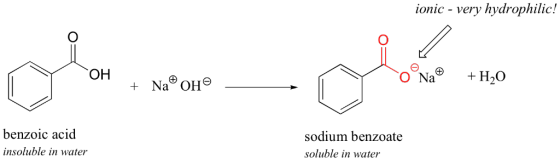
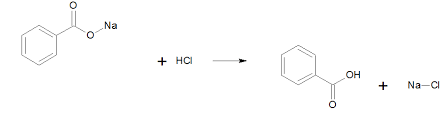
The layers are separated in separating funnel and then on adding HCl sodium benzoate forms benzoic acid and becomes hydrophobic and gets precipitated as benzoic acid crystals.
Add Answer to:
Draw the reaction mechanism with chemical structures in the
separation of naphthalene and benzoic acid by...
please provide an equation for the reaction of the aqueous layer with Hdl. The following experiment...
please provide an equation for the reaction of the aqueous layer with Hdl. The following experiment was done: add 1g of 1:1 mixture of benzoic acid and naphthalene. add 30 ml of dichloromethane to dissolve. Add solution to a separatory funnel. Add 15ml of NaOH, shake and separate the two layers. with the aqueous layer, containing NaOH, combine 6M HCl until you have reached a pH of 2. ice to speed up the production of crystals.
Draw an extraction flow chart for the Extraction experiment you completed. experiment below Separation of a...
Draw an extraction flow chart for the Extraction experiment you completed. experiment below Separation of a Benzoic Acid/Biphenyl Mixture by Acid-Base Extraction Prepare the solution to be extracted by dissolving 2.5 g of a 1:1 mixture of benzoic acid/ biphenyl in 25 mL of tert-butyl methyl ether (MTBE) . Using a 125 mL separatory funnel extract the ether solution with a mixture containing 10 mL of distilled water and 15 mL of saturated NaHCO3 . Repeat After removing the aqueous...
Extraction of solids: Experiment outlined below Draw a “roadmap” of the experiment, containing chemical structures and...
 Extraction of solids: Experiment outlined below
Draw a “roadmap” of the experiment, containing chemical
structures and “layers” (organic and aqueous). This should contain
the individual reactions occurring in each step, and show which
layer the various components are present. Make sure you think about
whether the acetaminophen, caffeine and aspirin are neutral,
protonated or deprotonated.
Preliminary separation obtain a sample (1.0g) of the mixture. weigh the sample and record it. this sample should consist of a 2:1:1 mixture (by mass)...
Extraction of solids: Experiment outlined below
Draw a “roadmap” of the experiment, containing chemical
structures and “layers” (organic and aqueous). This should contain
the individual reactions occurring in each step, and show which
layer the various components are present. Make sure you think about
whether the acetaminophen, caffeine and aspirin are neutral,
protonated or deprotonated.
Preliminary separation obtain a sample (1.0g) of the mixture. weigh the sample and record it. this sample should consist of a 2:1:1 mixture (by mass)...
azobenzene m-nitroaniline benzoic acid dichloromethane 2xIM HC1 (20 mL) extraction and separation upper aqueous layer lower...
 azobenzene m-nitroaniline benzoic acid dichloromethane 2xIM HC1 (20 mL) extraction and separation upper aqueous layer lower organic layer azobenzene benzoic acid m-nitroaniline chloride, water extraction and separation lower organic layer upper aqueous layer
In Exp #2 you added NaOH(aq) to the separatory funnel which contained benzoic acid and naphthalene...
In Exp #2 you added NaOH(aq) to the separatory funnel which contained benzoic acid and naphthalene in dichloromethane. Explain the important process that happened at the molecular level and bulk level in this step. Include solubility considerations in your answer. Give your best answer in four sentences or less.
The Separation of Three Organic Compounds by Acid, Base Reactions and Liquid, Liquid Extraction. Okay, so...
The Separation of Three Organic Compounds by Acid, Base Reactions and Liquid, Liquid Extraction. Okay, so we had solid benzoic acid, ethyl 4- aminobenzoate, and 9-fluorenone all dissolved in diethyl ether. We separated the basic component by adding 3M HCl, we separated the acidic component by adding 3M NaOH. I don't understand what happens here. To isolate the acidic solution, we added 6 M NaOH and used the vacuum to recover the solid. To isolate the basic solution we added...
The Separation of Three Organic Compounds by Acid, Base Reactions and Liquid, Liquid Extraction. Okay, so...
The Separation of Three Organic Compounds by Acid, Base Reactions and Liquid, Liquid Extraction. Okay, so we had solid benzoic acid, ethyl 4- aminobenzoate, and 9-fluorenone all dissolved in methyleene chloride. We separated the basic component by adding 3M HCl, we separated the acidic component by adding 3M NaOH. I don't understand what happens here. To isolate the acidic solution, we added 6 M NaOH and used the vacuum to recover the solid. To isolate the basic solution we added...
Draw a flowchart for the flowing extraction: When the residual magnesium has all dissolved, transfer the...
Draw a flowchart for the flowing extraction: When the residual magnesium has all dissolved, transfer the mixture to a separatory funnel and separate the layers [Technique 10.3]. Keep both layers. Return the aqueous layer to the funnel and extract it twice with 25-mL portions of ether. Combine the two ether extracts with the ether layer from the first separation and dry the combined ether solution with anhydrous potassium carbonate. Set the aqueous layer aside for later neutralization.
Draw a flow chart to show the separation of these compounds by extraction : Dichloromethane, benzoic...
Draw a flow chart to show the separation of these compounds by extraction : Dichloromethane, benzoic acid, and naphthalene. Then discuss and identify the isolation mechanism (in the form of equations showing the actual structures) for naphthalene (with general discussion on solubility) Organics Extraction lab question
Experiment: A mixture of equal proportions of benzoic acid, ethyl 4-aminobenzoate, and 1,4-dimethoxybenzene are to be...
Experiment: A mixture of equal proportions of benzoic acid, ethyl 4-aminobenzoate, and 1,4-dimethoxybenzene are to be separated by extraction using the solvent diethyl ether. Day 1: Part A. Isolation of the basic component: In a small beaker, dissolve 3 g of the mixture (benzoic acid, ethyl 4-aminobenzoate, and 1,4-dimethoxybenzene) in 30 mL of diethyl ether and transfer the mixture to a 125- mL separatory funnel (see Fig. 1) using a little diethyl ether to complete the transfer. Add 10 mL...
 Extraction of solids: Experiment outlined below
Draw a “roadmap” of the experiment, containing chemical
structures and “layers” (organic and aqueous). This should contain
the individual reactions occurring in each step, and show which
layer the various components are present. Make sure you think about
whether the acetaminophen, caffeine and aspirin are neutral,
protonated or deprotonated.
Preliminary separation obtain a sample (1.0g) of the mixture. weigh the sample and record it. this sample should consist of a 2:1:1 mixture (by mass)...
Extraction of solids: Experiment outlined below
Draw a “roadmap” of the experiment, containing chemical
structures and “layers” (organic and aqueous). This should contain
the individual reactions occurring in each step, and show which
layer the various components are present. Make sure you think about
whether the acetaminophen, caffeine and aspirin are neutral,
protonated or deprotonated.
Preliminary separation obtain a sample (1.0g) of the mixture. weigh the sample and record it. this sample should consist of a 2:1:1 mixture (by mass)...
 azobenzene m-nitroaniline benzoic acid dichloromethane 2xIM HC1 (20 mL) extraction and separation upper aqueous layer lower organic layer azobenzene benzoic acid m-nitroaniline chloride, water extraction and separation lower organic layer upper aqueous layer
Most questions answered within 3 hours.
-
Where is the error in this code sequence?
String s1 = "Hello";
String s2 = "ello";...
asked 11 months ago -
Financial data for Joel de Paris, Inc., for last year
follow:
Joel de Paris, Inc.
Balance...
asked 11 months ago -
Consider this reaction:
Al2(SO4)3 (aq)+ BaCl3
(aq) Al2Cl6 (aq)- +
3BaSO4(s) . What is the...
asked 11 months ago -
Suppose that Savneet is considering increasing her
recent random sample from 20 car rentals to 40...
asked 11 months ago -
Trucks arrive at an unloading terminal at an average rate of 120
per hour.
Trucks arrive...
asked 11 months ago -
Why are methanol and ethanol completely soluble in water while
octanol is not very little soluble....
asked 11 months ago -
A facilities manager at a university reads in a research report
that the mean amount of...
asked 11 months ago -
When the CuSO4 is rehydrated by adding water to the anhydrous
compound, is this an endothermic...
asked 11 months ago -
A ray of sunlight is passing from diamond into crown glass; the
angle of incidence is...
asked 11 months ago -
A block of mass 0.249 kg is placed on top of a light, vertical
spring of...
asked 11 months ago -
how do the kidneys compensate in the presences of acidosis
a) trigger hyperventilate
b) reserve acid...
asked 11 months ago -
Question 501 pts
The rental rate of capital to the firm increases. Which of the
following...
asked 11 months ago