Describe the differences seen in the alteration of generations between gymnosperms, angiosperms and nonvascular plants.
Describe the differences seen in the alteration of generations between gymnosperms, angiosperms and nonvascular plants.
Homework Answers
Alternation of generation contains two phases, diploid sporophytic stage and haploid gametophytic stage. In non-vascular plants like mosses (bryophytes), the haploid gametophytic stage is the dominant stage. On the other hand, in vascular plants like gymnosperms and angiosperms the diploid sporophytic stage is the dominant stage.
In gymnosperms, sporophyte grows in association with gametophyte, means sporophyte is totally dependent on gametophytes. On the other hand, in gymnosperms and angiosperms, sporophyte is independent of gametophyte.
In gymnosperms, self-fertilization is common whereas in vascular plants, cross fertilization is more common.
Add Answer to:
Describe the differences seen in the alteration of generations
between gymnosperms, angiosperms and nonvascular plants.
Describe the major differences and similarities between gymnosperms and angiosperms.
Describe the major differences and similarities between gymnosperms and angiosperms.
"Describe the 5 major TRENDS in the evolution of land plants; from Bryophytes to Gymnosperms/Angiosperms, AND...
"Describe the 5 major TRENDS in the evolution of land plants; from Bryophytes to Gymnosperms/Angiosperms, AND explain how these trends contribute to success."I am answering questions for my college biology class (second semester of Biology for science majors). We are doing our Plant Diversity II lab. These evolutionary trends are DIFFERENT from the five uniquely derived traits of land plants according to my lab teacher, which based on what I think I know are: 1. Alternation of generations 2. multicellular,...
In which plants--mosses, ferns, gymnosperms, and/or angiosperms--is the sporophyte generation dominant (i.e., the most recognizable form)?...
In which plants--mosses, ferns, gymnosperms, and/or angiosperms--is the sporophyte generation dominant (i.e., the most recognizable form)? Where is the gametophyte found in these plants?
In which plants--mosses, ferns, gymnosperms, and/or angiosperms--is the gametophyte generation dominant (i.e., the most recognizable form)?...
In which plants--mosses, ferns, gymnosperms, and/or angiosperms--is the gametophyte generation dominant (i.e., the most recognizable form)? Where is the sporophyte found in these plants?
Plants Lycophyte Angiosperms Bryophyte Charophytes Gymnosperms 106. 107. 108. Embryos 109. Vascular Seeds 110. Flowers
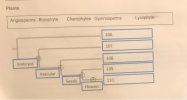 Plants Lycophyte Angiosperms Bryophyte Charophytes Gymnosperms 106. 107. 108. Embryos 109. Vascular Seeds 110. Flowers
1. Name the closest relatives to the land plants. 2. List advantages and problems faced by...
1. Name the closest relatives to the land plants. 2. List advantages and problems faced by early plants when they started colonizing terrestrial habitats. 3. List all the similarities that all current land plants share with charophytes. What distinguishes modern plants from charophytes? 4. Plants can be classified based on the presence or absence of___________________. Nonvascular plants are called…… 5. Which form dominates the nonvascular plant life cycle? Which form is dominant for vascular plants? 6. Which additional characteristics are...
A. What is meant by the statement that plants undergo an alternation of generations? B. In...
A. What is meant by the statement that plants undergo an alternation of generations? B. In a typical multicellular plant, are the alternating generations equivalent or does one dominate over the other? Using mosses and angiosperms as examples, briefly describe how the dominant generation has changed during plant evolution.
please answers these 6 questions with readable handwriting and in a good explanations 1. Describe the broad evolution of plants in the plant kingdom (in terms of phylogeny, reproduction, alternati...
 please answers these 6 questions with readable
handwriting and in a good explanations
1. Describe the broad evolution of plants in the plant kingdom (in terms of phylogeny, reproduction, alternation of generations, leaf modifications, and vascularity) 2. Compare and contrast microsporogenesis and microgametogenesis in Pinus and angiosperms). You must use, but are not limited to, the following terms: anther, microsporangia, generative cell, microsporocytes, megasporocyte microspores, pollen sacs, pollen grain, sperm, tube cell, 3. Compare and contrast megasporogenesis and megagametogenesis in...
please answers these 6 questions with readable
handwriting and in a good explanations
1. Describe the broad evolution of plants in the plant kingdom (in terms of phylogeny, reproduction, alternation of generations, leaf modifications, and vascularity) 2. Compare and contrast microsporogenesis and microgametogenesis in Pinus and angiosperms). You must use, but are not limited to, the following terms: anther, microsporangia, generative cell, microsporocytes, megasporocyte microspores, pollen sacs, pollen grain, sperm, tube cell, 3. Compare and contrast megasporogenesis and megagametogenesis in...
Describe the procedures described throughout this laborotory activity: 10.1 Flowers external: 10 Seed Plants II: Angiosperms...
 Describe the procedures described throughout this laborotory
activity:
10.1 Flowers external:
10 Seed Plants II: Angiosperms After completing this exercise, you will be able to 1. define heterosporous, angiosperm, fruit, pollination, double fertiliation, endosperm, aeed, germina tion, annual, biennial, perennial 2. describe the significanceo 3. identify the structures of the flower: 4. recognize the structures and events (those in boldface) that take place in angiosperm reproduction; 5. describe the origin and function of fruit and seed; 6. identify the characteristics...
Describe the procedures described throughout this laborotory
activity:
10.1 Flowers external:
10 Seed Plants II: Angiosperms After completing this exercise, you will be able to 1. define heterosporous, angiosperm, fruit, pollination, double fertiliation, endosperm, aeed, germina tion, annual, biennial, perennial 2. describe the significanceo 3. identify the structures of the flower: 4. recognize the structures and events (those in boldface) that take place in angiosperm reproduction; 5. describe the origin and function of fruit and seed; 6. identify the characteristics...
QUESTION 50 Which of the following is SHARED between Gymnosperms and Angiosperms? Both clades make pollen...
QUESTION 50 Which of the following is SHARED between Gymnosperms and Angiosperms? Both clades make pollen grains that grow pollen tubes into ovules for fertilization. Both clades utilize cones to store and protect developing seeds. Both clades currently have approximately the same number of species on the planet. Both clades have an extra layer of ovary tissue surrounding the ovule. None of the above. With regard to moving materials throughout plants, the Xylem conducts ___________. Xylem tissue is composed of...
 Plants Lycophyte Angiosperms Bryophyte Charophytes Gymnosperms 106. 107. 108. Embryos 109. Vascular Seeds 110. Flowers
 please answers these 6 questions with readable
handwriting and in a good explanations
1. Describe the broad evolution of plants in the plant kingdom (in terms of phylogeny, reproduction, alternation of generations, leaf modifications, and vascularity) 2. Compare and contrast microsporogenesis and microgametogenesis in Pinus and angiosperms). You must use, but are not limited to, the following terms: anther, microsporangia, generative cell, microsporocytes, megasporocyte microspores, pollen sacs, pollen grain, sperm, tube cell, 3. Compare and contrast megasporogenesis and megagametogenesis in...
please answers these 6 questions with readable
handwriting and in a good explanations
1. Describe the broad evolution of plants in the plant kingdom (in terms of phylogeny, reproduction, alternation of generations, leaf modifications, and vascularity) 2. Compare and contrast microsporogenesis and microgametogenesis in Pinus and angiosperms). You must use, but are not limited to, the following terms: anther, microsporangia, generative cell, microsporocytes, megasporocyte microspores, pollen sacs, pollen grain, sperm, tube cell, 3. Compare and contrast megasporogenesis and megagametogenesis in...
 Describe the procedures described throughout this laborotory
activity:
10.1 Flowers external:
10 Seed Plants II: Angiosperms After completing this exercise, you will be able to 1. define heterosporous, angiosperm, fruit, pollination, double fertiliation, endosperm, aeed, germina tion, annual, biennial, perennial 2. describe the significanceo 3. identify the structures of the flower: 4. recognize the structures and events (those in boldface) that take place in angiosperm reproduction; 5. describe the origin and function of fruit and seed; 6. identify the characteristics...
Describe the procedures described throughout this laborotory
activity:
10.1 Flowers external:
10 Seed Plants II: Angiosperms After completing this exercise, you will be able to 1. define heterosporous, angiosperm, fruit, pollination, double fertiliation, endosperm, aeed, germina tion, annual, biennial, perennial 2. describe the significanceo 3. identify the structures of the flower: 4. recognize the structures and events (those in boldface) that take place in angiosperm reproduction; 5. describe the origin and function of fruit and seed; 6. identify the characteristics...
Most questions answered within 3 hours.
-
Where is the error in this code sequence?
String s1 = "Hello";
String s2 = "ello";...
asked 10 months ago -
Financial data for Joel de Paris, Inc., for last year
follow:
Joel de Paris, Inc.
Balance...
asked 10 months ago -
Consider this reaction:
Al2(SO4)3 (aq)+ BaCl3
(aq) Al2Cl6 (aq)- +
3BaSO4(s) . What is the...
asked 10 months ago -
Suppose that Savneet is considering increasing her
recent random sample from 20 car rentals to 40...
asked 10 months ago -
Trucks arrive at an unloading terminal at an average rate of 120
per hour.
Trucks arrive...
asked 10 months ago -
Why are methanol and ethanol completely soluble in water while
octanol is not very little soluble....
asked 10 months ago -
A facilities manager at a university reads in a research report
that the mean amount of...
asked 10 months ago -
When the CuSO4 is rehydrated by adding water to the anhydrous
compound, is this an endothermic...
asked 10 months ago -
A ray of sunlight is passing from diamond into crown glass; the
angle of incidence is...
asked 10 months ago -
A block of mass 0.249 kg is placed on top of a light, vertical
spring of...
asked 10 months ago -
how do the kidneys compensate in the presences of acidosis
a) trigger hyperventilate
b) reserve acid...
asked 10 months ago -
Question 501 pts
The rental rate of capital to the firm increases. Which of the
following...
asked 10 months ago