Tay-Sachs disease is an autosomal recessive disorder. Among Ashkenazi Jews of central European ancestry about in...
Tay-Sachs disease is an autosomal recessive disorder. Among Ashkenazi Jews of central European ancestry about in 1/3600 children are born with Tay-Sachs disease. What is the frequency for being a carrier for Tay-Sachs in this population? A carrier does not show the trait but can pass it on to his/her offspring.
Homework Answers
 hope
it helps.
hope
it helps.
Add Answer to:
Tay-Sachs disease is an autosomal recessive disorder. Among
Ashkenazi Jews of central European ancestry about in...
The incidence of Tay Sachs, an autosomal recessive genetic disorder, is approximately 1 in 3,500 in...
 The incidence of Tay Sachs, an autosomal recessive genetic
disorder, is approximately 1 in 3,500 in a certain population of
Ashkenazi Jews. Assuming Hardy-Weinberg equilibrium, what is the
frequency of carriers for the Tay Sachs allele in this
population?
The incidence of Tay Sachs, an autosomal recessive genetic disorder, is approximately 1 in 3,500 in a certain population of Ashkenazi Jews. Assuming Hardy-Weinberg equilibrium, what is the frequency of carriers for the Tay Sachs allele in this population? OOO 98.5%...
The incidence of Tay Sachs, an autosomal recessive genetic
disorder, is approximately 1 in 3,500 in a certain population of
Ashkenazi Jews. Assuming Hardy-Weinberg equilibrium, what is the
frequency of carriers for the Tay Sachs allele in this
population?
The incidence of Tay Sachs, an autosomal recessive genetic disorder, is approximately 1 in 3,500 in a certain population of Ashkenazi Jews. Assuming Hardy-Weinberg equilibrium, what is the frequency of carriers for the Tay Sachs allele in this population? OOO 98.5%...
2) Tay-Sachs disease is an autosomal recessive neurological disorder that is fatal in infancy. Despite its...
2) Tay-Sachs disease is an autosomal recessive neurological disorder that is fatal in infancy. Despite its invariably lethal effect, Tay-Sachs disease occurs at very high frequency in some Central and Eastern European (Ashkenazi) Jewish populations. In certain Ashkenazi populations, 1 in 1000 infants has Tay-Sachs disease. Population biologists believe the high frequency is a consequence of genetic bottlenecks caused by pogroms (genocide) that have reduced the population multiple times in the last several hundred years. a) In the population described,...
Give the Hardy–Weinberg expected genotypic frequencies for an autosomal locus with three alleles, where the frequencies...
Give the Hardy–Weinberg expected genotypic frequencies for an autosomal locus with three alleles, where the frequencies of alleles A1, A2, and A3 are defined as p, q, and r, respectively. Set the problem up and show your work. Tay–Sachs disease is an autosomal recessive disorder. Among Ashkenazi Jews, the frequency of Tay–Sachs disease is 1 in 3600. If the Ashkenazi population is mating randomly for the Tay–Sachs gene, what proportion of the population consists of heterozygous carriers of the Tay–Sachs...
9 % of a small sect are born with the lethal autosomal recessive trait of Tay-Sachs...
 9 % of a small sect are born with the lethal autosomal recessive trait of Tay-Sachs - 1. What is the frequency of the recessive gene in this population? -2. What is the frequency of the dominant gene? -3. What is the frequency of the heterozyous in this population? -4-5. What is the probability that the first born child of a healthy couple who are members of the sect, will have Tay-Sachs?
6.Tay-Sachs disease is an autosomal recessive disorder that causes degeneration of nerve tissue in infants. Infants...
6.Tay-Sachs disease is an autosomal recessive disorder that causes degeneration of nerve tissue in infants. Infants with Tay-Sachs disease develop blindness, paralysis, and die at an early age. The gene for this disorder is located on chromosome 15. Sickle cell anemia is another autosomal recessive disorder. A person who is homozygous recessive for the sickle cell allele will have an abnormal hemoglobin protein which causes the red blood cells to have a sickle shape. The misshapen blood cells block capillaries...
16.Tay-Sachs is an autosomal recessive disease. A couple (Jack & Jill) is worried about having a...
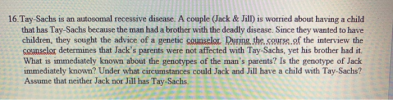 16.Tay-Sachs is an autosomal recessive disease. A couple (Jack & Jill) is worried about having a child that has Tay-Sachs because the man had a brother with the deadly disease. Since they wanted to have children, they sought the advice of a genetic counselor. During the course of the interview the sounselor determines that Jack's parents were not affected with Tay-Sachs, yet his brother had it. What is immediately known about the genotypes of the man's parents? Is the genotype...
Tay-Sachs Disease is an autosomal recessive disease. That means that it is carried on one of...
Tay-Sachs Disease is an autosomal recessive disease. That means that it is carried on one of the autosomal chromosomes and that only individuals with the two recessive disease alleles will have the disease phenotype. John and Sue are both carriers of the disease. Use the letters T and t to represent alleles. a.) What is John’s genotype? b.)Sue’s genotype? c.) What percentage of their children would you predict to have Tay-Sachs Disease? Show your work with a Punnett square.
Tay-Sachs disease is an autosomal recessive disorder caused by a mutation in the HEXA gene that...
Tay-Sachs disease is an autosomal recessive disorder caused by a mutation in the HEXA gene that results in progressive deterioration of the nervous system. Affected indivisuals usually die by age 4. Let D represent the wildtype allele and d the disease-causing allele. Because the Tay-Sachs disease allele has been observed at relatively high frequencies in several human populations, it has ocassionally been suggested that this locus may be subject to balancing selection due to heterozygote advantage. Here we will explore...
BATO manner. This diseaSe is inherited in an autosomal recessive (15 pts) Tay-Sachs disease is a...
 BATO manner. This diseaSe is inherited in an autosomal recessive (15 pts) Tay-Sachs disease is a mutation in the HEXA gene, resulting in low EXA gene, resulting in low level of the enzyme hexosaminidase A. Tay-Sachs abilities and results in death by the disease causes deterioration of mental and physical age of four. e in which a family member (shaded) died from Tay-Sachs disease. n she had a blood finds that she is a carrier for Tay-Sachs disease whe Individual...
Please provide answers with explanations for these questions. 1. Tay Sachs disease is an inherited disorder....
 Please provide answers with explanations for these
questions.
1. Tay Sachs disease is an inherited disorder. Children who are born with Tay Sachs have progressive neurological problems and typically die before age 4. It is inherited in an autosomal recessive manner Below are pedigrees from two families where some members of a family have Tay Sachs disease. Neither Hillary nor Justin have Tay Sachs disease. If Hillary and Justin have a child, what is the chance this child will have...
Please provide answers with explanations for these
questions.
1. Tay Sachs disease is an inherited disorder. Children who are born with Tay Sachs have progressive neurological problems and typically die before age 4. It is inherited in an autosomal recessive manner Below are pedigrees from two families where some members of a family have Tay Sachs disease. Neither Hillary nor Justin have Tay Sachs disease. If Hillary and Justin have a child, what is the chance this child will have...
 The incidence of Tay Sachs, an autosomal recessive genetic
disorder, is approximately 1 in 3,500 in a certain population of
Ashkenazi Jews. Assuming Hardy-Weinberg equilibrium, what is the
frequency of carriers for the Tay Sachs allele in this
population?
The incidence of Tay Sachs, an autosomal recessive genetic disorder, is approximately 1 in 3,500 in a certain population of Ashkenazi Jews. Assuming Hardy-Weinberg equilibrium, what is the frequency of carriers for the Tay Sachs allele in this population? OOO 98.5%...
The incidence of Tay Sachs, an autosomal recessive genetic
disorder, is approximately 1 in 3,500 in a certain population of
Ashkenazi Jews. Assuming Hardy-Weinberg equilibrium, what is the
frequency of carriers for the Tay Sachs allele in this
population?
The incidence of Tay Sachs, an autosomal recessive genetic disorder, is approximately 1 in 3,500 in a certain population of Ashkenazi Jews. Assuming Hardy-Weinberg equilibrium, what is the frequency of carriers for the Tay Sachs allele in this population? OOO 98.5%...
 9 % of a small sect are born with the lethal autosomal recessive trait of Tay-Sachs - 1. What is the frequency of the recessive gene in this population? -2. What is the frequency of the dominant gene? -3. What is the frequency of the heterozyous in this population? -4-5. What is the probability that the first born child of a healthy couple who are members of the sect, will have Tay-Sachs?
 16.Tay-Sachs is an autosomal recessive disease. A couple (Jack & Jill) is worried about having a child that has Tay-Sachs because the man had a brother with the deadly disease. Since they wanted to have children, they sought the advice of a genetic counselor. During the course of the interview the sounselor determines that Jack's parents were not affected with Tay-Sachs, yet his brother had it. What is immediately known about the genotypes of the man's parents? Is the genotype...
 BATO manner. This diseaSe is inherited in an autosomal recessive (15 pts) Tay-Sachs disease is a mutation in the HEXA gene, resulting in low EXA gene, resulting in low level of the enzyme hexosaminidase A. Tay-Sachs abilities and results in death by the disease causes deterioration of mental and physical age of four. e in which a family member (shaded) died from Tay-Sachs disease. n she had a blood finds that she is a carrier for Tay-Sachs disease whe Individual...
 Please provide answers with explanations for these
questions.
1. Tay Sachs disease is an inherited disorder. Children who are born with Tay Sachs have progressive neurological problems and typically die before age 4. It is inherited in an autosomal recessive manner Below are pedigrees from two families where some members of a family have Tay Sachs disease. Neither Hillary nor Justin have Tay Sachs disease. If Hillary and Justin have a child, what is the chance this child will have...
Please provide answers with explanations for these
questions.
1. Tay Sachs disease is an inherited disorder. Children who are born with Tay Sachs have progressive neurological problems and typically die before age 4. It is inherited in an autosomal recessive manner Below are pedigrees from two families where some members of a family have Tay Sachs disease. Neither Hillary nor Justin have Tay Sachs disease. If Hillary and Justin have a child, what is the chance this child will have...
Most questions answered within 3 hours.
-
Where is the error in this code sequence?
String s1 = "Hello";
String s2 = "ello";...
asked 10 months ago -
Financial data for Joel de Paris, Inc., for last year
follow:
Joel de Paris, Inc.
Balance...
asked 10 months ago -
Consider this reaction:
Al2(SO4)3 (aq)+ BaCl3
(aq) Al2Cl6 (aq)- +
3BaSO4(s) . What is the...
asked 10 months ago -
Suppose that Savneet is considering increasing her
recent random sample from 20 car rentals to 40...
asked 11 months ago -
Trucks arrive at an unloading terminal at an average rate of 120
per hour.
Trucks arrive...
asked 11 months ago -
Why are methanol and ethanol completely soluble in water while
octanol is not very little soluble....
asked 11 months ago -
A facilities manager at a university reads in a research report
that the mean amount of...
asked 11 months ago -
When the CuSO4 is rehydrated by adding water to the anhydrous
compound, is this an endothermic...
asked 11 months ago -
A ray of sunlight is passing from diamond into crown glass; the
angle of incidence is...
asked 11 months ago -
A block of mass 0.249 kg is placed on top of a light, vertical
spring of...
asked 11 months ago -
how do the kidneys compensate in the presences of acidosis
a) trigger hyperventilate
b) reserve acid...
asked 11 months ago -
Question 501 pts
The rental rate of capital to the firm increases. Which of the
following...
asked 11 months ago