Basic logic of natural selection and how scientists test hypotheses of natural selection
Basic logic of natural selection and how scientists test hypotheses of natural selection
Homework Answers
Basic logic of Natural Selection :-
Natural Selection based on four characteristics of living systems.
1. Variation :- every organism has unique features that's the reason behind individuals in a population vary from one another.
2. Inheritance :- Traits (genotypes and phenotypes) can passes through one generation to next generation (like parents to offsprings)
3.Selection :- some variants reproduce more than others which makes them beneficial during Natural Selection.
Those organism reproduced most with the suitable traits which are favourable to environment ,survived most due to natural selection.The higher the reproduction rate of a population, the higher the competitive pressure is on an individual to survive. This pressure ensures that only the most suitable members survive while the weaker members perish.
Adaptation
A characteristic that is genetically controlled; increases an
organisms chance of survival.
4.Time:- successful variations accumulate over many generations.
Darwin's model of evolution by natural selection allowed him to explain the patterns he had seen during his travels. For example, if the Galapagos finch species shared an common ancestor, it made sense that they should broadly resemble one another (and mainland finches, who likely shared that common ancestor). If groups of finches had been isolated on separate islands for many generations, however, each group would have been exposed to a different environment in which different heritable traits might have been favored, such as different sizes and shapes of beaks for using different food sources. These factors could have led to the formation of distinct species on each island.
Natural selection is a best example for explanation of how evolution happened and various examples prove that it is an important force controlling evolution.
Example :- polar bear. They hunt in the snowy arctic; they sneak up on their prey; and they are, after all, white. Thus they appear to be well adapted to their environment. White Polar bear survived easily in the snowy arctic region.
Many times of history of life mass extinction have occurred.
Such a mass extinction ended the 'dinosaurs' species at the end of the Cretaceous Period.Dinosaurs were large and dominated the world, whereas mammals were small and nocturnal, sneaking around in the dinosaurs' world. It was not until the dinosaurs went extinct that the mammals could take over and flourish. The mechanism that caused this extinction was a massive asteroid striking the Earth. This example shows that natural selection alone is not sufficient to explain the history of life. No matter how well adapted an animal is, it may not survive always.
Let's take a simple hypothetical example for understand the natural selection clearly.
A group of rabbits with heritable variation in fur color (white
vs. grey) has just moved into a new area where the rocks are grey.
This environment features hawks, which like to eat rabbits and can
see the white ones more easily than the grey ones against the grey
rock.
Because the hawks can see and catch the white rabbits more easily,
a relatively large fraction of the white rabbits are eaten, while a
much smaller fraction of the grey rabbits are eaten. The ratio of
white to grey in the surviving ("not-eaten") group, it will be
higher than in the starting population.Fur color is a heritable
trait (one that can be passed from parent to child).
Survival of More number of grey rabbits tend to increase more number of grey rabbits in next generation.After several generations of selection, the population might be made up almost entirely of grey one. This is an example of natural selection during evolution.
Above examples concluded that , natural selection not favoured that inherited traits those are superior than others instead of it favoured those Traits which are beneficial for survival the organism and reproduced more .
In the example of Darwin's finches, observed that groups in a single population may become isolated from one another by geographical barriers, such as ocean surrounding islands, or by other mechanisms. Once isolated, the groups can no longer interbreed and are exposed to different environments. In each environment, natural selection is likely to favour different traits (and other evolutionary forces, such as random drift, may also operate separately on the groups). Over many generations, differences in heritable traits can accumulate between the groups, to the extent that they are considered separate species.
Based on various evidence, scientists think that this type of process has repeated frequently during the history of life on Earth. Evolution by natural selection and other mechanisms underlies the distinct diversity of present-day life forms, and the action of natural selection can explain the fit between present-time organisms and their environments.
Add Answer to:
Basic logic of natural selection and how scientists test
hypotheses of natural selection
What is the basic idea of natural selection? What is evolutionary adaption? Describe the five types...
What is the basic idea of natural selection? What is evolutionary adaption? Describe the five types of evidence of evolution. Click or tap here to enter text. Click or tap here to enter text. Click or tap here to enter text. Click or tap here to enter text. Click or tap here to enter text. What kinds of adaptations did Darwin observe in the Galápagos finches? What are the two observations that formed that basis of Darwin’s theory of natural...
Questino 7. How I genetic drift different from natural selection? A. Natural Selection occurs because some...
Questino 7. How I genetic drift different from natural selection? A. Natural Selection occurs because some alleles confer higher fitness, whereas genetic drift occurs because of sampling error. B. Natural selection has a stronger effect in large population, whereas genetic drift acts primarily in small populations. C. Natural selection is a mechanism of evoltion, whereas genetic drift is not a mechnaism but an outcome of evolution. D. Natrual selection tends to cause very rapid evolution whereas gentic drift tends to...
Describe the four basic causes of evolution: natural selection, mutation, genetic drift, and gene flow. The...
Describe the four basic causes of evolution: natural selection, mutation, genetic drift, and gene flow. The paper should be 400- 500 words (~ 1 double-spaced, APA formatted page). Refer to the attached document for the grading rubric.
Define natural selection. What is the essential difference between natural selection and the selection practiced by...
Define natural selection. What is the essential difference between natural selection and the selection practiced by plant and animal breeders? What special adaptive challenges are posed by variable environments? What are the major factors that constrain the process of natural selection?
How is sexual selection different from natural selection, and why are the reproductive strategies of males...
How is sexual selection different from natural selection, and why are the reproductive strategies of males and females different?
1. Describe how the process of natural selection works, and how it results in adaptations (Darwin's...
1. Describe how the process of natural selection works, and how it results in adaptations (Darwin's Observations and Conclusions) • How does unequal reproductive success lead to natural selection? What are adaptations? Explain Darwin’s observations and conclusions. • Describe evolution by natural selection? What are some important points about evolution? 2. Describe examples of and evidence for evolution by natural selection that can be seen in your daily life. 3. Discuss the different kinds of evidence that support the theory...
How does transgenerational epigenetic inheritance affect Darwinian selection? Emphasise on how epigenetics affects natural selection and...
How does transgenerational epigenetic inheritance affect Darwinian selection? Emphasise on how epigenetics affects natural selection and give examples
Charles Darwin’s theory of natural selection is considered a paradigm shift—a theory that has wide-ranging effects....
Charles Darwin’s theory of natural selection is considered a paradigm shift—a theory that has wide-ranging effects. Describe another paradigm shift that has occurred in biology. Make a case for why this shift has fundamentally changed the way scientists see the world and the sorts of questions they ask. I know that realizing the earth was not the center of the universe was a paradigm shift but I'm curious how to explain how it fundamentally changed the way scientists see the...
Intersexual selection may result in males that have very striking characters. How would natural selection interfere...
Intersexual selection may result in males that have very striking characters. How would natural selection interfere in this situation?
Scientists often propose and reject a variety of hypotheses before they design a single test. Discuss...
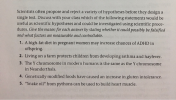 Scientists often propose and reject a variety of hypotheses before they design a single test. Discuss with your class which of the following statements would be useful as scientific hypotheses and could be investigated using scientific proce- dures. Give the reason for each answer by stating whether it could possibly be falsified and what factors are measurable and controllable. 1. A high-fat diet in pregnant women may increase chances of ADHD in offspring 2. Living on a farm protects children...
 Scientists often propose and reject a variety of hypotheses before they design a single test. Discuss with your class which of the following statements would be useful as scientific hypotheses and could be investigated using scientific proce- dures. Give the reason for each answer by stating whether it could possibly be falsified and what factors are measurable and controllable. 1. A high-fat diet in pregnant women may increase chances of ADHD in offspring 2. Living on a farm protects children...
Most questions answered within 3 hours.
-
Where is the error in this code sequence?
String s1 = "Hello";
String s2 = "ello";...
asked 10 months ago -
Financial data for Joel de Paris, Inc., for last year
follow:
Joel de Paris, Inc.
Balance...
asked 10 months ago -
Consider this reaction:
Al2(SO4)3 (aq)+ BaCl3
(aq) Al2Cl6 (aq)- +
3BaSO4(s) . What is the...
asked 10 months ago -
Suppose that Savneet is considering increasing her
recent random sample from 20 car rentals to 40...
asked 10 months ago -
Trucks arrive at an unloading terminal at an average rate of 120
per hour.
Trucks arrive...
asked 10 months ago -
Why are methanol and ethanol completely soluble in water while
octanol is not very little soluble....
asked 10 months ago -
A facilities manager at a university reads in a research report
that the mean amount of...
asked 10 months ago -
When the CuSO4 is rehydrated by adding water to the anhydrous
compound, is this an endothermic...
asked 10 months ago -
A ray of sunlight is passing from diamond into crown glass; the
angle of incidence is...
asked 10 months ago -
A block of mass 0.249 kg is placed on top of a light, vertical
spring of...
asked 10 months ago -
how do the kidneys compensate in the presences of acidosis
a) trigger hyperventilate
b) reserve acid...
asked 10 months ago -
Question 501 pts
The rental rate of capital to the firm increases. Which of the
following...
asked 10 months ago