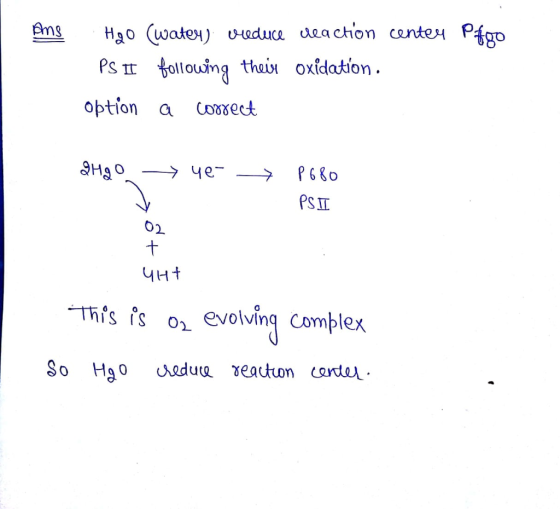
Which of the following reduce reaction center chlorophylls following their oxidation? SELECT ANY CHOICES THAT APPLY...
Which of the following reduce reaction center chlorophylls following their oxidation? SELECT ANY CHOICES THAT APPLY
a) H2O
b)CO2
c)NADPH
d)ATP
Homework Answers
Add Answer to:
Which of the following reduce reaction center chlorophylls
following their oxidation? SELECT ANY CHOICES THAT APPLY...
1. 2. 3 The Cori cycle involves which of the following processes? (select all that apply)...
 1.
2.
3
The Cori cycle involves which of the following processes? (select all that apply) gluconeogenesis urea cycle citric acid cycle glycolysis (aerobic conditions) glycolysis (anaerobic conditions) transamination 0 beta-oxidation Which of the following is the electron carrier produced in the pentose phosphate pathway? FADH2 NADPH ubiquinone cytochrome C NADH Attaching coenzyme A to a fatty acid at the beginning of beta-oxidation requires: 2 ATP equivalents 1 ATP equivalent 3 ATP equivalents 4 ATP equivalents
1.
2.
3
The Cori cycle involves which of the following processes? (select all that apply) gluconeogenesis urea cycle citric acid cycle glycolysis (aerobic conditions) glycolysis (anaerobic conditions) transamination 0 beta-oxidation Which of the following is the electron carrier produced in the pentose phosphate pathway? FADH2 NADPH ubiquinone cytochrome C NADH Attaching coenzyme A to a fatty acid at the beginning of beta-oxidation requires: 2 ATP equivalents 1 ATP equivalent 3 ATP equivalents 4 ATP equivalents
6. Which answer choices are true about photorespiration? Select all that apply. Photorespiration increases the efficiency...
 6. Which answer choices are true about photorespiration? Select all that apply. Photorespiration increases the efficiency of photosynthesis. It happens because 3-phosphoglycerate cannot be reduced to form triose phosphate sugars. It happens because there is so much more CO2 in the atmosphere than 02. It happens because rubisco can add either O or Co, to RuBP. CO2 and ATP are produced. ATP is consumed by photorespiration.
Which of the following does NOT undergo oxidation-reduction reactions? A. ATP B. NADH C. NADPH D....
Which of the following does NOT undergo oxidation-reduction reactions? A. ATP B. NADH C. NADPH D. FAD
which change(s) to this reaction system would increase the rate of reaction? select all that apply....
which change(s) to this reaction system would increase the rate of reaction? select all that apply. CO+H2O --> CO2+H2 addition of catalyst addition of CO addition of CO2 lowering the temperature addition of H2
Question 14 (1 point) Saved Which of the following is an example of an oxidation reaction?...
 Question 14 (1 point) Saved Which of the following is an example of an oxidation reaction? O a) 02C-CH2-CH2-CO2 + FAD = н со, C=C + FADH, OCH Ob) CH3CCO2 + CO2 + ATP - OCCH_CCO2 + ADP + Pi Oc) ÇO CO2 H2N-C-H H-C-NH2 CH CH, d) Ala-Ser + H20 + Ala + Ser e) None of the answers is correct.
Which of the following does not occur during the calvin cycle? a) oxidation of NADPH b)...
Which of the following does not occur during the calvin cycle? a) oxidation of NADPH b) release of oxygen c) regeneration of the CO2 acceptor d) carbon fixation
1. which of the following are produced during the light reactions of photosynthesis? a) ADP,NADP+,O2 b)glucose,...
1. which of the following are produced during the light reactions of photosynthesis? a) ADP,NADP+,O2 b)glucose, ADP,NAD+ c)ATP,NADPH,CO2 d)glucose,ADP,NADP+,CO2 e)ATP,NADPH,O3 2. Which type of light energy is not used by plants during photosynthesis? a)blue b)yellow c)violet d)red E)none of the above=identofy 3. Photosystem II a)does not have a reaction center b)is reduced by NADPH c)passes electrons to photosystem I d)has P700 at its reaction e)all the choices are correct 4. The photolysis of water a)combines with carbon dioxide b)produces NADPH...
SELECT ALL THAT APPLY. Which of the following atoms or molecules help comprise the heme center...
SELECT ALL THAT APPLY. Which of the following atoms or molecules help comprise the heme center of the proteins myoglobin and hemoglobin? A. Nitrogen B. Proximal Histidine C. Distal Histidine D. Oxygen
Q1. Which of the following apply to cellular respiration? (Select ALL that apply.) A. Cellular respiration...
Q1. Which of the following apply to cellular respiration? (Select ALL that apply.) A. Cellular respiration uses sunlight to convert low energy carbon dioxide into high energy sugar molecules. B. Cellular respiration breaks down high energy sugars thereby releasing energy for the cell to do work. C. Cellular respiration stores the energy from sugar in the form of ATP. D. Cellular respiration consumes O2 and releases CO2. Q2. Why is oxygen required for life? Select ONE option: A. It facilitates...
Which of the following is true regarding ᐃG? (mark all that apply) Group of answer choices...
Which of the following is true regarding ᐃG? (mark all that apply) Group of answer choices When Keq is >> 1, ᐃG is large and negative When Keq is << 1, ᐃG is large and positive When Keq is << 1, ᐃG is small and positive When Keq is << 1, ᐃG is large and negative When Keq is >> 1, ᐃG is small and positive 2-Why is coupling of reactions an important biochemical mechanism to allow non-spontaneous reactions to...
 1.
2.
3
The Cori cycle involves which of the following processes? (select all that apply) gluconeogenesis urea cycle citric acid cycle glycolysis (aerobic conditions) glycolysis (anaerobic conditions) transamination 0 beta-oxidation Which of the following is the electron carrier produced in the pentose phosphate pathway? FADH2 NADPH ubiquinone cytochrome C NADH Attaching coenzyme A to a fatty acid at the beginning of beta-oxidation requires: 2 ATP equivalents 1 ATP equivalent 3 ATP equivalents 4 ATP equivalents
1.
2.
3
The Cori cycle involves which of the following processes? (select all that apply) gluconeogenesis urea cycle citric acid cycle glycolysis (aerobic conditions) glycolysis (anaerobic conditions) transamination 0 beta-oxidation Which of the following is the electron carrier produced in the pentose phosphate pathway? FADH2 NADPH ubiquinone cytochrome C NADH Attaching coenzyme A to a fatty acid at the beginning of beta-oxidation requires: 2 ATP equivalents 1 ATP equivalent 3 ATP equivalents 4 ATP equivalents
 6. Which answer choices are true about photorespiration? Select all that apply. Photorespiration increases the efficiency of photosynthesis. It happens because 3-phosphoglycerate cannot be reduced to form triose phosphate sugars. It happens because there is so much more CO2 in the atmosphere than 02. It happens because rubisco can add either O or Co, to RuBP. CO2 and ATP are produced. ATP is consumed by photorespiration.
 Question 14 (1 point) Saved Which of the following is an example of an oxidation reaction? O a) 02C-CH2-CH2-CO2 + FAD = н со, C=C + FADH, OCH Ob) CH3CCO2 + CO2 + ATP - OCCH_CCO2 + ADP + Pi Oc) ÇO CO2 H2N-C-H H-C-NH2 CH CH, d) Ala-Ser + H20 + Ala + Ser e) None of the answers is correct.
Most questions answered within 3 hours.
-
Where is the error in this code sequence?
String s1 = "Hello";
String s2 = "ello";...
asked 11 months ago -
Financial data for Joel de Paris, Inc., for last year
follow:
Joel de Paris, Inc.
Balance...
asked 11 months ago -
Consider this reaction:
Al2(SO4)3 (aq)+ BaCl3
(aq) Al2Cl6 (aq)- +
3BaSO4(s) . What is the...
asked 11 months ago -
Suppose that Savneet is considering increasing her
recent random sample from 20 car rentals to 40...
asked 11 months ago -
Trucks arrive at an unloading terminal at an average rate of 120
per hour.
Trucks arrive...
asked 11 months ago -
Why are methanol and ethanol completely soluble in water while
octanol is not very little soluble....
asked 11 months ago -
A facilities manager at a university reads in a research report
that the mean amount of...
asked 11 months ago -
When the CuSO4 is rehydrated by adding water to the anhydrous
compound, is this an endothermic...
asked 11 months ago -
A ray of sunlight is passing from diamond into crown glass; the
angle of incidence is...
asked 11 months ago -
A block of mass 0.249 kg is placed on top of a light, vertical
spring of...
asked 11 months ago -
how do the kidneys compensate in the presences of acidosis
a) trigger hyperventilate
b) reserve acid...
asked 11 months ago -
Question 501 pts
The rental rate of capital to the firm increases. Which of the
following...
asked 11 months ago