Draw a graph showing what would happen to resting membrane potential over time, if the sodium/potassium...
Draw a graph showing what would happen to resting membrane potential over time, if the sodium/potassium pump were not functioning. How would this affect a neuron's ability to produce action potentials? What does this imply about the quantity of ions that normally cross the membrane during the course of an action potential?
Homework Answers
Na-K pumps are very important to maintain resting membrane potential and also for generating action potential. The nerve membrane is permeable to K ions. But very poorly permeable to Na ions. So, Na ions enter with difficulty where as K ions move very easily. Na ions that enter with difficulty, can't leave the cell at all. Where as K ions that enter can leave easily. So there will be accumulation of Na ions inside and accumulation of K ions out side. K ions leave the cell to compensate for the accumulation of Na inside. So the ion concentrations are getting reversed. Because there are more Na ions inside, K ions are moving out and accumulating out side. This completely disturbs the normal nerve environment needed for the resting potential and action potential generation. If it lasts for a long time, resting potential becomes zero , membrane goes to equilibrium state of ions and action potential also can't be generated.This prevents the nerve impulse generation and flow of information across nerve.

If the Na-K pump does not work for a long time, membrane potential will be zero.
During action potential, Na ions diffuse in to the cell and K ions move out of the cell. But the concentration is reversed now, So no movement of ions can happen and no action potential is generated
Add Answer to:
Draw a graph showing what would happen to resting
membrane potential over time, if the sodium/potassium...
could you please explain how you did each one 5. Draw a graph showing what would...
 could you please explain how you did each one
5. Draw a graph showing what would happen to resting membrane potential over time, if the sodium/potassium pump were not functioning. How would this affect a neuron's ability to produce action potentials? What does this imply about the quantity of ions that normally cross the membrane during the course of an action potential? (Group D). Topic 2: Action potential conduction and synaptic transmission 6. How would you alter sodium and/or potassium...
could you please explain how you did each one
5. Draw a graph showing what would happen to resting membrane potential over time, if the sodium/potassium pump were not functioning. How would this affect a neuron's ability to produce action potentials? What does this imply about the quantity of ions that normally cross the membrane during the course of an action potential? (Group D). Topic 2: Action potential conduction and synaptic transmission 6. How would you alter sodium and/or potassium...
1Of the permeable of potassium ions decrease, what would happen to the membrane potential? depolarize is...
1Of the permeable of potassium ions decrease, what would happen to the membrane potential? depolarize is this correct? 2/What will happen to the resting membrane potential if you add potassium ions to the extracellular fluid? it will decrease is this correct 3/ What is oxygen used for in cellular respiration? a/to accept carbon from the citric acid cycle, creating C02 b./to accept hydrogen from NADH, refreshing NAD+, creating H20 which one is correct
What is the main function of the sodium potassium pump in the neuron? a. Establish concentration...
What is the main function of the sodium potassium pump in the neuron? a. Establish concentration gradients for sodium and potassium ions. b. Depolarize the membrane to threshold. c. Make the inside of the cell more negative than the outside. d. Make the inside of the cell more positive than the outside. e. Pump ions down their concentration gradients during an action potential. A patient of yours has been poisoned by a toxin which prevents fast repolarization of the membrane...
Draw an action potential on a graph showing the x-axis and y-axis with proper labels and...
 Draw an action potential on a graph showing the x-axis and y-axis with proper labels and numbers (the numbers are approximate as they may vary slightly from neuron to neuron). A. Describe the ionic conductances that underlie the action potential including gating of the specific ion channels at threshold, rising phase, falling phase and the undershoot phase. Explain threshold, absolute refractory period and relative refractory period in relation to the action potential. B. C. Sodium and potassium currents demonstrate very...
Which section of the graph represents the time when sodium AND potassium ions voltage gates are...
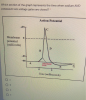 Which section of the graph represents the time when sodium AND potassium ions voltage gates are closed?* Action Potential +35 С Membrane 0 potential (millivolts) D B -65 -90 A Threshold Level E 3 Time (milliseconds) ОА B D E
In its resting state, the membrane surrounding a neuron is permeable to potassium ions but only...
 In its resting state, the membrane surrounding a neuron is
permeable to potassium ions but only slightly permeable to sodium
ions. Thus, positive K ions can flow through the membrane in an
attempt to equalize K concentration, but Na ions cannot as quickly.
This leads to an excess of Na ions outside of the cell. If the
space outside the cell is defined as zero electric potential, then
the electric potential of the interior of the cell is negative.
This...
In its resting state, the membrane surrounding a neuron is
permeable to potassium ions but only slightly permeable to sodium
ions. Thus, positive K ions can flow through the membrane in an
attempt to equalize K concentration, but Na ions cannot as quickly.
This leads to an excess of Na ions outside of the cell. If the
space outside the cell is defined as zero electric potential, then
the electric potential of the interior of the cell is negative.
This...
1. How is an increase in stimulus strength reflected by an action potential? Draw this answer...
 1. How is an increase in stimulus strength reflected by an action potential? Draw this answer out and attach it to your post. 2. Why is the Nat/K* pump responsible for maintaining resting membrane potential? 3. Explain how repolarization happens. Give characteristics of the absolute and relative refractory periods in terms of voltage-gated sodium channel conformation. At what point can a new action potential be generated? 4. Outline a situation that would reduce the likelihood of an action potential occurring....
Resting potential has been drawn for you. Continue that line to show what would happen to...
 Resting potential has been drawn for you. Continue that line to show what would happen to membrane potential in the POSTsynaptic muscle cell if the person was exposed to cyclosarin. Cyclosarin prevents acetylcholinesterase (the enzyme that breaks down the neurotransmitter) from breaking down acetylcholine (the neurotransmitter). Membrane Potential * Clear sketch Submit response I Switch to text response
Neurons are electrically excitable cells in the nervous system that function to process and transmit information...
 Neurons are electrically excitable cells in the nervous system that function to process and transmit information from one part the body to another, through specialized connections called synapses. The signaling process is partly electrical and partly chemical. In vertebrate animals, neurons are the core components of the brain, spinal cord and peripheral nerves. Neurons carry messages in the form of electrical signals called nerve impulses or action potentials. An action potential occurs when the resting membrane potential at a specific...
Draw a graph of what happens during the action potentials of an SA node call and...
Draw a graph of what happens during the action potentials of an SA node call and the action potentialsbof a cardiac muscle cell. Your x-axis should be time in seconds and your y-axis should be membrane potential in millivolts. Be sure to indicate on the graph which ion channels are open at which times and which ions are moving in which direction. inlcude a paragraph description of the similarities and differences between the two types of action potentials.
 could you please explain how you did each one
5. Draw a graph showing what would happen to resting membrane potential over time, if the sodium/potassium pump were not functioning. How would this affect a neuron's ability to produce action potentials? What does this imply about the quantity of ions that normally cross the membrane during the course of an action potential? (Group D). Topic 2: Action potential conduction and synaptic transmission 6. How would you alter sodium and/or potassium...
could you please explain how you did each one
5. Draw a graph showing what would happen to resting membrane potential over time, if the sodium/potassium pump were not functioning. How would this affect a neuron's ability to produce action potentials? What does this imply about the quantity of ions that normally cross the membrane during the course of an action potential? (Group D). Topic 2: Action potential conduction and synaptic transmission 6. How would you alter sodium and/or potassium...
 Draw an action potential on a graph showing the x-axis and y-axis with proper labels and numbers (the numbers are approximate as they may vary slightly from neuron to neuron). A. Describe the ionic conductances that underlie the action potential including gating of the specific ion channels at threshold, rising phase, falling phase and the undershoot phase. Explain threshold, absolute refractory period and relative refractory period in relation to the action potential. B. C. Sodium and potassium currents demonstrate very...
 Which section of the graph represents the time when sodium AND potassium ions voltage gates are closed?* Action Potential +35 С Membrane 0 potential (millivolts) D B -65 -90 A Threshold Level E 3 Time (milliseconds) ОА B D E
 In its resting state, the membrane surrounding a neuron is
permeable to potassium ions but only slightly permeable to sodium
ions. Thus, positive K ions can flow through the membrane in an
attempt to equalize K concentration, but Na ions cannot as quickly.
This leads to an excess of Na ions outside of the cell. If the
space outside the cell is defined as zero electric potential, then
the electric potential of the interior of the cell is negative.
This...
In its resting state, the membrane surrounding a neuron is
permeable to potassium ions but only slightly permeable to sodium
ions. Thus, positive K ions can flow through the membrane in an
attempt to equalize K concentration, but Na ions cannot as quickly.
This leads to an excess of Na ions outside of the cell. If the
space outside the cell is defined as zero electric potential, then
the electric potential of the interior of the cell is negative.
This...
 1. How is an increase in stimulus strength reflected by an action potential? Draw this answer out and attach it to your post. 2. Why is the Nat/K* pump responsible for maintaining resting membrane potential? 3. Explain how repolarization happens. Give characteristics of the absolute and relative refractory periods in terms of voltage-gated sodium channel conformation. At what point can a new action potential be generated? 4. Outline a situation that would reduce the likelihood of an action potential occurring....
 Resting potential has been drawn for you. Continue that line to show what would happen to membrane potential in the POSTsynaptic muscle cell if the person was exposed to cyclosarin. Cyclosarin prevents acetylcholinesterase (the enzyme that breaks down the neurotransmitter) from breaking down acetylcholine (the neurotransmitter). Membrane Potential * Clear sketch Submit response I Switch to text response
 Neurons are electrically excitable cells in the nervous system that function to process and transmit information from one part the body to another, through specialized connections called synapses. The signaling process is partly electrical and partly chemical. In vertebrate animals, neurons are the core components of the brain, spinal cord and peripheral nerves. Neurons carry messages in the form of electrical signals called nerve impulses or action potentials. An action potential occurs when the resting membrane potential at a specific...
Most questions answered within 3 hours.
-
Where is the error in this code sequence?
String s1 = "Hello";
String s2 = "ello";...
asked 10 months ago -
Financial data for Joel de Paris, Inc., for last year
follow:
Joel de Paris, Inc.
Balance...
asked 10 months ago -
Consider this reaction:
Al2(SO4)3 (aq)+ BaCl3
(aq) Al2Cl6 (aq)- +
3BaSO4(s) . What is the...
asked 10 months ago -
Suppose that Savneet is considering increasing her
recent random sample from 20 car rentals to 40...
asked 10 months ago -
Trucks arrive at an unloading terminal at an average rate of 120
per hour.
Trucks arrive...
asked 10 months ago -
Why are methanol and ethanol completely soluble in water while
octanol is not very little soluble....
asked 10 months ago -
A facilities manager at a university reads in a research report
that the mean amount of...
asked 10 months ago -
When the CuSO4 is rehydrated by adding water to the anhydrous
compound, is this an endothermic...
asked 10 months ago -
A ray of sunlight is passing from diamond into crown glass; the
angle of incidence is...
asked 10 months ago -
A block of mass 0.249 kg is placed on top of a light, vertical
spring of...
asked 10 months ago -
how do the kidneys compensate in the presences of acidosis
a) trigger hyperventilate
b) reserve acid...
asked 10 months ago -
Question 501 pts
The rental rate of capital to the firm increases. Which of the
following...
asked 10 months ago