You have successfully isolated pure cultures of a bacterium from soil. What result might you expect...
Homework Answers
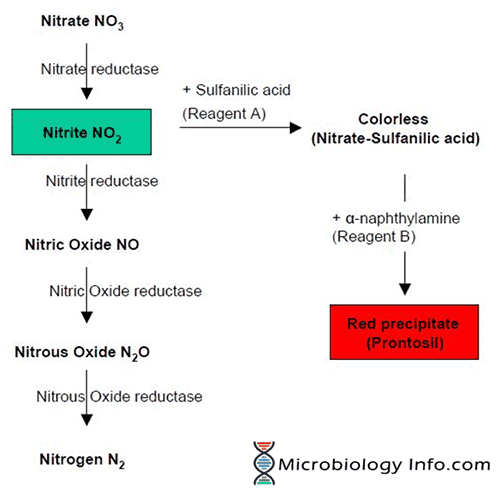
Successfully isolated pure cultures of the bacterium from soil. The anaerobic bacteria which grows under the soil is under the anaerobic condition and if these bacterial are under the nitrate broth they would require the nitrate as a nutrient for the growth. A heavy inoculum of test organism is incubated in a broth containing nitrate. These organisms are producing the nitrate reductase enzyme which can easily react on nitrate to get reduced into nitric oxide, nitrous, and nitrogen.
The nitrate reduction test is based on the detection of nitrite and its ability to form a red compound when it reacts with sulfanilic acid to form a complex (nitrite-sulfanilic acid) which then reacts with a α-naphthylamine to give a red precipitate (prontosil), which is a water-soluble azo dye.
However, only when nitrate is present in the medium, red color will be produced. If there’s no red color in the medium after you’ve added sulfanilic acid and α-naphthylamine means only that nitrite is not present in the medium.
There is two explanations for this observation.
- The nitrate may not have been reduced; the strain is nitrate-negative.
- The nitrate may have been reduced to nitrite which has then been completely reduced to nitric oxide, nitrous oxide, or nitrogen which will not react with the reagents that react with nitrite; the strain is nitrate-positive.
Thus, when nitrite is not detected, it is necessary to test if the organism has reduced nitrate beyond nitrite. This can be done indirectly by adding small amount of Zinc powder to the culture. Zinc powder catalyses the reduction of nitrate to nitrite. The development of the red colour on addition of Zinc indicates that nitrate was not reduced by the organism which suggests that the test organism is not capable of reducing nitrate. If no color change occurs after the addition of zinc, this indicates that the organism reduced nitrate to one of the other nitrogen compounds and thus is a nitrate reducer.
The experiment was conducted with following steps:
Method
Determination of nitrate reduction to nitrite is a two step process.
- Inoculating the nitrate broths with bacterial suspension.
- Incubating the tubes at the optimal temperature 30°C or 37°C for 24 hours.
- Later on incubation look for N2 gas first before adding reagents.
- By Adding 6-8 drops of nitrite reagent A and add the 6-8 drops of nitrite reagent B.
- The Observation for the reaction (color development) within a minute or less.
- If no color develops add zinc powder.
- Again on observing for at least 3 minutes for a red color to develop after addition of zinc.
On conducting the experiment the expected result obtained as follow:
- Positive Test:
– Development of a cherry red colouration on addition of reagent A and B
– Absence of a red color development on adding Zn powder - Negative Test:
– A development of red color on addition of Zn powder
Add Answer to:
You
have successfully isolated pure cultures of a bacterium from soil.
What result might you expect...
A bacterium was isolated from the human gut and successfully grown on NA in the lab....
 A bacterium was isolated from
the human gut and successfully grown on NA in the lab. Where
in thioglycollate medium would you expect to see growth for this
organism and why?
AaBbCcDdE ABCD de AaBbCcDde AaBbCD AaBbCcDdE A. A. EEZE, . Normal Preformatted No Spacing Heading 1 Heading 2 1) A bacterium was isolated from the human gut and successfully grown on NA in the lab. Where in thioglycollate medium would you expect to see growth for this organism, and...
A bacterium was isolated from
the human gut and successfully grown on NA in the lab. Where
in thioglycollate medium would you expect to see growth for this
organism and why?
AaBbCcDdE ABCD de AaBbCcDde AaBbCD AaBbCcDdE A. A. EEZE, . Normal Preformatted No Spacing Heading 1 Heading 2 1) A bacterium was isolated from the human gut and successfully grown on NA in the lab. Where in thioglycollate medium would you expect to see growth for this organism, and...
1. Would you expect a sample of soil taken from a garden to be positive for...
 1. Would you expect a sample of soil taken from a garden to be positive for nitrate reductase? Why or why not?
In your membrane fraction that you gently isolated from the cell you have an enzyme activity...
 In your membrane fraction that you gently isolated from the cell you have an enzyme activity that you are interested in studying. a. You need to determine if the protein is an integral or peripheral membrane protein. How would you determine this? a. What type of amino acids do you expect if the protein is an integral membrane protein? (list 2 specific amino acids and explain why) TT TT Paragraph Arial 3 (121)
You have isolated a bacterium from the gut of a pug and wish to know how...
You have isolated a bacterium from the gut of a pug and wish to know how it transports maltose into the cell. You perform an experiment that shows uptake of fluorescent-labeled maltose is equal when the bacteria is grown in media in the presence and absence of inhibitors of ATP production. What is the mechanism of maltose transport in this cell? a) facilitated diffusion b) group translocation c) simple diffusion d) active transport e) endocytosis
Microbiology. How would you obtain a pure culture of a single bacterial species from agar plate...
Microbiology. How would you obtain a pure culture of a single bacterial species from agar plate holding a mixed population of bacteria? What methods would you use to identify this bacterium that you have isolated?
Nitrate broth lab 1. what role does nitrate play in respiration 2. what nitrate reduction result...
Nitrate broth lab 1. what role does nitrate play in respiration 2. what nitrate reduction result would you expect in an obligate anaerobe. Explain 3. Why does the presence of a red color after zinc addition indicate a negative result for nitrate reduction 4. A facultative anaerobe can reduce nitrate. Would you expect to see a positive result when the test is done under conditions where the bacteria is exposed to large amounts of oxygen? Explain
You have isolated a new species of bacterium, Mustget caffeinum, from a compost heap that was...
 You have isolated a new species of bacterium, Mustget caffeinum, from a compost heap that was heavily enriched with coffee grinds. You discover that it can grow using caffeine as its only carbon source but seems to grow better on other carbon sources, You decide to compare its growth rate in defined minimal media (MM) supplemented with either sucrose or caffeine as the sole carbon source. You inoculated M, caffeinum into both MM-caffeine and MM-sucrose at 8 AM. Because this...
Microbiology Question If a bacterium exhibits purple growth on MacConkey agar, what color would you expect...
Microbiology Question If a bacterium exhibits purple growth on MacConkey agar, what color would you expect it to demonstrate when grown on Hektoen agar? On Eosin-Methylene Blue agar? (please also explain why) I know that a positive result is pink in MacConkey, and that my teacher is trying to get some critical thinking done with this question, but I'm not even sure what to think. Please help!
Streak Place Isolation for Obtaining Pure Cultures Data Interpretation Please type the answers to the following...
 Streak Place Isolation for Obtaining Pure Cultures Data Interpretation Please type the answers to the following questions below (double spaced) and attach the data collection sheets when you hand in this lab report. 2. When an agar plate is inoculated, why is the loop sterilized after the initial Inoculation is put on? 2. Define pure culture, a mixed culture? 3. Define a bacterial colony. List four characteristics by which bacterial colonies may be distinguished? 4. Why should a Petri dish...
3. You have 1.98g of isolated pure ibuprofen, what is the maximum amounts in grams of...
3. You have 1.98g of isolated pure ibuprofen, what is the maximum amounts in grams of (S,S ) diastereomeric salt that you could have started with? a. 2.5 b. 2.54 c. 3.14 d. 3.97 Can you show explanation as well please.
 A bacterium was isolated from
the human gut and successfully grown on NA in the lab. Where
in thioglycollate medium would you expect to see growth for this
organism and why?
AaBbCcDdE ABCD de AaBbCcDde AaBbCD AaBbCcDdE A. A. EEZE, . Normal Preformatted No Spacing Heading 1 Heading 2 1) A bacterium was isolated from the human gut and successfully grown on NA in the lab. Where in thioglycollate medium would you expect to see growth for this organism, and...
A bacterium was isolated from
the human gut and successfully grown on NA in the lab. Where
in thioglycollate medium would you expect to see growth for this
organism and why?
AaBbCcDdE ABCD de AaBbCcDde AaBbCD AaBbCcDdE A. A. EEZE, . Normal Preformatted No Spacing Heading 1 Heading 2 1) A bacterium was isolated from the human gut and successfully grown on NA in the lab. Where in thioglycollate medium would you expect to see growth for this organism, and...
 1. Would you expect a sample of soil taken from a garden to be positive for nitrate reductase? Why or why not?
 In your membrane fraction that you gently isolated from the cell you have an enzyme activity that you are interested in studying. a. You need to determine if the protein is an integral or peripheral membrane protein. How would you determine this? a. What type of amino acids do you expect if the protein is an integral membrane protein? (list 2 specific amino acids and explain why) TT TT Paragraph Arial 3 (121)
 You have isolated a new species of bacterium, Mustget caffeinum, from a compost heap that was heavily enriched with coffee grinds. You discover that it can grow using caffeine as its only carbon source but seems to grow better on other carbon sources, You decide to compare its growth rate in defined minimal media (MM) supplemented with either sucrose or caffeine as the sole carbon source. You inoculated M, caffeinum into both MM-caffeine and MM-sucrose at 8 AM. Because this...
 Streak Place Isolation for Obtaining Pure Cultures Data Interpretation Please type the answers to the following questions below (double spaced) and attach the data collection sheets when you hand in this lab report. 2. When an agar plate is inoculated, why is the loop sterilized after the initial Inoculation is put on? 2. Define pure culture, a mixed culture? 3. Define a bacterial colony. List four characteristics by which bacterial colonies may be distinguished? 4. Why should a Petri dish...
Most questions answered within 3 hours.
-
Where is the error in this code sequence?
String s1 = "Hello";
String s2 = "ello";...
asked 11 months ago -
Financial data for Joel de Paris, Inc., for last year
follow:
Joel de Paris, Inc.
Balance...
asked 11 months ago -
Consider this reaction:
Al2(SO4)3 (aq)+ BaCl3
(aq) Al2Cl6 (aq)- +
3BaSO4(s) . What is the...
asked 11 months ago -
Suppose that Savneet is considering increasing her
recent random sample from 20 car rentals to 40...
asked 11 months ago -
Trucks arrive at an unloading terminal at an average rate of 120
per hour.
Trucks arrive...
asked 11 months ago -
Why are methanol and ethanol completely soluble in water while
octanol is not very little soluble....
asked 11 months ago -
A facilities manager at a university reads in a research report
that the mean amount of...
asked 11 months ago -
When the CuSO4 is rehydrated by adding water to the anhydrous
compound, is this an endothermic...
asked 11 months ago -
A ray of sunlight is passing from diamond into crown glass; the
angle of incidence is...
asked 11 months ago -
A block of mass 0.249 kg is placed on top of a light, vertical
spring of...
asked 11 months ago -
how do the kidneys compensate in the presences of acidosis
a) trigger hyperventilate
b) reserve acid...
asked 11 months ago -
Question 501 pts
The rental rate of capital to the firm increases. Which of the
following...
asked 11 months ago