The following is an image of a section of dna. if a replication fork is moving...
The following is an image of a section of dna. if a replication fork is moving from right to left, which strand (top or Bottom) is the template strand for the leading strand.
3' AAATCGCGATCGATGGTCTGAGTTTGAATC 5'
5' TTTAGCGCTAGCTACCAGACTCAAACTTAG 3'
Homework Answers
The strand at the bottom is the template strand for the synthesis of leading strand if the replication fork moves from right to left.
DNA has anti-parallel nature i.e. one of the strands has
3' 5'
polarity whereas the other strand has opposite polarity i.e.
5'3'.
Since DNA replication occurs only by elongating a 3' end, one of
the strands is replicated continuously as the replication fork
moves. The DNA strand synthesized by this template is known as the
leading strand. The other strand of the DNA is replicated with the
DNA polymerase moving in the opposite direction of the replication
fork. The DNA strand synthesized by this template is known as the
lagging strand and is synthesized in the form of short fragments
called the Okazaki fragments.
5'
polarity whereas the other strand has opposite polarity i.e.
5'3'.
Since DNA replication occurs only by elongating a 3' end, one of
the strands is replicated continuously as the replication fork
moves. The DNA strand synthesized by this template is known as the
leading strand. The other strand of the DNA is replicated with the
DNA polymerase moving in the opposite direction of the replication
fork. The DNA strand synthesized by this template is known as the
lagging strand and is synthesized in the form of short fragments
called the Okazaki fragments.
Add Answer to:
The following is an image of a section of dna. if a replication
fork is moving...
3: AAATCGCGATCGATGGTCTGAGTTTGAATC -5' 5' TTTAGCGCTAGCTACCAGACTCAAACTTAG-3' The following is an image of a section of DNA. If...
 3: AAATCGCGATCGATGGTCTGAGTTTGAATC -5' 5' TTTAGCGCTAGCTACCAGACTCAAACTTAG-3' The following is an image of a section of DNA. If areplication fork is moving from right to left, which strand (top or bottom) is the template Strand for the leading Strand?
In DNA replication, the ________ strand grows towards the replication fork, while the ________ strand grows...
In DNA replication, the ________ strand grows towards the replication fork, while the ________ strand grows away from the replication fork. mRNA; leading leading; lagging leading; template lagging; template lagging; leading Which of the following is not necessarily related to tumour formation? an overactive MYC gene proto-oncogenes inactive tumour-suppressor genes cell de-differentiation metastasis The total number of unique, three-base combinations of the four nucleic acid bases in DNA is 12. 16. 20. 64. 256. The purpose of cloning is to...
Which one of the following is true about DNA replication?
Which one of the following is true about DNA replication? The lagging strand is discontinuously synthesized in the direction away from the moving replication fork. The lagging strand is continuously synthesized in the direction away from the moving replication fork. The leading strand is continuously synthesized in the direction away from the moving replication fork. The leading strand is discontinuously synthesized in the direction away from the moving replication fork.
QUESTION 3 Replication Now DNA Origin of replication DOC Replication fork B CON RO Unreplicated DNA...
 QUESTION 3 Replication Now DNA Origin of replication DOC Replication fork B CON RO Unreplicated DNA Prokaryotic DNA The above diagram shows DNA replication in bacterial cells. An antibody specific only to DNA polymerase I was added to DNA undergoing replication in bacterial cells. Which of the following statements are CORRECT? a. There would be a higher concentration of antibodies on the leading strands of replication foris A and B and a lower concentration of antibodies on the lagging strands...
The image shows a replication fork, template DNA strands, and new DNA strands. Label the image...
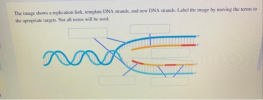 The image shows a replication fork, template DNA strands, and new DNA strands. Label the image by moving the terms to the apropriate targets. Not all terms will be used.
Describe the process of DNA replication. (Your answer should include the following: replication fork, semiconservative replication,...
Describe the process of DNA replication. (Your answer should include the following: replication fork, semiconservative replication, replication fork, DNA gyrase, helicase, primase, DNA polymerase, DNA ligase, leading strand, lagging strand, continuous replication, non-continuous replication, and Okazaki fragment)
Below is a figure of a DNA molecule undergoing replication. The arrow indicates the direction the...
 Below is a figure of a DNA molecule undergoing replication. The
arrow indicates the direction the replication fork is moving during
synthesis. From the list provided, indicate which option fits best
in each box on the diagram.
21
[ Choose ]
leading strand
template strand
lagging strand
22
[ Choose ]
leading strand
template strand
lagging...
Below is a figure of a DNA molecule undergoing replication. The
arrow indicates the direction the replication fork is moving during
synthesis. From the list provided, indicate which option fits best
in each box on the diagram.
21
[ Choose ]
leading strand
template strand
lagging strand
22
[ Choose ]
leading strand
template strand
lagging...
correct? . Consider the diagrammatic view of a DNA replication fork below: 000 Indicate the direction...
 correct? .
Consider the diagrammatic view of a DNA replication fork below: 000 Indicate the direction of the bottom parental strand, from left to right. 03-31 It cannot be inferred from the information given O 3-5 0 5'-3'
correct? .
Consider the diagrammatic view of a DNA replication fork below: 000 Indicate the direction of the bottom parental strand, from left to right. 03-31 It cannot be inferred from the information given O 3-5 0 5'-3'
Vocabulary: DNA Replication
Vocabulary: DNA Replication A. Helicase B. Primase C. Single Strand Binding Protein (SSB) D. Topoisomerase E. Origin of Replication F. DNA Polymerase G. Leading Strand H. Lagging strand I. DNA Ligase J. Okazaki Fragment K. Replication Fork L. RNA Primer M. Topoisomerase .1. Site where the replication of a DNA molecule begins. 2. The new continuous complementary DNA strand synthesized in the direction for the replication fork. 3. A discontinuously synthesized DNA strand that elongates in a direction away from the replication fork 4. Relaxes...
In the following diagram, A and B are two Okazaki fragments generated during DNA replication. Open...
 In the following diagram, A and B are two Okazaki fragments
generated during DNA replication. Open boxes represent the primers
and dotted lines represent the newly synthesized DNA strands.
a. To which direction (left or right) is the replication fork is
moving? (1 mark)
b. Which Okazaki fragment is made first in the diagram? Explain.
(2 marks)
c. (i) Which enzyme in E. coli synthesizes the primers on
Okazaki fragments? (1 mark)
(ii) What is the difference of this enzyme...
In the following diagram, A and B are two Okazaki fragments
generated during DNA replication. Open boxes represent the primers
and dotted lines represent the newly synthesized DNA strands.
a. To which direction (left or right) is the replication fork is
moving? (1 mark)
b. Which Okazaki fragment is made first in the diagram? Explain.
(2 marks)
c. (i) Which enzyme in E. coli synthesizes the primers on
Okazaki fragments? (1 mark)
(ii) What is the difference of this enzyme...
 3: AAATCGCGATCGATGGTCTGAGTTTGAATC -5' 5' TTTAGCGCTAGCTACCAGACTCAAACTTAG-3' The following is an image of a section of DNA. If areplication fork is moving from right to left, which strand (top or bottom) is the template Strand for the leading Strand?
 QUESTION 3 Replication Now DNA Origin of replication DOC Replication fork B CON RO Unreplicated DNA Prokaryotic DNA The above diagram shows DNA replication in bacterial cells. An antibody specific only to DNA polymerase I was added to DNA undergoing replication in bacterial cells. Which of the following statements are CORRECT? a. There would be a higher concentration of antibodies on the leading strands of replication foris A and B and a lower concentration of antibodies on the lagging strands...
 The image shows a replication fork, template DNA strands, and new DNA strands. Label the image by moving the terms to the apropriate targets. Not all terms will be used.
 Below is a figure of a DNA molecule undergoing replication. The
arrow indicates the direction the replication fork is moving during
synthesis. From the list provided, indicate which option fits best
in each box on the diagram.
21
[ Choose ]
leading strand
template strand
lagging strand
22
[ Choose ]
leading strand
template strand
lagging...
Below is a figure of a DNA molecule undergoing replication. The
arrow indicates the direction the replication fork is moving during
synthesis. From the list provided, indicate which option fits best
in each box on the diagram.
21
[ Choose ]
leading strand
template strand
lagging strand
22
[ Choose ]
leading strand
template strand
lagging...
 correct? .
Consider the diagrammatic view of a DNA replication fork below: 000 Indicate the direction of the bottom parental strand, from left to right. 03-31 It cannot be inferred from the information given O 3-5 0 5'-3'
correct? .
Consider the diagrammatic view of a DNA replication fork below: 000 Indicate the direction of the bottom parental strand, from left to right. 03-31 It cannot be inferred from the information given O 3-5 0 5'-3'
 In the following diagram, A and B are two Okazaki fragments
generated during DNA replication. Open boxes represent the primers
and dotted lines represent the newly synthesized DNA strands.
a. To which direction (left or right) is the replication fork is
moving? (1 mark)
b. Which Okazaki fragment is made first in the diagram? Explain.
(2 marks)
c. (i) Which enzyme in E. coli synthesizes the primers on
Okazaki fragments? (1 mark)
(ii) What is the difference of this enzyme...
In the following diagram, A and B are two Okazaki fragments
generated during DNA replication. Open boxes represent the primers
and dotted lines represent the newly synthesized DNA strands.
a. To which direction (left or right) is the replication fork is
moving? (1 mark)
b. Which Okazaki fragment is made first in the diagram? Explain.
(2 marks)
c. (i) Which enzyme in E. coli synthesizes the primers on
Okazaki fragments? (1 mark)
(ii) What is the difference of this enzyme...
Most questions answered within 3 hours.
-
Where is the error in this code sequence?
String s1 = "Hello";
String s2 = "ello";...
asked 11 months ago -
Financial data for Joel de Paris, Inc., for last year
follow:
Joel de Paris, Inc.
Balance...
asked 11 months ago -
Consider this reaction:
Al2(SO4)3 (aq)+ BaCl3
(aq) Al2Cl6 (aq)- +
3BaSO4(s) . What is the...
asked 11 months ago -
Suppose that Savneet is considering increasing her
recent random sample from 20 car rentals to 40...
asked 11 months ago -
Trucks arrive at an unloading terminal at an average rate of 120
per hour.
Trucks arrive...
asked 11 months ago -
Why are methanol and ethanol completely soluble in water while
octanol is not very little soluble....
asked 11 months ago -
A facilities manager at a university reads in a research report
that the mean amount of...
asked 11 months ago -
When the CuSO4 is rehydrated by adding water to the anhydrous
compound, is this an endothermic...
asked 11 months ago -
A ray of sunlight is passing from diamond into crown glass; the
angle of incidence is...
asked 11 months ago -
A block of mass 0.249 kg is placed on top of a light, vertical
spring of...
asked 11 months ago -
how do the kidneys compensate in the presences of acidosis
a) trigger hyperventilate
b) reserve acid...
asked 11 months ago -
Question 501 pts
The rental rate of capital to the firm increases. Which of the
following...
asked 11 months ago