Briefly describe the process of translation and include the appropriate RNA molecules and high-energy phosphates.
Briefly describe the process of translation and include the appropriate RNA molecules and high-energy phosphates.
Homework Answers
Translation is the process in which polypeptide chain ( protein) is formed with the help of ribosomal RNA (rRNA ), Messenger RNA( m - RNA) and Transfer RNA(t- RNA).
The three main steps involved are
Firstly activation of amino acid takes place by formation of amino acyl AMP enzyme complex. Then following steps continue one by one.
1 Initiation:- Ribosome assemble around the m- RNA and t- RNA along with the amino acid come to lie at the p site of ribosome.
2 elongation:- the tRNA transfers it's amino acid after reading the codon on mRNA and move to A site and come come out from exit site ... another activated tRNA molecule come to lie over the p site and some process continues until the complete polypeptide chain is formed.
3 termination:- when peptidyl tRNA encounter the stop cidon( UAA, UAG, UGA) , then ribosomal folds the polypeptide into the final structure.
Add Answer to:
Briefly describe the process of translation and include the
appropriate RNA molecules and high-energy phosphates.
In the process of translation, RNA molecules do all of the following except Catalyze the formation...
In the process of translation, RNA molecules do all of the following except Catalyze the formation of peptide bonds Bring amino acids to the site of translation Carry the message that was transcribed from DNA Provide the site for translation Catalyze the formation of bonds in a sugar-phosphate backbone
DIAGRAM and BRIEFLY explain how energy from high energy electron carriers is converted to ATP during...
DIAGRAM and BRIEFLY explain how energy from high energy electron carriers is converted to ATP during respiration in mitochondria and aerobic bacteria. Label each process involved in energy conversions, and label two of the proteins involved in the final steps of making ATP. (compare this to ATP production during Photosynthesis) [hint: discuss electrons, gradients, and phosphates, and the proper terms for the pathways involved.]
pleasevanswer asap Complementary base-pairing is important in processes involving DNA and RNA, including gene expression. Describe...
 pleasevanswer asap
Complementary base-pairing is important in processes involving DNA and RNA, including gene expression. Describe the steps during prokaryotic translation where complementary base-pairing of RNA to RNA is essential to translation. Be sure to include what molecules are complementary, and how this base-pairing contributes to translation. T T T Arial 3 (12pt) T.E.E. 3. 25
pleasevanswer asap
Complementary base-pairing is important in processes involving DNA and RNA, including gene expression. Describe the steps during prokaryotic translation where complementary base-pairing of RNA to RNA is essential to translation. Be sure to include what molecules are complementary, and how this base-pairing contributes to translation. T T T Arial 3 (12pt) T.E.E. 3. 25
a) Describe and sketch the vibrational energy levels observed for diatomic molecules in the harmonic oscillator...
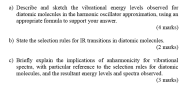 a) Describe and sketch the vibrational energy levels observed for diatomic molecules in the harmonic oscillator approximation, using an appropriate formula to support your answer (4 marks) b) State the selection rules for IR transitions in diatomic molecules. (2 marks) c) Briefly explain the implications of anharmonicity for vibrational spectra, with particular reference to the selection rules for diatomic molecules, and the resultant energy levels and spectra observed. (3 marks)
a) Describe and sketch the vibrational energy levels observed for...
a) Describe and sketch the vibrational energy levels observed for diatomic molecules in the harmonic oscillator approximation, using an appropriate formula to support your answer (4 marks) b) State the selection rules for IR transitions in diatomic molecules. (2 marks) c) Briefly explain the implications of anharmonicity for vibrational spectra, with particular reference to the selection rules for diatomic molecules, and the resultant energy levels and spectra observed. (3 marks)
a) Describe and sketch the vibrational energy levels observed for...
Describe the process of DNA replication. Include the ingredients needed, the enzymes used, the steps in...
Describe the process of DNA replication. Include the ingredients needed, the enzymes used, the steps in the process and the final product. Describe the process by which the information in a gene is transcribed and translated into a protein. Correctly use these words in your description (and highlight them as bold text in your submission): tRNA amino acid start codon transcription mRNA gene codon RNA polymerase ribosome translation anti-codon peptide bond stop codon
State a type of RNA polynucleotide and its role in the translation process. 1) 2) 3)
State a type of RNA polynucleotide and its role in the translation process. 1) 2) 3)
Uluruunu us RJ15 1. Draw or describe the process of eukaryotic transcription and translation, using the...
 Uluruunu us RJ15 1. Draw or describe the process of eukaryotic transcription and translation, using the following terms as needed (not all terms will be used): sigma factor, RNA polymerase, DNA polymerase, origin of replication, ribosome, start codon, transcriptional start site, stop codon, nucleus, -10 and -35 sequences, TATA box, TBP, inducer, transcriptional stop site, Shine-Delgrano sequence, Kozak sequence, RNA splicing. 2. Draw or describe the process of prokaryotic/eubacterial transcription and translation, using as many of the terms above as...
Which of the indicated carbon positions on the ribose sugar (below) contains the high-energy phosphates in...
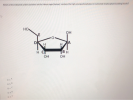 Which of the indicated carbon positions on the ribose sugar (below) contains the high-energy phosphates in nucleotide triphosphate building blocks? ОН В Н он ОН
Describe the central dogma of molecular biology, briefly describe the processes of transcription and translation. Long...
Describe the central dogma of molecular biology, briefly describe the processes of transcription and translation. Long answer please
Multiple RNA molecules are important in translation: mRNA, tRNA, and rRNA. Which of the following is...
Multiple RNA molecules are important in translation: mRNA, tRNA, and rRNA. Which of the following is most likely to slow the production of a single protein in the cytoplasm? Downregulation of genes encoding tRNA components. An increase in the synthesis of the 80S ribosomal proteins important in ribosomal translational initiation. Recruitment of RBPs that promote RNAse degradation to the 3’UTR of the mRNA transcript. Mutations in mitochondrial tRNAs important in the synthesis of mitochondrial proteins.
 pleasevanswer asap
Complementary base-pairing is important in processes involving DNA and RNA, including gene expression. Describe the steps during prokaryotic translation where complementary base-pairing of RNA to RNA is essential to translation. Be sure to include what molecules are complementary, and how this base-pairing contributes to translation. T T T Arial 3 (12pt) T.E.E. 3. 25
pleasevanswer asap
Complementary base-pairing is important in processes involving DNA and RNA, including gene expression. Describe the steps during prokaryotic translation where complementary base-pairing of RNA to RNA is essential to translation. Be sure to include what molecules are complementary, and how this base-pairing contributes to translation. T T T Arial 3 (12pt) T.E.E. 3. 25
 a) Describe and sketch the vibrational energy levels observed for diatomic molecules in the harmonic oscillator approximation, using an appropriate formula to support your answer (4 marks) b) State the selection rules for IR transitions in diatomic molecules. (2 marks) c) Briefly explain the implications of anharmonicity for vibrational spectra, with particular reference to the selection rules for diatomic molecules, and the resultant energy levels and spectra observed. (3 marks)
a) Describe and sketch the vibrational energy levels observed for...
a) Describe and sketch the vibrational energy levels observed for diatomic molecules in the harmonic oscillator approximation, using an appropriate formula to support your answer (4 marks) b) State the selection rules for IR transitions in diatomic molecules. (2 marks) c) Briefly explain the implications of anharmonicity for vibrational spectra, with particular reference to the selection rules for diatomic molecules, and the resultant energy levels and spectra observed. (3 marks)
a) Describe and sketch the vibrational energy levels observed for...
 Uluruunu us RJ15 1. Draw or describe the process of eukaryotic transcription and translation, using the following terms as needed (not all terms will be used): sigma factor, RNA polymerase, DNA polymerase, origin of replication, ribosome, start codon, transcriptional start site, stop codon, nucleus, -10 and -35 sequences, TATA box, TBP, inducer, transcriptional stop site, Shine-Delgrano sequence, Kozak sequence, RNA splicing. 2. Draw or describe the process of prokaryotic/eubacterial transcription and translation, using as many of the terms above as...
 Which of the indicated carbon positions on the ribose sugar (below) contains the high-energy phosphates in nucleotide triphosphate building blocks? ОН В Н он ОН
Most questions answered within 3 hours.
-
Where is the error in this code sequence?
String s1 = "Hello";
String s2 = "ello";...
asked 11 months ago -
Financial data for Joel de Paris, Inc., for last year
follow:
Joel de Paris, Inc.
Balance...
asked 11 months ago -
Consider this reaction:
Al2(SO4)3 (aq)+ BaCl3
(aq) Al2Cl6 (aq)- +
3BaSO4(s) . What is the...
asked 11 months ago -
Suppose that Savneet is considering increasing her
recent random sample from 20 car rentals to 40...
asked 11 months ago -
Trucks arrive at an unloading terminal at an average rate of 120
per hour.
Trucks arrive...
asked 11 months ago -
Why are methanol and ethanol completely soluble in water while
octanol is not very little soluble....
asked 11 months ago -
A facilities manager at a university reads in a research report
that the mean amount of...
asked 11 months ago -
When the CuSO4 is rehydrated by adding water to the anhydrous
compound, is this an endothermic...
asked 11 months ago -
A ray of sunlight is passing from diamond into crown glass; the
angle of incidence is...
asked 11 months ago -
A block of mass 0.249 kg is placed on top of a light, vertical
spring of...
asked 11 months ago -
how do the kidneys compensate in the presences of acidosis
a) trigger hyperventilate
b) reserve acid...
asked 11 months ago -
Question 501 pts
The rental rate of capital to the firm increases. Which of the
following...
asked 11 months ago