A fluid with a specific heat of 2.0 kJ/kg. 0C enters an adiabatic piping system at...
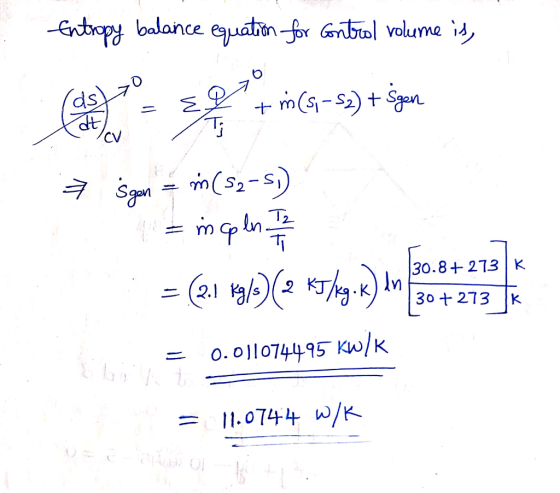
A fluid with a specific heat of 2.0 kJ/kg. 0C enters an adiabatic piping system at 30 0at a rate of 2.1 kg/s. If the water temperature rises by 0.8 0C during flow due to friction, what is the rate of entropy generation in the pipe in W/K?
Be sure to enter your answer in W/K, not in kW/K
Homework Answers
Add Answer to:
A fluid with a specific heat of 2.0 kJ/kg. 0C enters
an adiabatic piping system at...
A vapor compression refrigeration cycle utilizes R-134a as the working fluid. The refrigerant flow rate is 50 g/s. Vapor at 150 kPa and -10 0C enters the compressor and leaves at 1.2 MPa and 75 0C. Th...
A vapor compression refrigeration cycle utilizes R-134a as the working fluid. The refrigerant flow rate is 50 g/s. Vapor at 150 kPa and -10 0C enters the compressor and leaves at 1.2 MPa and 75 0C. The power input to the non-adiabatic compressor is measured and found to be 2.4 kW. The refrigerant enters the expansion valve at 1.15 MPa and 40 0C and leaves the evaporator at 160 kPa and -15 0C. Determine the entropy generation in the compression...
NO INTERPOLATION REQUIRED Air enters an adiabatic turbine at 1000 kPa and 1625 degrees C (state...
NO INTERPOLATION REQUIRED Air enters an adiabatic turbine at 1000 kPa and 1625 degrees C (state 1) with a mass flow rate of 5 kg/s and leaves at 100 kPa the isentropic efficiency of the turbine is 85%. Neglecting the kinetic energy change of the steam, and considering variable specific heats, determine: a. the isentropic power of the turbine Isentropic power in kW b. the temperature at the turbine exit temperature at exit in degrees C c. the actual power...
Steam enters a horizontal pipe operating at steady state with a specific enthalpy of 1,671 kJ/kg...
Steam enters a horizontal pipe operating at steady state with a specific enthalpy of 1,671 kJ/kg and a mass flow rate of 0.5 kg/s. At the exit, the specific enthalpy is 2,162 kJ/kg. If there is no significant change in kinetic energy from inlet to exit, determine the rate of heat transfer between the pipe and its surroundings, in kW.
Tubular heat exchanger design A liquid food (with specific heat 3.9 kJ/[kg °C]) flows in the...
Tubular heat exchanger design A liquid food (with specific heat 3.9 kJ/[kg °C]) flows in the inner pipe of a double pipe heat exchanger. The liquid food enters the heat exchanger at 72°C and exits at 6°C at a flow rate of 0.5 kg/s. In the annular section, cold water at 2°C enters the heat exchanger and flows concurrently at a flow rate of 12 kg/s. The average specific heat of water is 4.10 kJ/(kg °C). Assuming steady-state conditions. a)...
A) Steam enters a horizontal pipe operating at steady state with a specific enthalpy of 2,663 kJ/...
A) Steam enters a horizontal pipe operating at steady state with a specific enthalpy of 2,663 kJ/kg and a mass flow rate of 0.1 kg/s. At the exit, the specific enthalpy is 1,531 kJ/kg. If there is no significant change in kinetic energy from inlet to exit, determine the rate of heat transfer between the pipe and its surroundings, in kW. B) Refrigerant 134a enters a horizontal pipe operating at steady state at 40°C, 3.1 bar and a velocity of...
Problem statement: A heat exchanger is required to heat up milk (Specific heat of 3.93 kJ/kg...
Problem statement: A heat exchanger is required to heat up milk (Specific heat of 3.93 kJ/kg K) flowing at 2kg/s from 4 degrees C to 74 degrees C. If water (4.2 kJ/kg K) at 95 C is being used as the hot fluid with flow rate of 8kg/s, determine the length of tubular heat exchanger, if diameter of contact pipe surface between water and milk is 5 cm and overall heat transfer co-efficient is estimated to be 20000 W/m2K. Provide...
Water is the working fluid in a Rankine cycle. Superheated vapor enters the turbine at 10...
Water is the working fluid in a Rankine cycle. Superheated vapor enters the turbine at 10 Mpa, 560 C with a mass flow rate of 7.8kg/s and exits at 8 kPa. Saturated liquid enters the pump at 8 kPa. The isentropic turbine efficiency is 85%, and the isentropic pump efficiency is 85%. Cooling water enters the adiabatic condenser at 18 C and exits at 36 C with no significant change in pressure and assuming the specific heat of the cooling...
Twenty [kw] of heat is to be removed from 375 [k] water flowing at 0.15 [kg/s] into the inner pipe of concentric tube heat exchanger. Cooling water enters the annulus at 290 [k] and leaves at 320...
 Twenty [kw] of heat is to be removed from 375 [k] water flowing at 0.15 [kg/s] into the inner pipe of concentric tube heat exchanger. Cooling water enters the annulus at 290 [k] and leaves at 320 [k] with a flow in the opposite direction of the inner flow. The diameter of the thin- walled inner pipe is 2.5 [cm] a) b) c) Calculate the exit temperature of the hot fluid and the mass flow rate of the cold fluid...
In a counter flow double pipe heat exchanger water is heated from 25^0C to 75^0C by...
In a counter flow double pipe heat exchanger water is heated from 25^0C to 75^0C by oil with specific heat of 1.44KJ/KgK and mass flow rate of 0.81 kg/s.The oil is cooled from 240^0C to 150^0C.If the overall heat exchanger coefficient is 470W/m^2 0C.Calculate; 1.The rate flow of heat transfer 2.Sketch temperature distribution diagram 3.The mass flow rate of water 4.The surface area of the heat exchanger
A hot fluid of specific heat 4100 J/kg K flows through a parallel flow heat exchanger...
 A hot fluid of specific heat 4100 J/kg K flows through a parallel flow heat exchanger at the rate of 3.5 kg/min with an inlet temp. of 105C. A cold fluid of specific heat 2350 J/kg K flows in at a rate of 9 kg/min and with inlet temperature 25C. Make calculations for maximum possible effectiveness if the fluid flow conforms to parallel * .flow arrangement 0.596 0.458 .321 0.825 O
 Twenty [kw] of heat is to be removed from 375 [k] water flowing at 0.15 [kg/s] into the inner pipe of concentric tube heat exchanger. Cooling water enters the annulus at 290 [k] and leaves at 320 [k] with a flow in the opposite direction of the inner flow. The diameter of the thin- walled inner pipe is 2.5 [cm] a) b) c) Calculate the exit temperature of the hot fluid and the mass flow rate of the cold fluid...
 A hot fluid of specific heat 4100 J/kg K flows through a parallel flow heat exchanger at the rate of 3.5 kg/min with an inlet temp. of 105C. A cold fluid of specific heat 2350 J/kg K flows in at a rate of 9 kg/min and with inlet temperature 25C. Make calculations for maximum possible effectiveness if the fluid flow conforms to parallel * .flow arrangement 0.596 0.458 .321 0.825 O
Most questions answered within 3 hours.
-
Where is the error in this code sequence?
String s1 = "Hello";
String s2 = "ello";...
asked 11 months ago -
Financial data for Joel de Paris, Inc., for last year
follow:
Joel de Paris, Inc.
Balance...
asked 11 months ago -
Consider this reaction:
Al2(SO4)3 (aq)+ BaCl3
(aq) Al2Cl6 (aq)- +
3BaSO4(s) . What is the...
asked 11 months ago -
Suppose that Savneet is considering increasing her
recent random sample from 20 car rentals to 40...
asked 11 months ago -
Trucks arrive at an unloading terminal at an average rate of 120
per hour.
Trucks arrive...
asked 11 months ago -
Why are methanol and ethanol completely soluble in water while
octanol is not very little soluble....
asked 11 months ago -
A facilities manager at a university reads in a research report
that the mean amount of...
asked 11 months ago -
When the CuSO4 is rehydrated by adding water to the anhydrous
compound, is this an endothermic...
asked 11 months ago -
A ray of sunlight is passing from diamond into crown glass; the
angle of incidence is...
asked 11 months ago -
A block of mass 0.249 kg is placed on top of a light, vertical
spring of...
asked 11 months ago -
how do the kidneys compensate in the presences of acidosis
a) trigger hyperventilate
b) reserve acid...
asked 11 months ago -
Question 501 pts
The rental rate of capital to the firm increases. Which of the
following...
asked 11 months ago