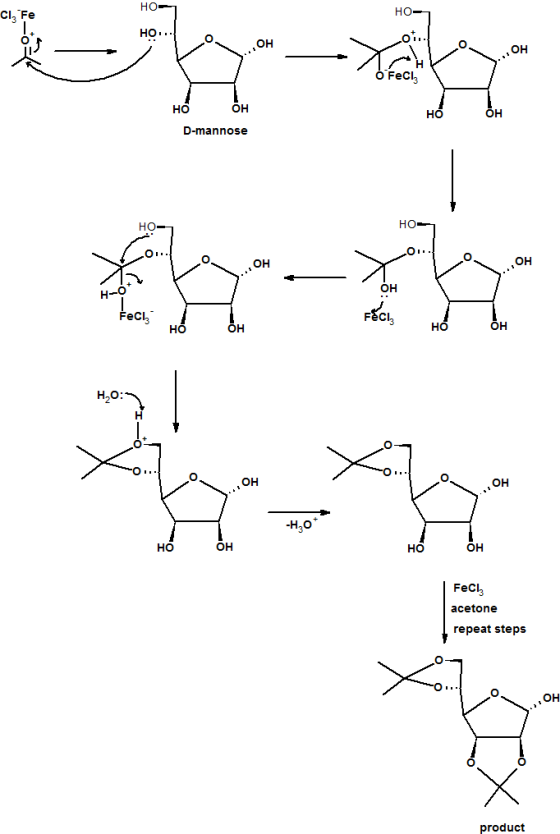
Full mechanism for the synthesis of diacetone mannose from D-mannose, ferric chloride and excess acetone
Homework Answers
Drawn below is a possible mechanism for the formation of diacetone mannose starting with D-mannose. The first step is FeCl3 (Lewis acid) forms a bond with a molecule of acetone to generate a more electrophilic carbon center. The mannose Oh then acts as nucelophile and attacks this carbonyl carbon center. The process is repeated to form mon-acetone mannose and then a diacetone mannose derrivative.
Add Answer to:
Full mechanism for the synthesis of diacetone mannose from
D-mannose, ferric chloride and excess acetone
Write a full mechanism for the acid catalyzed conversion of acetone into irs corresponding enol. Draw...
 Write a full mechanism for the acid catalyzed conversion of
acetone into irs corresponding enol.
Draw all of the possible resonance structures for each of the
following
0 0 0 Hi Hi Ho 2009 b. Write a full mechanism for the acid catalyzed conversion of acetone into its corresponding enol. c. Draw all of the possible resonance structures for each of the following:
Write a full mechanism for the acid catalyzed conversion of
acetone into irs corresponding enol.
Draw all of the possible resonance structures for each of the
following
0 0 0 Hi Hi Ho 2009 b. Write a full mechanism for the acid catalyzed conversion of acetone into its corresponding enol. c. Draw all of the possible resonance structures for each of the following:
Propose a one-step synthesis of chloroacetone from acetone. Why can this reaction not be run under...
Propose a one-step synthesis of chloroacetone from acetone. Why can this reaction not be run under basic conditions? If the synthesis were attempted under basic conditions, what would the product be? Propose a mechanism for that process.
Draw the mechanism for the acid-chloride synthesis of ethyl butyrate using butyryl chloride, ethanol, sodium bicarbonate, and pyridine.
Draw the mechanism for the acid-chloride synthesis of ethyl butyrate using butyryl chloride, ethanol, sodium bicarbonate, and pyridine.
4ml of 1M ferric chloride (FeCl3·6H20 dissolved in 2M HCl), 2ml of 1M ferrous chloride (FeCl2·4H2O in...
 4ml of 1M ferric chloride (FeCl3·6H20 dissolved in 2M
HCl), 2ml of 1M ferrous chloride (FeCl2·4H2O in 2M HCl),
25ml of 1.5M ammonium hydroxide
Based on the amounts of material used in your experiment, how many grams of magnetite Fe304 could have theoretically been produced by the synthesis reaction assuming 100% yield? FeCl2 (aq) 2 FeCl3 (aq) 8 NH4OH (aq) -Fe304 (s)8 NH4CI (aq) + 4 H20 (1) Assuming that the magnetite nanoparticles are round, with an average diameter of 20.0...
4ml of 1M ferric chloride (FeCl3·6H20 dissolved in 2M
HCl), 2ml of 1M ferrous chloride (FeCl2·4H2O in 2M HCl),
25ml of 1.5M ammonium hydroxide
Based on the amounts of material used in your experiment, how many grams of magnetite Fe304 could have theoretically been produced by the synthesis reaction assuming 100% yield? FeCl2 (aq) 2 FeCl3 (aq) 8 NH4OH (aq) -Fe304 (s)8 NH4CI (aq) + 4 H20 (1) Assuming that the magnetite nanoparticles are round, with an average diameter of 20.0...
Full Mechanism of Tollen's Test with the following compounds: 1. Heptaldehyde (heptanal) 2. Acetone (dimethyl ketone)...
Full Mechanism of Tollen's Test with the following compounds: 1. Heptaldehyde (heptanal) 2. Acetone (dimethyl ketone) 3. Benzaldehyde 4. Ethyl acetate 5. Benzoic acid
Please write out full reaction mechanism: Iron (II) chloride tetrahydrate and iron (III) chloride hexahydrate will...
Please write out full reaction mechanism: Iron (II) chloride tetrahydrate and iron (III) chloride hexahydrate will be dissolved in deionized (DI) water to form a homogeneous solution. The solution will then be heated in a water bath at 65°C for 15-20 minutes; followed by the addition of 25% sodium hydroxide. Please write full chemical formula (step by step + explanation) so that I can understand. Please write legibly if handwritten. Thank you so much!
Show the full electron pushing mechanism with arrows for the synthesis of p-bromoaniline from aniline. Show...
 Show the full electron pushing mechanism with arrows for the
synthesis of p-bromoaniline from aniline. Show any side
products
NH3 N 'CH3 NH CH HCI, H2O 1) H+, H20 Br2 H3C CH COONa CH COOH 2) 5% NaOH Aniline Acetic anhydride Acetanilide p-bromo acetanilide p-bromoaniline bp 184 oC mp 114 oC mp 166 oC mp 64 oC
Show the full electron pushing mechanism with arrows for the
synthesis of p-bromoaniline from aniline. Show any side
products
NH3 N 'CH3 NH CH HCI, H2O 1) H+, H20 Br2 H3C CH COONa CH COOH 2) 5% NaOH Aniline Acetic anhydride Acetanilide p-bromo acetanilide p-bromoaniline bp 184 oC mp 114 oC mp 166 oC mp 64 oC
Draw the full arrow-pushing mechanism for the completion steps of the synthesis of Corymine MeOC CO2Me...
 Draw the full arrow-pushing mechanism for the completion steps
of the synthesis of Corymine
MeOC CO2Me c) KBH4 d) Cs2CO3 .IIIlll MeO2 CO2Me a) MSOH b) NaBH3CN HCHO N7" 'N 75% III N7|'N 92% CO2Me HO, CO2Me IIIIIIII e) DIBAL-H 84% (+)-corymine [(+)-4] (X-ray)
Draw the full arrow-pushing mechanism for the completion steps
of the synthesis of Corymine
MeOC CO2Me c) KBH4 d) Cs2CO3 .IIIlll MeO2 CO2Me a) MSOH b) NaBH3CN HCHO N7" 'N 75% III N7|'N 92% CO2Me HO, CO2Me IIIIIIII e) DIBAL-H 84% (+)-corymine [(+)-4] (X-ray)
Alcohols and PHUVIL Report Sheet D. Ferric Chloride Test Alcohol FeCl, Test Ethanol 2-propanol 1-Butyl alcohol Cycl...
 Alcohols and PHUVIL Report Sheet D. Ferric Chloride Test Alcohol FeCl, Test Ethanol 2-propanol 1-Butyl alcohol Cyclohexanol Phenol Unknown E. Identification of Unknown Substance Unknown # Conclusions Results Summary of Testing B. Odor B. Soluble in water? B.PH C. Oxidation: CO 2 D. FeCl3 Structure Name of Unknown Page 8 of
Please show full mechanism with arrows and mechanism name for this multi synthesis problem(C-G) Me Me...
 Please show full mechanism with arrows and mechanism
name for this multi synthesis problem(C-G)
Me Me HX Me Et Me Et OH s-CI Me EtgN BuOK C 1) ВНн, 2) NaOH H2O2 MeOK Br2 F Me Et G O SIO
Please show full mechanism with arrows and mechanism
name for this multi synthesis problem(C-G)
Me Me HX Me Et Me Et OH s-CI Me EtgN BuOK C 1) ВНн, 2) NaOH H2O2 MeOK Br2 F Me Et G O SIO
 Write a full mechanism for the acid catalyzed conversion of
acetone into irs corresponding enol.
Draw all of the possible resonance structures for each of the
following
0 0 0 Hi Hi Ho 2009 b. Write a full mechanism for the acid catalyzed conversion of acetone into its corresponding enol. c. Draw all of the possible resonance structures for each of the following:
Write a full mechanism for the acid catalyzed conversion of
acetone into irs corresponding enol.
Draw all of the possible resonance structures for each of the
following
0 0 0 Hi Hi Ho 2009 b. Write a full mechanism for the acid catalyzed conversion of acetone into its corresponding enol. c. Draw all of the possible resonance structures for each of the following:
 4ml of 1M ferric chloride (FeCl3·6H20 dissolved in 2M
HCl), 2ml of 1M ferrous chloride (FeCl2·4H2O in 2M HCl),
25ml of 1.5M ammonium hydroxide
Based on the amounts of material used in your experiment, how many grams of magnetite Fe304 could have theoretically been produced by the synthesis reaction assuming 100% yield? FeCl2 (aq) 2 FeCl3 (aq) 8 NH4OH (aq) -Fe304 (s)8 NH4CI (aq) + 4 H20 (1) Assuming that the magnetite nanoparticles are round, with an average diameter of 20.0...
4ml of 1M ferric chloride (FeCl3·6H20 dissolved in 2M
HCl), 2ml of 1M ferrous chloride (FeCl2·4H2O in 2M HCl),
25ml of 1.5M ammonium hydroxide
Based on the amounts of material used in your experiment, how many grams of magnetite Fe304 could have theoretically been produced by the synthesis reaction assuming 100% yield? FeCl2 (aq) 2 FeCl3 (aq) 8 NH4OH (aq) -Fe304 (s)8 NH4CI (aq) + 4 H20 (1) Assuming that the magnetite nanoparticles are round, with an average diameter of 20.0...
 Show the full electron pushing mechanism with arrows for the
synthesis of p-bromoaniline from aniline. Show any side
products
NH3 N 'CH3 NH CH HCI, H2O 1) H+, H20 Br2 H3C CH COONa CH COOH 2) 5% NaOH Aniline Acetic anhydride Acetanilide p-bromo acetanilide p-bromoaniline bp 184 oC mp 114 oC mp 166 oC mp 64 oC
Show the full electron pushing mechanism with arrows for the
synthesis of p-bromoaniline from aniline. Show any side
products
NH3 N 'CH3 NH CH HCI, H2O 1) H+, H20 Br2 H3C CH COONa CH COOH 2) 5% NaOH Aniline Acetic anhydride Acetanilide p-bromo acetanilide p-bromoaniline bp 184 oC mp 114 oC mp 166 oC mp 64 oC
 Draw the full arrow-pushing mechanism for the completion steps
of the synthesis of Corymine
MeOC CO2Me c) KBH4 d) Cs2CO3 .IIIlll MeO2 CO2Me a) MSOH b) NaBH3CN HCHO N7" 'N 75% III N7|'N 92% CO2Me HO, CO2Me IIIIIIII e) DIBAL-H 84% (+)-corymine [(+)-4] (X-ray)
Draw the full arrow-pushing mechanism for the completion steps
of the synthesis of Corymine
MeOC CO2Me c) KBH4 d) Cs2CO3 .IIIlll MeO2 CO2Me a) MSOH b) NaBH3CN HCHO N7" 'N 75% III N7|'N 92% CO2Me HO, CO2Me IIIIIIII e) DIBAL-H 84% (+)-corymine [(+)-4] (X-ray)
 Alcohols and PHUVIL Report Sheet D. Ferric Chloride Test Alcohol FeCl, Test Ethanol 2-propanol 1-Butyl alcohol Cyclohexanol Phenol Unknown E. Identification of Unknown Substance Unknown # Conclusions Results Summary of Testing B. Odor B. Soluble in water? B.PH C. Oxidation: CO 2 D. FeCl3 Structure Name of Unknown Page 8 of
 Please show full mechanism with arrows and mechanism
name for this multi synthesis problem(C-G)
Me Me HX Me Et Me Et OH s-CI Me EtgN BuOK C 1) ВНн, 2) NaOH H2O2 MeOK Br2 F Me Et G O SIO
Please show full mechanism with arrows and mechanism
name for this multi synthesis problem(C-G)
Me Me HX Me Et Me Et OH s-CI Me EtgN BuOK C 1) ВНн, 2) NaOH H2O2 MeOK Br2 F Me Et G O SIO
Most questions answered within 3 hours.
-
Where is the error in this code sequence?
String s1 = "Hello";
String s2 = "ello";...
asked 11 months ago -
Financial data for Joel de Paris, Inc., for last year
follow:
Joel de Paris, Inc.
Balance...
asked 11 months ago -
Consider this reaction:
Al2(SO4)3 (aq)+ BaCl3
(aq) Al2Cl6 (aq)- +
3BaSO4(s) . What is the...
asked 11 months ago -
Suppose that Savneet is considering increasing her
recent random sample from 20 car rentals to 40...
asked 11 months ago -
Trucks arrive at an unloading terminal at an average rate of 120
per hour.
Trucks arrive...
asked 11 months ago -
Why are methanol and ethanol completely soluble in water while
octanol is not very little soluble....
asked 11 months ago -
A facilities manager at a university reads in a research report
that the mean amount of...
asked 11 months ago -
When the CuSO4 is rehydrated by adding water to the anhydrous
compound, is this an endothermic...
asked 11 months ago -
A ray of sunlight is passing from diamond into crown glass; the
angle of incidence is...
asked 11 months ago -
A block of mass 0.249 kg is placed on top of a light, vertical
spring of...
asked 11 months ago -
how do the kidneys compensate in the presences of acidosis
a) trigger hyperventilate
b) reserve acid...
asked 11 months ago -
Question 501 pts
The rental rate of capital to the firm increases. Which of the
following...
asked 11 months ago