
Homework Answers
Request Answer!
We need at least 10 more requests to produce the answer.
0 / 10 have requested this problem solution
The more requests, the faster the answer.
Add Answer to:
cuts R U U U rate the other points of motion one at a time, Bonus...
Problem 1) (25 points) Consider the op amp based electrical circuit shown in Figure P1. 6...
 Problem 1) (25 points) Consider the op amp based electrical circuit shown in Figure P1. 6 a. Obtain the differential equations involving v, and v. (15 points) b. Find the transfer function H(s) = V(s)/V(s). (10 points) + Ito Figure P1
A Band Pass filter can be created by cascading two op amp circuits as shown in...
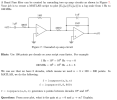 A Band Pass filter can be created by cascading two op amp circuits as shown in Figure 7. Your job is to create a MATLAB script to plot IVo(jw)/V(jw) in a log scale from 1 Hz to 100 MHz. 1 kS2 1 nF F 500 2 500 ? _vlt) Figure 7: Cascaded op amp circuit Hints: Use 100 points per decade so your script runs faster. For example 1Hz = 102-100 Hz ? a = 0 100 MHz-106-108 Hz-, b-8...
Laboratory 1: operation amplifier characteristics A. Objectives: 1. To study the basic characteri...
 thanks
Laboratory 1: operation amplifier characteristics A. Objectives: 1. To study the basic characteristics of an operational amplifier 2. To study the bias circuit of an operational amplifier B. Apparatus: 1. DC Power supply 2. Experimental board and corresponding components 3. Electronic calculator (prepared by students) 4. Digital camera (prepared by students for photo taking of the experimental results) 5. Laptop computer with the software PicoScope 6 and Microsoft Word installed. 6. PicoScope PC Oscilloscope and its accessories. 7. Multimeter...
thanks
Laboratory 1: operation amplifier characteristics A. Objectives: 1. To study the basic characteristics of an operational amplifier 2. To study the bias circuit of an operational amplifier B. Apparatus: 1. DC Power supply 2. Experimental board and corresponding components 3. Electronic calculator (prepared by students) 4. Digital camera (prepared by students for photo taking of the experimental results) 5. Laptop computer with the software PicoScope 6 and Microsoft Word installed. 6. PicoScope PC Oscilloscope and its accessories. 7. Multimeter...
Problem 1 (25 Pts) Consider the OP amp circuit shown below with R = 100kN and...
 Problem 1 (25 Pts) Consider the OP amp circuit shown below with R = 100kN and C = 1(10): Parta) 10 pts Find the complex transfer function for the circuit in terms of frequency f(Hz). Part b) 5 pts Compute the gain of at as a function of frequency f(Hz). Parte) 10 pts Compute the corresponding gains at 100, 1000, 10000 Hz. R 3R 5R Vå w V
Problem 1 (25 Pts) Consider the OP amp circuit shown below with R = 100kN and...
 Problem 1 (25 Pts) Consider the OP amp circuit shown below with R = 100kN and C = 1(10)-5 F: for the circuit in terms of frequency f(Hz). VO Part b) 5 pts Compute the gain of at as a function of frequency f(Hz). Vi Part c) 10 pts Compute the corresponding gains at 100, 1000, 10000 Hz. Part a) 10 pts Find the complex transfer function in R 3R 5R Via V.
Problem 1 (25 Pts) Consider the OP amp circuit shown below with R = 100kN and...
 Problem 1 (25 Pts) Consider the OP amp circuit shown below with R = 100kN and C = 1(10)-5 F: Part a) 10 pts Find the complex transfer function for the circuit in terms of frequency f (Hz). Vi Part b) 5 pts Compute the gain of at as a function of frequency f(Hz). Part c) 10 pts Compute the corresponding gains at 100, 1000, 10000 Hz. Vo R 3R 5R с Vů V.
Learning Goal: To analyze op amps that sum different input voltages. Before proceeding, review summing op...
 Learning Goal: To analyze op amps that sum different input voltages. Before proceeding, review summing op amp circuits and the ideal op amp assumptions. Figure 1 of 1 Review Part A - Calculating the output voltage of a summing op amp circuit For the circuit shown(Figure 1). determine V, when R1 = 3.4 kN, R2 = 5.0 kN. R3 = 7.0 kN Rp = 100 kn. Vi = 20 mV, V = 50 mV V3 = 280 mV and Voc...
Problem 1 (25 Pts) Consider the OP amp circuit shown below with R = 100kN and...
 Problem 1 (25 Pts) Consider the OP amp circuit shown below with R = 100kN and C = 1(10)-SP: Part a) 10 pts Find the complex transfer function for the circuit in terms of frequency f(Hz). Part b) 5 pts Compute the gain ofat as a function of frequency f(Hz). Parte) 10 pts Compute the corresponding gains at 100, 1000, 10000 Hz. R 3R 5R Vim -VO
Problem 1 (25 Pts) Consider the OP amp circuit shown below with R = 100kN and...
 Problem 1 (25 Pts) Consider the OP amp circuit shown below with R = 100kN and C = 1(10)-5F: Part a) 10 pts Find the complex transfer functions for the circuit in terms of frequency f(Hz). Part b) 5 pts Compute the gain ofat as a function of frequency f(Hz). Parte) 10 pts Compute the corresponding gains at 100, 1000, 10000 Hz. R 3R 5R Vi ve
Determine the complex transfer function T(s) = V/V; for the circuit shown below. Specify it as...
 Determine the complex transfer function T(s) = V/V; for the circuit shown below. Specify it as a function of the complex frequency, s, and the symbols for the resistors and capacitor. On the attached graph, plot the magnitude of the complex transfer function T(jw) in decibels as a function of the frequency f of the source as f varies from 1 Hz to 1 MHz. Assume that the op amp is ideal. Use as the numerical values for the resistors...
 Problem 1) (25 points) Consider the op amp based electrical circuit shown in Figure P1. 6 a. Obtain the differential equations involving v, and v. (15 points) b. Find the transfer function H(s) = V(s)/V(s). (10 points) + Ito Figure P1
 A Band Pass filter can be created by cascading two op amp circuits as shown in Figure 7. Your job is to create a MATLAB script to plot IVo(jw)/V(jw) in a log scale from 1 Hz to 100 MHz. 1 kS2 1 nF F 500 2 500 ? _vlt) Figure 7: Cascaded op amp circuit Hints: Use 100 points per decade so your script runs faster. For example 1Hz = 102-100 Hz ? a = 0 100 MHz-106-108 Hz-, b-8...
 thanks
Laboratory 1: operation amplifier characteristics A. Objectives: 1. To study the basic characteristics of an operational amplifier 2. To study the bias circuit of an operational amplifier B. Apparatus: 1. DC Power supply 2. Experimental board and corresponding components 3. Electronic calculator (prepared by students) 4. Digital camera (prepared by students for photo taking of the experimental results) 5. Laptop computer with the software PicoScope 6 and Microsoft Word installed. 6. PicoScope PC Oscilloscope and its accessories. 7. Multimeter...
thanks
Laboratory 1: operation amplifier characteristics A. Objectives: 1. To study the basic characteristics of an operational amplifier 2. To study the bias circuit of an operational amplifier B. Apparatus: 1. DC Power supply 2. Experimental board and corresponding components 3. Electronic calculator (prepared by students) 4. Digital camera (prepared by students for photo taking of the experimental results) 5. Laptop computer with the software PicoScope 6 and Microsoft Word installed. 6. PicoScope PC Oscilloscope and its accessories. 7. Multimeter...
 Problem 1 (25 Pts) Consider the OP amp circuit shown below with R = 100kN and C = 1(10): Parta) 10 pts Find the complex transfer function for the circuit in terms of frequency f(Hz). Part b) 5 pts Compute the gain of at as a function of frequency f(Hz). Parte) 10 pts Compute the corresponding gains at 100, 1000, 10000 Hz. R 3R 5R Vå w V
 Problem 1 (25 Pts) Consider the OP amp circuit shown below with R = 100kN and C = 1(10)-5 F: for the circuit in terms of frequency f(Hz). VO Part b) 5 pts Compute the gain of at as a function of frequency f(Hz). Vi Part c) 10 pts Compute the corresponding gains at 100, 1000, 10000 Hz. Part a) 10 pts Find the complex transfer function in R 3R 5R Via V.
 Problem 1 (25 Pts) Consider the OP amp circuit shown below with R = 100kN and C = 1(10)-5 F: Part a) 10 pts Find the complex transfer function for the circuit in terms of frequency f (Hz). Vi Part b) 5 pts Compute the gain of at as a function of frequency f(Hz). Part c) 10 pts Compute the corresponding gains at 100, 1000, 10000 Hz. Vo R 3R 5R с Vů V.
 Learning Goal: To analyze op amps that sum different input voltages. Before proceeding, review summing op amp circuits and the ideal op amp assumptions. Figure 1 of 1 Review Part A - Calculating the output voltage of a summing op amp circuit For the circuit shown(Figure 1). determine V, when R1 = 3.4 kN, R2 = 5.0 kN. R3 = 7.0 kN Rp = 100 kn. Vi = 20 mV, V = 50 mV V3 = 280 mV and Voc...
 Problem 1 (25 Pts) Consider the OP amp circuit shown below with R = 100kN and C = 1(10)-SP: Part a) 10 pts Find the complex transfer function for the circuit in terms of frequency f(Hz). Part b) 5 pts Compute the gain ofat as a function of frequency f(Hz). Parte) 10 pts Compute the corresponding gains at 100, 1000, 10000 Hz. R 3R 5R Vim -VO
 Problem 1 (25 Pts) Consider the OP amp circuit shown below with R = 100kN and C = 1(10)-5F: Part a) 10 pts Find the complex transfer functions for the circuit in terms of frequency f(Hz). Part b) 5 pts Compute the gain ofat as a function of frequency f(Hz). Parte) 10 pts Compute the corresponding gains at 100, 1000, 10000 Hz. R 3R 5R Vi ve
 Determine the complex transfer function T(s) = V/V; for the circuit shown below. Specify it as a function of the complex frequency, s, and the symbols for the resistors and capacitor. On the attached graph, plot the magnitude of the complex transfer function T(jw) in decibels as a function of the frequency f of the source as f varies from 1 Hz to 1 MHz. Assume that the op amp is ideal. Use as the numerical values for the resistors...
Most questions answered within 3 hours.
-
Where is the error in this code sequence?
String s1 = "Hello";
String s2 = "ello";...
asked 11 months ago -
Financial data for Joel de Paris, Inc., for last year
follow:
Joel de Paris, Inc.
Balance...
asked 11 months ago -
Consider this reaction:
Al2(SO4)3 (aq)+ BaCl3
(aq) Al2Cl6 (aq)- +
3BaSO4(s) . What is the...
asked 11 months ago -
Suppose that Savneet is considering increasing her
recent random sample from 20 car rentals to 40...
asked 11 months ago -
Trucks arrive at an unloading terminal at an average rate of 120
per hour.
Trucks arrive...
asked 11 months ago -
Why are methanol and ethanol completely soluble in water while
octanol is not very little soluble....
asked 11 months ago -
A facilities manager at a university reads in a research report
that the mean amount of...
asked 11 months ago -
When the CuSO4 is rehydrated by adding water to the anhydrous
compound, is this an endothermic...
asked 11 months ago -
A ray of sunlight is passing from diamond into crown glass; the
angle of incidence is...
asked 11 months ago -
A block of mass 0.249 kg is placed on top of a light, vertical
spring of...
asked 11 months ago -
how do the kidneys compensate in the presences of acidosis
a) trigger hyperventilate
b) reserve acid...
asked 11 months ago -
Question 501 pts
The rental rate of capital to the firm increases. Which of the
following...
asked 11 months ago