• For the circuit in Figure 1, assume that the voltage drop across the infrared emitter...
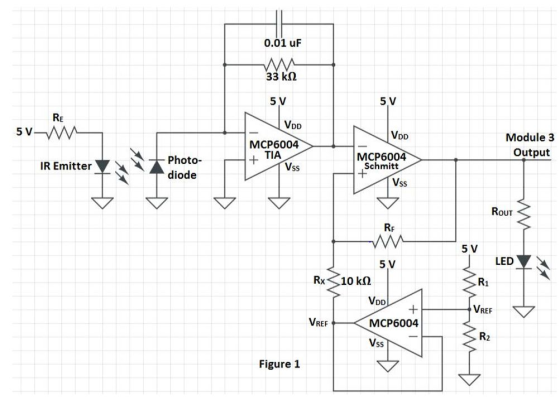
• For the circuit in Figure 1, assume that the voltage drop across the infrared emitter is 1.3 V. Determine the value of RE that will limit the emitter current to a maximum of 50 mA.
• For the circuit in Figure 1, assume RX = 10 kΩ and VS = 5 V. Using the equation given in the introduction section, determine the value of RF needed to implement the Schmitt Trigger with a spread or hysteresis value between 0.5 V to 1 V. Use only standard resistor values in your lab kit.
• VREF must equal 2.5 V. In Lab 7, a buffer op-amp was used to provide this voltage. You may use the same op-amp to provide VREF to both Modules 2 and 3. Use the same values of ROUT, R1 and R2 that you used in Labs 6 and 7.
Homework Answers


Add Answer to:
• For the circuit in Figure 1, assume that the voltage drop
across the infrared emitter...
For the circuit in Figure 1, assme that the voltage drop across the infrared emitter is 1.3 V. De...
 R1= 12 K ohm
R2= 12 K ohm
rout= 1.2 K ohm
For the circuit in Figure 1, assme that the voltage drop across the infrared emitter is 1.3 V. Determine the value of RE that will set the current through the emitter to a value within the range of 50 mA to 80 mA. For the circuit in Figure 1, assume Rx 10 kQ and Vs 5 V. Using the equation given in the introduction section, determine the value...
R1= 12 K ohm
R2= 12 K ohm
rout= 1.2 K ohm
For the circuit in Figure 1, assme that the voltage drop across the infrared emitter is 1.3 V. Determine the value of RE that will set the current through the emitter to a value within the range of 50 mA to 80 mA. For the circuit in Figure 1, assume Rx 10 kQ and Vs 5 V. Using the equation given in the introduction section, determine the value...
For the driven-right-leg system below along with its equivalent circuit, assume 4. R,-5M0(non-ideal input impedance of op-amp) db Rx Auxiliary op amp RL db R1 Vcm_ Vi R5 2 RF R4 Rx o v RG 0 7 RA Aux...
 For the driven-right-leg system below along with its equivalent circuit, assume 4. R,-5M0(non-ideal input impedance of op-amp) db Rx Auxiliary op amp RL db R1 Vcm_ Vi R5 2 RF R4 Rx o v RG 0 7 RA Auxiliary Amplifier O VREF 2 R2 What are the benefits of using the driven-right-leg circuit? What is the value of the common-mode voltage if resistor RRL is tied to ground instead of the auxiliary amplifier? e.
For the driven-right-leg system below along...
For the driven-right-leg system below along with its equivalent circuit, assume 4. R,-5M0(non-ideal input impedance of op-amp) db Rx Auxiliary op amp RL db R1 Vcm_ Vi R5 2 RF R4 Rx o v RG 0 7 RA Auxiliary Amplifier O VREF 2 R2 What are the benefits of using the driven-right-leg circuit? What is the value of the common-mode voltage if resistor RRL is tied to ground instead of the auxiliary amplifier? e.
For the driven-right-leg system below along...
Part C - Saturation of a summing op amp circuit For the circuit shown(Figure 2), determine...
 Part C - Saturation of a summing op amp circuit
For the circuit shown(Figure 2), determine the range (i.e.,
maximum and minimum values) of V1V1 such that the op amp operates
in the linear region. Assume that R1 = 5.0 kΩ , R2 = 8.2 kΩ , R3 =
8.2 kΩ , RF = 180 kΩ , V2 = 10 mV, V3 = 60 mV , and VCC = 15 V
.
Express your answer to three significant figures separated...
Part C - Saturation of a summing op amp circuit
For the circuit shown(Figure 2), determine the range (i.e.,
maximum and minimum values) of V1V1 such that the op amp operates
in the linear region. Assume that R1 = 5.0 kΩ , R2 = 8.2 kΩ , R3 =
8.2 kΩ , RF = 180 kΩ , V2 = 10 mV, V3 = 60 mV , and VCC = 15 V
.
Express your answer to three significant figures separated...
Solve by using basic node-voltage or superposition! The op amp in the circuit of Fig. P5.23...
 Solve by using basic node-voltage or superposition! The op amp in the circuit of Fig. P5.23 is ideal. a) What op amp circuit configuration is this? b) Find vo in terms of vs c) Find the range of values for such that does not saturate and the op amp remains in its linear region of operation. Figure P5.23 96 kΩ 24 kΩ 10 V 16 kΩ 10V 24 kΩ
Question 3 (Marks: 14) Regarding the following Op-Amp circuit in figure 3: 80 kΩ 80 kΩ...
 Question 3 (Marks: 14) Regarding the following Op-Amp circuit in figure 3: 80 kΩ 80 kΩ 20 ΚΩ 40 kΩ 1.2V 20 kg 2.8V Figure 3 Q.3.1 Define the different stages of the Op-Amp circuit. What does each Op-Amp do? Q.3.2 Calculate the output voltage Vo (6) Q.3.3 (4) How would you modify the circuit to double the output voltage V.? You cannot change the input voltages. Give the method and value of component/s changed. (Your answer needs to provide...
A. (10 pts) Implement the voltage amplifier shown below using an ideal op amp circuit. You have o...
 a. (10 pts) Implement the voltage amplifier shown below using an ideal op amp circuit. You have one op amp available for this circuit, and a range of resistors with values from 1 kΩ to 100 ka. Draw the schematic of your op amp circuit, labeling resistor values. Make sure the gain, input resistance, and output resistance of your circuit matches the model in the schematic. R=012 *100v, RL 100 b. (5 pts) Your amplifier circuit should have a frequency...
how to draw this circuit in pspice PRE-LAB Resistors 150kQ, 180k2, 220k2, 270k2, 330k2, 39k02, 470k2, 560kQ Part A. I...
 how to draw this circuit in pspice
PRE-LAB Resistors 150kQ, 180k2, 220k2, 270k2, 330k2, 39k02, 470k2, 560kQ Part A. Inverting Amplifier. Deliverables - PSpice schematie and graphs 1. Draw the circuit for a standard inverting amplifier (see text). You can leave the resistors variables for now: Ai 2. Choose the resistor values from components available for this lab in the list above to give a gain between 5 and 10. Use values of 5.6 kΩ or greater. Record the resistor...
how to draw this circuit in pspice
PRE-LAB Resistors 150kQ, 180k2, 220k2, 270k2, 330k2, 39k02, 470k2, 560kQ Part A. Inverting Amplifier. Deliverables - PSpice schematie and graphs 1. Draw the circuit for a standard inverting amplifier (see text). You can leave the resistors variables for now: Ai 2. Choose the resistor values from components available for this lab in the list above to give a gain between 5 and 10. Use values of 5.6 kΩ or greater. Record the resistor...
The op amp in the circuit in (Figure 1) is ideal. Suppose R-16 kΩ Part A...
 The op amp in the circuit in (Figure 1) is ideal. Suppose R-16 kΩ Part A What op amp circuit configuration is this? O This circuit is an example of the inverting amplifier o This circuit is an example of the non-inverting amplifier Submit Request Answer ▼ Part B Find vo in terms of vs Express your answer in terms of vs 07 Figure 1 of 1 > Submit Request Answer Part C 56 kΩ Find the minimum value of...
Laboratory 1: operation amplifier characteristics A. Objectives: 1. To study the basic characteri...
 thanks
Laboratory 1: operation amplifier characteristics A. Objectives: 1. To study the basic characteristics of an operational amplifier 2. To study the bias circuit of an operational amplifier B. Apparatus: 1. DC Power supply 2. Experimental board and corresponding components 3. Electronic calculator (prepared by students) 4. Digital camera (prepared by students for photo taking of the experimental results) 5. Laptop computer with the software PicoScope 6 and Microsoft Word installed. 6. PicoScope PC Oscilloscope and its accessories. 7. Multimeter...
thanks
Laboratory 1: operation amplifier characteristics A. Objectives: 1. To study the basic characteristics of an operational amplifier 2. To study the bias circuit of an operational amplifier B. Apparatus: 1. DC Power supply 2. Experimental board and corresponding components 3. Electronic calculator (prepared by students) 4. Digital camera (prepared by students for photo taking of the experimental results) 5. Laptop computer with the software PicoScope 6 and Microsoft Word installed. 6. PicoScope PC Oscilloscope and its accessories. 7. Multimeter...
1. Set up the circuit of Figure 1. Notice that the voltage probes have been renamed...
 1. Set up the circuit of Figure 1. Notice that the voltage probes have been renamed VB and VE, and the display has been customized to only show V(dc). You can do this by double-clicking the display and selecting the parameters tab. VCC 20.0V RB 470KO VB Q2 2N4124 Vide- Vide) VE RE $2.20 FIGURE 1: EMITTER FOLLOWER AMPLIFIER TECH 150 - Electronic Devices and Circuits Lab 10 - The Emitter Follower Amplifier - using Multisim 2. Calculate the theoretical...
 R1= 12 K ohm
R2= 12 K ohm
rout= 1.2 K ohm
For the circuit in Figure 1, assme that the voltage drop across the infrared emitter is 1.3 V. Determine the value of RE that will set the current through the emitter to a value within the range of 50 mA to 80 mA. For the circuit in Figure 1, assume Rx 10 kQ and Vs 5 V. Using the equation given in the introduction section, determine the value...
R1= 12 K ohm
R2= 12 K ohm
rout= 1.2 K ohm
For the circuit in Figure 1, assme that the voltage drop across the infrared emitter is 1.3 V. Determine the value of RE that will set the current through the emitter to a value within the range of 50 mA to 80 mA. For the circuit in Figure 1, assume Rx 10 kQ and Vs 5 V. Using the equation given in the introduction section, determine the value...
 For the driven-right-leg system below along with its equivalent circuit, assume 4. R,-5M0(non-ideal input impedance of op-amp) db Rx Auxiliary op amp RL db R1 Vcm_ Vi R5 2 RF R4 Rx o v RG 0 7 RA Auxiliary Amplifier O VREF 2 R2 What are the benefits of using the driven-right-leg circuit? What is the value of the common-mode voltage if resistor RRL is tied to ground instead of the auxiliary amplifier? e.
For the driven-right-leg system below along...
For the driven-right-leg system below along with its equivalent circuit, assume 4. R,-5M0(non-ideal input impedance of op-amp) db Rx Auxiliary op amp RL db R1 Vcm_ Vi R5 2 RF R4 Rx o v RG 0 7 RA Auxiliary Amplifier O VREF 2 R2 What are the benefits of using the driven-right-leg circuit? What is the value of the common-mode voltage if resistor RRL is tied to ground instead of the auxiliary amplifier? e.
For the driven-right-leg system below along...
 Part C - Saturation of a summing op amp circuit
For the circuit shown(Figure 2), determine the range (i.e.,
maximum and minimum values) of V1V1 such that the op amp operates
in the linear region. Assume that R1 = 5.0 kΩ , R2 = 8.2 kΩ , R3 =
8.2 kΩ , RF = 180 kΩ , V2 = 10 mV, V3 = 60 mV , and VCC = 15 V
.
Express your answer to three significant figures separated...
Part C - Saturation of a summing op amp circuit
For the circuit shown(Figure 2), determine the range (i.e.,
maximum and minimum values) of V1V1 such that the op amp operates
in the linear region. Assume that R1 = 5.0 kΩ , R2 = 8.2 kΩ , R3 =
8.2 kΩ , RF = 180 kΩ , V2 = 10 mV, V3 = 60 mV , and VCC = 15 V
.
Express your answer to three significant figures separated...
 Solve by using basic node-voltage or superposition! The op amp in the circuit of Fig. P5.23 is ideal. a) What op amp circuit configuration is this? b) Find vo in terms of vs c) Find the range of values for such that does not saturate and the op amp remains in its linear region of operation. Figure P5.23 96 kΩ 24 kΩ 10 V 16 kΩ 10V 24 kΩ
 Question 3 (Marks: 14) Regarding the following Op-Amp circuit in figure 3: 80 kΩ 80 kΩ 20 ΚΩ 40 kΩ 1.2V 20 kg 2.8V Figure 3 Q.3.1 Define the different stages of the Op-Amp circuit. What does each Op-Amp do? Q.3.2 Calculate the output voltage Vo (6) Q.3.3 (4) How would you modify the circuit to double the output voltage V.? You cannot change the input voltages. Give the method and value of component/s changed. (Your answer needs to provide...
 a. (10 pts) Implement the voltage amplifier shown below using an ideal op amp circuit. You have one op amp available for this circuit, and a range of resistors with values from 1 kΩ to 100 ka. Draw the schematic of your op amp circuit, labeling resistor values. Make sure the gain, input resistance, and output resistance of your circuit matches the model in the schematic. R=012 *100v, RL 100 b. (5 pts) Your amplifier circuit should have a frequency...
 how to draw this circuit in pspice
PRE-LAB Resistors 150kQ, 180k2, 220k2, 270k2, 330k2, 39k02, 470k2, 560kQ Part A. Inverting Amplifier. Deliverables - PSpice schematie and graphs 1. Draw the circuit for a standard inverting amplifier (see text). You can leave the resistors variables for now: Ai 2. Choose the resistor values from components available for this lab in the list above to give a gain between 5 and 10. Use values of 5.6 kΩ or greater. Record the resistor...
how to draw this circuit in pspice
PRE-LAB Resistors 150kQ, 180k2, 220k2, 270k2, 330k2, 39k02, 470k2, 560kQ Part A. Inverting Amplifier. Deliverables - PSpice schematie and graphs 1. Draw the circuit for a standard inverting amplifier (see text). You can leave the resistors variables for now: Ai 2. Choose the resistor values from components available for this lab in the list above to give a gain between 5 and 10. Use values of 5.6 kΩ or greater. Record the resistor...
 The op amp in the circuit in (Figure 1) is ideal. Suppose R-16 kΩ Part A What op amp circuit configuration is this? O This circuit is an example of the inverting amplifier o This circuit is an example of the non-inverting amplifier Submit Request Answer ▼ Part B Find vo in terms of vs Express your answer in terms of vs 07 Figure 1 of 1 > Submit Request Answer Part C 56 kΩ Find the minimum value of...
 thanks
Laboratory 1: operation amplifier characteristics A. Objectives: 1. To study the basic characteristics of an operational amplifier 2. To study the bias circuit of an operational amplifier B. Apparatus: 1. DC Power supply 2. Experimental board and corresponding components 3. Electronic calculator (prepared by students) 4. Digital camera (prepared by students for photo taking of the experimental results) 5. Laptop computer with the software PicoScope 6 and Microsoft Word installed. 6. PicoScope PC Oscilloscope and its accessories. 7. Multimeter...
thanks
Laboratory 1: operation amplifier characteristics A. Objectives: 1. To study the basic characteristics of an operational amplifier 2. To study the bias circuit of an operational amplifier B. Apparatus: 1. DC Power supply 2. Experimental board and corresponding components 3. Electronic calculator (prepared by students) 4. Digital camera (prepared by students for photo taking of the experimental results) 5. Laptop computer with the software PicoScope 6 and Microsoft Word installed. 6. PicoScope PC Oscilloscope and its accessories. 7. Multimeter...
 1. Set up the circuit of Figure 1. Notice that the voltage probes have been renamed VB and VE, and the display has been customized to only show V(dc). You can do this by double-clicking the display and selecting the parameters tab. VCC 20.0V RB 470KO VB Q2 2N4124 Vide- Vide) VE RE $2.20 FIGURE 1: EMITTER FOLLOWER AMPLIFIER TECH 150 - Electronic Devices and Circuits Lab 10 - The Emitter Follower Amplifier - using Multisim 2. Calculate the theoretical...
Most questions answered within 3 hours.
-
Where is the error in this code sequence?
String s1 = "Hello";
String s2 = "ello";...
asked 11 months ago -
Financial data for Joel de Paris, Inc., for last year
follow:
Joel de Paris, Inc.
Balance...
asked 11 months ago -
Consider this reaction:
Al2(SO4)3 (aq)+ BaCl3
(aq) Al2Cl6 (aq)- +
3BaSO4(s) . What is the...
asked 11 months ago -
Suppose that Savneet is considering increasing her
recent random sample from 20 car rentals to 40...
asked 11 months ago -
Trucks arrive at an unloading terminal at an average rate of 120
per hour.
Trucks arrive...
asked 11 months ago -
Why are methanol and ethanol completely soluble in water while
octanol is not very little soluble....
asked 11 months ago -
A facilities manager at a university reads in a research report
that the mean amount of...
asked 11 months ago -
When the CuSO4 is rehydrated by adding water to the anhydrous
compound, is this an endothermic...
asked 11 months ago -
A ray of sunlight is passing from diamond into crown glass; the
angle of incidence is...
asked 11 months ago -
A block of mass 0.249 kg is placed on top of a light, vertical
spring of...
asked 11 months ago -
how do the kidneys compensate in the presences of acidosis
a) trigger hyperventilate
b) reserve acid...
asked 11 months ago -
Question 501 pts
The rental rate of capital to the firm increases. Which of the
following...
asked 11 months ago