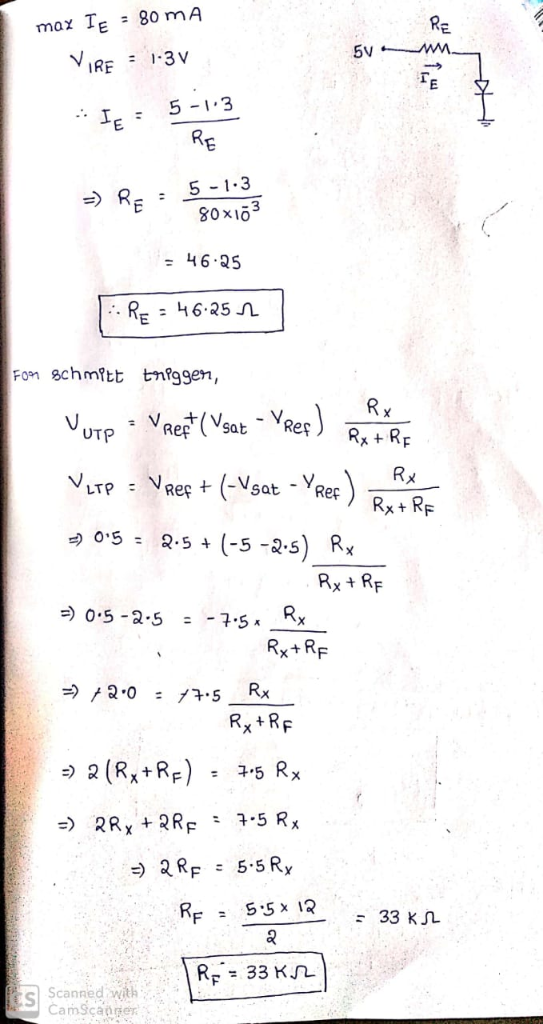
R1= 12 K ohm
R2= 12 K ohm
rout= 1.2 K ohm
Homework Answers
Add Answer to:
For the circuit in Figure 1, assme that the voltage drop across the infrared emitter is 1.3 V. De...
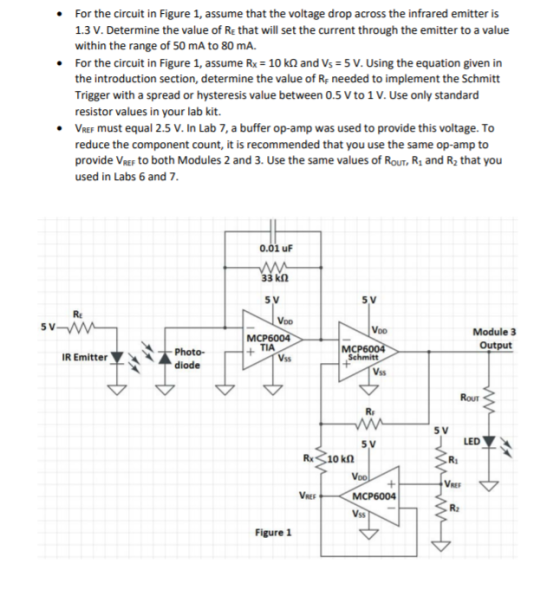
• For the circuit in Figure 1, assume that the voltage drop across the infrared emitter...
 • For the circuit in Figure 1, assume that the voltage drop
across the infrared emitter is 1.3 V. Determine the value of RE
that will limit the emitter current to a maximum of 50 mA.
• For the circuit in Figure 1, assume RX = 10 kΩ and VS = 5 V.
Using the equation given in the introduction section, determine the
value of RF needed to implement the Schmitt Trigger with a spread
or hysteresis value between 0.5...
• For the circuit in Figure 1, assume that the voltage drop
across the infrared emitter is 1.3 V. Determine the value of RE
that will limit the emitter current to a maximum of 50 mA.
• For the circuit in Figure 1, assume RX = 10 kΩ and VS = 5 V.
Using the equation given in the introduction section, determine the
value of RF needed to implement the Schmitt Trigger with a spread
or hysteresis value between 0.5...
For the circuit below, the output is at 15 V and the input voltage is at +2 V if the input voltage is gradually lowered to -2 V, at what input voltage does the output switch from +15 V to-15 V (to 1...
 For the circuit below, the output is at 15 V and the input voltage is at +2 V if the input voltage is gradually lowered to -2 V, at what input voltage does the output switch from +15 V to-15 V (to 1 % accuracy)? The op-amp has rail-to-rail swing, and a gain-bandwidth product of 3 MHz. The resistors used are r1 -1.5 k ohm and r2 22.8 k ohm r2 Vin 2 +2 V +15 V r1 f 1...
For the circuit below, the output is at-15 V, and the input voltage is at +2 V if the input voltage is gradually lowered to -2 V, at what input voltage does the output switch from-15 V to +15 V (to 1...
 For the circuit below, the output is at-15 V, and the input voltage is at +2 V if the input voltage is gradually lowered to -2 V, at what input voltage does the output switch from-15 V to +15 V (to 1 % accuracy)? The op-amp has rail-to-rail swing, and a gain-bandwidth product of 3 MHz. The resistors used are r1 0.6 k ohm and r2 49.8 k ohm. r2 Vin 2/+2 V +15 V r1 out f-1 kHz 15...
For the circuit below, the output is at -15 V, and the input voltage is at -2 V. if the input voltage is gradually raised to 2 V, at what input voltage does the output switch from-15 V to +15 V (to 1...
 For the circuit below, the output is at -15 V, and the input voltage is at -2 V. if the input voltage is gradually raised to 2 V, at what input voltage does the output switch from-15 V to +15 V (to 1% accuracy)? - The op-amp has rail-to-rail swing, and a gain-bandwidth product of 3 MHz. The resistors used are r1 1.3 k ohm and r2 37.7 k ohm r2 Vin 2/+2 V +15 V r1 o out f...
[1] The circuit diagram on the left below is a common emitter amplifier. It is the...
 [1] The circuit diagram on the left below is a common emitter amplifier. It is the full complement of components for this type of amplifier ready for AC analysis. This amplifier will be discussed in lecture prior to the lab exercises. However, with the circuit including only Rc. RE, Ri, and R2 as shown in the figure on the right, proceed with the design for a DC operating point of the common emitter amplifier. The following parameters are given: Vcc...
Good morning, I need help with the following, they all relate to OP Amps. Thanks in advance. 2 value 10.00 points Problem 05.010 An op amp voltage divider Find the voltage gain vo/vs of the circ...
 Good morning, I need help with the following, they all relate to
OP Amps. Thanks in advance.
2 value 10.00 points Problem 05.010 An op amp voltage divider Find the voltage gain vo/vs of the circuit given below, where R1-18 kΩ and R2-14 k 2. 20 kΩ R1 1% R2 The voltage gain vo/vs of the circuit is Hints Referene eBook & Resources Hint#1 Check my work 3. 1000 points value Problem 05.025-Voltage follower Calculate the output voltage vo in...
Good morning, I need help with the following, they all relate to
OP Amps. Thanks in advance.
2 value 10.00 points Problem 05.010 An op amp voltage divider Find the voltage gain vo/vs of the circuit given below, where R1-18 kΩ and R2-14 k 2. 20 kΩ R1 1% R2 The voltage gain vo/vs of the circuit is Hints Referene eBook & Resources Hint#1 Check my work 3. 1000 points value Problem 05.025-Voltage follower Calculate the output voltage vo in...
Q2. For the op-amp circuit as shown below, given that RS = 49.5 k, RL =...
 Q2. For the op-amp circuit as shown below, given that RS = 49.5 k, RL = 12 k 2, R1 = 10 kO, R2 = 9 ㏀, R3 = 7.5 ko, R4 = 5 ㏀R5 = 2.2 k2 Ry vo Ry Ri Rs (a) Determine the voltage gain G1-vo1/vs: Submit Answer Tries o/5 (b) Determine the voltage gain G2-vo/vs: Submit Answer Tries o/5 Q3. For the op-amp circuit shown below, find the value of VO, where R1 = 20 Ω,...
The input voltage v/in the circuit shown in the figure below is -0.02V. If the op...
 The input voltage v/in the circuit shown in the figure below is -0.02V. If the op amp is ideal, the current i_0 is 0.02 mA 0.095 mA - 0.095 mA - 0.02 mA
In the circuit below, use the method of your choice to compute the voltage drop across...
 In the circuit below, use the method of your choice to compute the voltage drop across the 5 Ohm resistor. 2 A R3 20 Ohms R2 10 Ohms +V1 V2 R1 5 Ohms 12 V 6 V QUESTION 10 In the previous problem, suppose that R1 is a "load". Compute the Thevenin equivalent resistance of the remaining circuit.
Question 6. (3 marks) Consider the relaxation oscillator circuit shown in Figure 4. Find the time...
 Question 6. (3 marks) Consider the relaxation oscillator circuit shown in Figure 4. Find the time period of the output (which is the output of the op-amp). Assume that the voltage drop across a forward biased diode is negligible. R ? R C = 6 micro-Farad + R= 2 k-Ohm V = 7 volt R1 = 2 k-Ohm R2 = 6 k-Ohm Selected Answer: Correct Answer: 52.7 + 0.5% 52.7 + 0.5% > R2 HHwwKG Figure 4: Circuit for Question...
 • For the circuit in Figure 1, assume that the voltage drop
across the infrared emitter is 1.3 V. Determine the value of RE
that will limit the emitter current to a maximum of 50 mA.
• For the circuit in Figure 1, assume RX = 10 kΩ and VS = 5 V.
Using the equation given in the introduction section, determine the
value of RF needed to implement the Schmitt Trigger with a spread
or hysteresis value between 0.5...
• For the circuit in Figure 1, assume that the voltage drop
across the infrared emitter is 1.3 V. Determine the value of RE
that will limit the emitter current to a maximum of 50 mA.
• For the circuit in Figure 1, assume RX = 10 kΩ and VS = 5 V.
Using the equation given in the introduction section, determine the
value of RF needed to implement the Schmitt Trigger with a spread
or hysteresis value between 0.5...
 For the circuit below, the output is at 15 V and the input voltage is at +2 V if the input voltage is gradually lowered to -2 V, at what input voltage does the output switch from +15 V to-15 V (to 1 % accuracy)? The op-amp has rail-to-rail swing, and a gain-bandwidth product of 3 MHz. The resistors used are r1 -1.5 k ohm and r2 22.8 k ohm r2 Vin 2 +2 V +15 V r1 f 1...
 For the circuit below, the output is at-15 V, and the input voltage is at +2 V if the input voltage is gradually lowered to -2 V, at what input voltage does the output switch from-15 V to +15 V (to 1 % accuracy)? The op-amp has rail-to-rail swing, and a gain-bandwidth product of 3 MHz. The resistors used are r1 0.6 k ohm and r2 49.8 k ohm. r2 Vin 2/+2 V +15 V r1 out f-1 kHz 15...
 For the circuit below, the output is at -15 V, and the input voltage is at -2 V. if the input voltage is gradually raised to 2 V, at what input voltage does the output switch from-15 V to +15 V (to 1% accuracy)? - The op-amp has rail-to-rail swing, and a gain-bandwidth product of 3 MHz. The resistors used are r1 1.3 k ohm and r2 37.7 k ohm r2 Vin 2/+2 V +15 V r1 o out f...
 [1] The circuit diagram on the left below is a common emitter amplifier. It is the full complement of components for this type of amplifier ready for AC analysis. This amplifier will be discussed in lecture prior to the lab exercises. However, with the circuit including only Rc. RE, Ri, and R2 as shown in the figure on the right, proceed with the design for a DC operating point of the common emitter amplifier. The following parameters are given: Vcc...
 Good morning, I need help with the following, they all relate to
OP Amps. Thanks in advance.
2 value 10.00 points Problem 05.010 An op amp voltage divider Find the voltage gain vo/vs of the circuit given below, where R1-18 kΩ and R2-14 k 2. 20 kΩ R1 1% R2 The voltage gain vo/vs of the circuit is Hints Referene eBook & Resources Hint#1 Check my work 3. 1000 points value Problem 05.025-Voltage follower Calculate the output voltage vo in...
Good morning, I need help with the following, they all relate to
OP Amps. Thanks in advance.
2 value 10.00 points Problem 05.010 An op amp voltage divider Find the voltage gain vo/vs of the circuit given below, where R1-18 kΩ and R2-14 k 2. 20 kΩ R1 1% R2 The voltage gain vo/vs of the circuit is Hints Referene eBook & Resources Hint#1 Check my work 3. 1000 points value Problem 05.025-Voltage follower Calculate the output voltage vo in...
 Q2. For the op-amp circuit as shown below, given that RS = 49.5 k, RL = 12 k 2, R1 = 10 kO, R2 = 9 ㏀, R3 = 7.5 ko, R4 = 5 ㏀R5 = 2.2 k2 Ry vo Ry Ri Rs (a) Determine the voltage gain G1-vo1/vs: Submit Answer Tries o/5 (b) Determine the voltage gain G2-vo/vs: Submit Answer Tries o/5 Q3. For the op-amp circuit shown below, find the value of VO, where R1 = 20 Ω,...
 The input voltage v/in the circuit shown in the figure below is -0.02V. If the op amp is ideal, the current i_0 is 0.02 mA 0.095 mA - 0.095 mA - 0.02 mA
 In the circuit below, use the method of your choice to compute the voltage drop across the 5 Ohm resistor. 2 A R3 20 Ohms R2 10 Ohms +V1 V2 R1 5 Ohms 12 V 6 V QUESTION 10 In the previous problem, suppose that R1 is a "load". Compute the Thevenin equivalent resistance of the remaining circuit.
 Question 6. (3 marks) Consider the relaxation oscillator circuit shown in Figure 4. Find the time period of the output (which is the output of the op-amp). Assume that the voltage drop across a forward biased diode is negligible. R ? R C = 6 micro-Farad + R= 2 k-Ohm V = 7 volt R1 = 2 k-Ohm R2 = 6 k-Ohm Selected Answer: Correct Answer: 52.7 + 0.5% 52.7 + 0.5% > R2 HHwwKG Figure 4: Circuit for Question...
Most questions answered within 3 hours.
-
Where is the error in this code sequence?
String s1 = "Hello";
String s2 = "ello";...
asked 11 months ago -
Financial data for Joel de Paris, Inc., for last year
follow:
Joel de Paris, Inc.
Balance...
asked 11 months ago -
Consider this reaction:
Al2(SO4)3 (aq)+ BaCl3
(aq) Al2Cl6 (aq)- +
3BaSO4(s) . What is the...
asked 11 months ago -
Suppose that Savneet is considering increasing her
recent random sample from 20 car rentals to 40...
asked 11 months ago -
Trucks arrive at an unloading terminal at an average rate of 120
per hour.
Trucks arrive...
asked 11 months ago -
Why are methanol and ethanol completely soluble in water while
octanol is not very little soluble....
asked 11 months ago -
A facilities manager at a university reads in a research report
that the mean amount of...
asked 11 months ago -
When the CuSO4 is rehydrated by adding water to the anhydrous
compound, is this an endothermic...
asked 11 months ago -
A ray of sunlight is passing from diamond into crown glass; the
angle of incidence is...
asked 11 months ago -
A block of mass 0.249 kg is placed on top of a light, vertical
spring of...
asked 11 months ago -
how do the kidneys compensate in the presences of acidosis
a) trigger hyperventilate
b) reserve acid...
asked 11 months ago -
Question 501 pts
The rental rate of capital to the firm increases. Which of the
following...
asked 11 months ago