|
Label the 5' and 3' ends of the template and primer strands in this image, from left to right in the image. Label the 5' and 3' ends of the template and primer strands in this image, from left to right in the image.
|

Homework Answers
The template strand is found in 3' to 5' of the direction. The RNA primer binds to it at 3' position.
And the direction of primer is 5' to 3' end. The upcoming nueotide binds at the 3' end of primer. Because the hydroxyl groul is present at the 3' end of primer.
Please look in the image for diagrammatic representation:
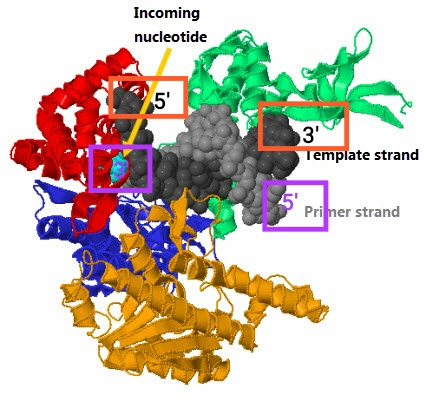
We have to give the direction feom left to right in the picture.
Answer is:
Template: 5' to 3'
Primer: 3' to 5'
Add Answer to:
Label the 5' and 3' ends of the template and primer strands in
this image, from...
The image shows a replication fork, template DNA strands, and new DNA strands. Label the image...
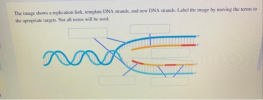 The image shows a replication fork, template DNA strands, and new DNA strands. Label the image by moving the terms to the apropriate targets. Not all terms will be used.
List the mechanistic steps of DNA synthesis starting with the primed template and deoxynucleoside triphosphate. A.)...
List the mechanistic steps of DNA synthesis starting with the primed template and deoxynucleoside triphosphate. A.) The hydrogen bond-dependent of the incoming nucleotide to the DNA template B.) Pyrophosphate is released and hydrolyzed to two phosphates by pyrophosphatase C.) the 3'-OH of the primer initiates a nucelophilic attack of the alpha-phosphate of the incoming nucleotide D.) The incoming nucleotide is now base-paired to the template and covalently linked to the primer DNA strand
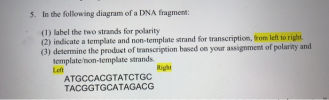
Please show work In the following diagram of a DNA fragment: 5. (1) label the two...
 Please show work
In the following diagram of a DNA fragment: 5. (1) label the two strands for polarity (2) indicate a template and non-template strand for transcription, from left to right. (3) determine the product of transcription based on your assignment of polarity and template/non-template strands. Right Left ATGCCACGTATCTGC TACGGTGCATAGACG 11
Please show work
In the following diagram of a DNA fragment: 5. (1) label the two strands for polarity (2) indicate a template and non-template strand for transcription, from left to right. (3) determine the product of transcription based on your assignment of polarity and template/non-template strands. Right Left ATGCCACGTATCTGC TACGGTGCATAGACG 11
1. Label the template and coding strand. Label upstream and downstream ends.
1. Label the template and coding strand. Label upstream and downstream ends.2. On the template strand identify the promoter.3. Identify the start site.4. Block off and number the triplets to be transcribed.5. Create the pre-mRNA. Label 5’ and 3’ ends.6. Using the codon table for mRNA (genetic dictionary), identify the start and stop codons.7. Identify the utrs (untranslated regions).8. Add a 5’ cap to the 5’ end of the mRNA transcript and a poly-A-tail to the 3’ end.9. Block off...
3: AAATCGCGATCGATGGTCTGAGTTTGAATC -5' 5' TTTAGCGCTAGCTACCAGACTCAAACTTAG-3' The following is an image of a section of DNA. If...
 3: AAATCGCGATCGATGGTCTGAGTTTGAATC -5' 5' TTTAGCGCTAGCTACCAGACTCAAACTTAG-3' The following is an image of a section of DNA. If areplication fork is moving from right to left, which strand (top or bottom) is the template Strand for the leading Strand?
This PCR step is called annealing. The annealing step follows the denaturation step: it is usually...
 This PCR step is called annealing. The annealing step follows the denaturation step: it is usually the lowest temperature in the PCR. The temperature of this step varies with each PCR reaction because each primer has its own sequence and may not be an identical match to the DNA template strand. GC or CG have three hydrogen bonds and AT or TA have two hydrogen bonds. Higher annealing temperatures are more stringent and require a better match between primer and...
please help 2. (a) Draw a dideoxyribonucleotide terminator (ddNTP). Label carbons with 1" through 5'. Draw...
 please help
2. (a) Draw a dideoxyribonucleotide terminator (ddNTP). Label carbons with 1" through 5'. Draw an arrow to point out the important functional difference between it and a regular deoxyribonucleotide (dNTP). You can show the base as a rectangle. (b) Which strand of DNA would result from sequencing with a primer that is taken directly from the top strand sequence- (e.g. a forward primer)- top or bottom strand sequence? (c) What sequence would you get- from the 5' side...
please help
2. (a) Draw a dideoxyribonucleotide terminator (ddNTP). Label carbons with 1" through 5'. Draw an arrow to point out the important functional difference between it and a regular deoxyribonucleotide (dNTP). You can show the base as a rectangle. (b) Which strand of DNA would result from sequencing with a primer that is taken directly from the top strand sequence- (e.g. a forward primer)- top or bottom strand sequence? (c) What sequence would you get- from the 5' side...
Description The three steps—the separation of the strands, annealing the primer to the template, and the...
Description The three steps—the separation of the strands, annealing the primer to the template, and the synthesis of new strands—take less than two minutes. Each is carried out in the same vial. At the end of a cycle, each piece of DNA in the vial has been duplicated. The cycle can be repeated 30 or more times, and each newly synthesized DNA piece acts as a new template. After 30 cycles, 1million copies of the initial DNA piece can be...
In the following diagram, label the following: leading and lagging strand
 In the following diagram, label the following: leading and lagging strand, Okazaki fragment, DNA polymerase, DNA ligase, helicase, RNA primase, singlestrand binding proteins, RNA primer, replication fork, topoisomerase and the 5' and 3' ends of strands.
5a. For the replication fork shown below: - label the leading and lagging strands; - draw...
 5a. For the replication fork shown below: - label the leading and lagging strands; - draw arrows to indicate which direction DNA synthesis is proceeding in for each of these strands; - label their 5' and 3' ends. Replication fork movement →→→ 5'-ATCTGGCAGTACGTACTGGATC CGUCAUGC GTCGAATCTGAC-3' CAGCTTAGACTG-5' ATCTGGCTATTCGT 3'-TAGACCGATAAGCATGACCTAG b. Okazaki fragments are generated during (leading / lagging) strand synthesis (circle the correct answer). c. Some U's are included in one of the strands in the figure. Why are there U's...
 The image shows a replication fork, template DNA strands, and new DNA strands. Label the image by moving the terms to the apropriate targets. Not all terms will be used.
 Please show work
In the following diagram of a DNA fragment: 5. (1) label the two strands for polarity (2) indicate a template and non-template strand for transcription, from left to right. (3) determine the product of transcription based on your assignment of polarity and template/non-template strands. Right Left ATGCCACGTATCTGC TACGGTGCATAGACG 11
Please show work
In the following diagram of a DNA fragment: 5. (1) label the two strands for polarity (2) indicate a template and non-template strand for transcription, from left to right. (3) determine the product of transcription based on your assignment of polarity and template/non-template strands. Right Left ATGCCACGTATCTGC TACGGTGCATAGACG 11
 3: AAATCGCGATCGATGGTCTGAGTTTGAATC -5' 5' TTTAGCGCTAGCTACCAGACTCAAACTTAG-3' The following is an image of a section of DNA. If areplication fork is moving from right to left, which strand (top or bottom) is the template Strand for the leading Strand?
 This PCR step is called annealing. The annealing step follows the denaturation step: it is usually the lowest temperature in the PCR. The temperature of this step varies with each PCR reaction because each primer has its own sequence and may not be an identical match to the DNA template strand. GC or CG have three hydrogen bonds and AT or TA have two hydrogen bonds. Higher annealing temperatures are more stringent and require a better match between primer and...
 please help
2. (a) Draw a dideoxyribonucleotide terminator (ddNTP). Label carbons with 1" through 5'. Draw an arrow to point out the important functional difference between it and a regular deoxyribonucleotide (dNTP). You can show the base as a rectangle. (b) Which strand of DNA would result from sequencing with a primer that is taken directly from the top strand sequence- (e.g. a forward primer)- top or bottom strand sequence? (c) What sequence would you get- from the 5' side...
please help
2. (a) Draw a dideoxyribonucleotide terminator (ddNTP). Label carbons with 1" through 5'. Draw an arrow to point out the important functional difference between it and a regular deoxyribonucleotide (dNTP). You can show the base as a rectangle. (b) Which strand of DNA would result from sequencing with a primer that is taken directly from the top strand sequence- (e.g. a forward primer)- top or bottom strand sequence? (c) What sequence would you get- from the 5' side...
 In the following diagram, label the following: leading and lagging strand, Okazaki fragment, DNA polymerase, DNA ligase, helicase, RNA primase, singlestrand binding proteins, RNA primer, replication fork, topoisomerase and the 5' and 3' ends of strands.
 5a. For the replication fork shown below: - label the leading and lagging strands; - draw arrows to indicate which direction DNA synthesis is proceeding in for each of these strands; - label their 5' and 3' ends. Replication fork movement →→→ 5'-ATCTGGCAGTACGTACTGGATC CGUCAUGC GTCGAATCTGAC-3' CAGCTTAGACTG-5' ATCTGGCTATTCGT 3'-TAGACCGATAAGCATGACCTAG b. Okazaki fragments are generated during (leading / lagging) strand synthesis (circle the correct answer). c. Some U's are included in one of the strands in the figure. Why are there U's...
Most questions answered within 3 hours.
-
Where is the error in this code sequence?
String s1 = "Hello";
String s2 = "ello";...
asked 11 months ago -
Financial data for Joel de Paris, Inc., for last year
follow:
Joel de Paris, Inc.
Balance...
asked 11 months ago -
Consider this reaction:
Al2(SO4)3 (aq)+ BaCl3
(aq) Al2Cl6 (aq)- +
3BaSO4(s) . What is the...
asked 11 months ago -
Suppose that Savneet is considering increasing her
recent random sample from 20 car rentals to 40...
asked 11 months ago -
Trucks arrive at an unloading terminal at an average rate of 120
per hour.
Trucks arrive...
asked 11 months ago -
Why are methanol and ethanol completely soluble in water while
octanol is not very little soluble....
asked 11 months ago -
A facilities manager at a university reads in a research report
that the mean amount of...
asked 11 months ago -
When the CuSO4 is rehydrated by adding water to the anhydrous
compound, is this an endothermic...
asked 11 months ago -
A ray of sunlight is passing from diamond into crown glass; the
angle of incidence is...
asked 11 months ago -
A block of mass 0.249 kg is placed on top of a light, vertical
spring of...
asked 11 months ago -
how do the kidneys compensate in the presences of acidosis
a) trigger hyperventilate
b) reserve acid...
asked 11 months ago -
Question 501 pts
The rental rate of capital to the firm increases. Which of the
following...
asked 11 months ago