

Homework Answers
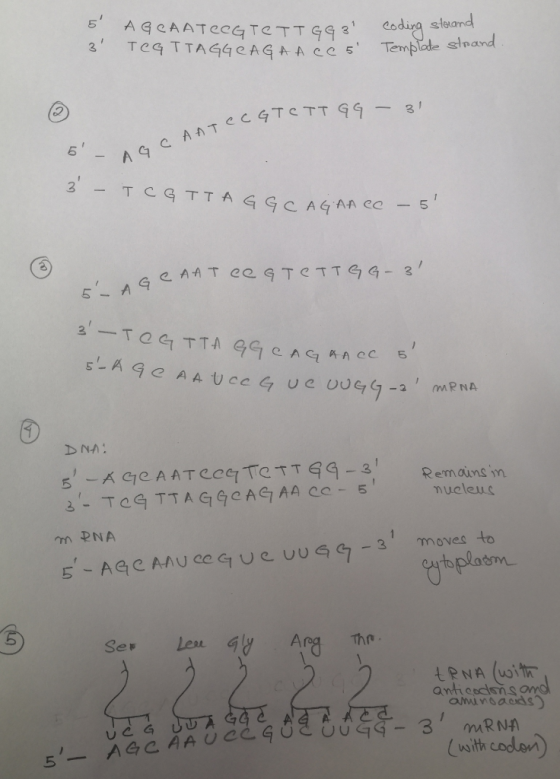
- Transcription is the process by which DNA sequence is copied to mRNA, by enzyme RNA polymerase.
- It occurs in the nucleus of eukaryotic cell and cytoplasm of prokaryotic cell.
- 5’ to 3’ strand of DNA serve as coding strand.
- 3’ to 5’ strand of DNA act as template strand.
- RNA is synthesized by complementary base pairing with the template strand.
- Thus, the RNA will have same sequence as coding strand (only T is replaced by U) and is oriented in 5’ to 3’ direction.
- Translation is the process by which genetic code carried by mRNA is converted to protein.
- It takes place in cytoplasm.
- During translation, tRNA carries amino acid to the ribosome, by matching anticodons to codons in mRNA.
- The secondary structure of tRNA form the clover leaf structure with the anticodon arm having complementary nucleotides for base pairing with codons in mRNA.
Add Answer to:
EXERCISE 10 PROTEIN SYNTHESIS Work with a partner to complete this exercise and answer the questions...
50 LAB 2 Genetics EXERCISE 10 PROTEIN SYNTHESIS Work with a partner to complete this exercise...
 50 LAB 2 Genetics EXERCISE 10 PROTEIN SYNTHESIS Work with a partner to complete this exercise and answer the questions that follow. You will use the DNA strand from Exercise to make the protein for which it codes STEP 1 Review the imaginary strand of DNA below. Note the complementary base pairs. AGCAATCCGTCTTGG TCGTTAGG CAGAACC STEP 2 Draw the DNA strand separating down the middle las in the beginning of DNA replication STEP 3 Draw the free-floating RNA bases linking...
Table 1B: Protein Synthesis with 2nd DNA Template Strand DNA Codons in the 2nd Template Strand...
 Table 1B: Protein Synthesis with 2nd DNA Template Strand DNA Codons in the 2nd Template Strand mRNA Sequence (List codons) Amino Acids in the Protein **Use the Genetic Code Chart on page 217 to determine the amino acids that will be placed in the protein Questions: 19. The three letter "code words of DNA and RNA that specify amino acids are called: A. codons B. promoters C. Introns D. anticodons 20. Proteins are composed of building blocks called: A. fatty...
Please help with 4-10! DNA, Genes,and Protein Synthesis Activity 13: 2. The bases that interact with each other are called complementary bases. this definition and your answers to 1 complete th...
 Please help with 4-10!
DNA, Genes,and Protein Synthesis Activity 13: 2. The bases that interact with each other are called complementary bases. this definition and your answers to 1 complete the following: a. Thiamine (T) is the complementary base of b. Cytosine (C) is the complementary base of c. Adenine (A) is the complementary base of d. Guanine (G) is the complementary base of Based on 3. Shown below is the nucleotide sequence for one strand of a stretch of...
Please help with 4-10!
DNA, Genes,and Protein Synthesis Activity 13: 2. The bases that interact with each other are called complementary bases. this definition and your answers to 1 complete the following: a. Thiamine (T) is the complementary base of b. Cytosine (C) is the complementary base of c. Adenine (A) is the complementary base of d. Guanine (G) is the complementary base of Based on 3. Shown below is the nucleotide sequence for one strand of a stretch of...
DNA, Genes and Protein Synthesis Activity 13: Protein Synthesis is the process by which cells produce (synthesize) proteins. An overview of the process is shown in model 2 (below). Gone 2...
 DNA, Genes and Protein Synthesis Activity 13: Protein Synthesis is the process by which cells produce (synthesize) proteins. An overview of the process is shown in model 2 (below). Gone 2 Gene 1 Gene 3 DNA strand3 TRANSLATION Protein Trp Gly Model 2 ACTIVITY and QUESTIONS 1. Based on the information you can gather from model 1 complete the following sentences: a. The nucleotide Adenine (A) always pairs with the nucleotide b. The nucleotide Guanine (G) always pairs with the...
During elongation of proteins during protein synthesis tRNA with the amino acid that matches its anticodon...
 During elongation of proteins during protein synthesis tRNA with the amino acid that matches its anticodon binds to the codon on the mRNA. each new amino acid is first transferred to the anticodon of the tRNA. anticodons on the ribosomes recognize the codons on the mRNA and attach the correct amino acids. ribosomes move along the DNA. RNA polymerase II uses the codons on the mRNA to polymerize the protein.
2. When transcribing an mRNA strand, RNA polymerase uses the strand of DNA to match complementary...
 2. When transcribing an mRNA strand, RNA polymerase uses the strand of DNA to match complementary bases with. RNA polymerase always reads this strand in the direction and always builds mRNA in the direction. (1.5 pts) 3. (0.5 pt) What is the significance of the +1 site in regards to transcription of mRNA? t) When translating an mRNA sequence, where does the ribosome always begin? 5. (0.5 pt) When translating an mRNA sequence, what signals the ribosome to end translation?...
the several other 10.4 to show t 3. The base uracil substitutes for the base thymine in RNA. Complete Table ways...
 the several other 10.4 to show t 3. The base uracil substitutes for the base thymine in RNA. Complete Table ways RNA differs from DNA Table 10.4 DNA Structure Compared with RNA Structure RNA Sugar Bases Strands Helix DNA Deoxyribose Adenine, guanine, thymine, cytosine Double stranded with base pairing Yes Complementary Base Pairing Complementary base pairing occurs between DNA and RNA. The RNA base uracil pairs with the DNA base adenine; the other bases pair as shown previously. Complete Table...
Question 9: The genetic code is read in groups of three nucleotides, called codons, in mRNA...
 Question 9:
The genetic code is read in groups of three nucleotides, called
codons, in mRNA that specifies for a particular amino acid.
tRNA molecules act as the amino acid carriers that by correctly
pairing with the codon on mRNA can deliver the correct amino acid
to the ribosome during translation. At the tip of each tRNA
molecule is a group of three nucleotides called an anticodon and at
the other end is where the corresponding amino acid is attached...
Question 9:
The genetic code is read in groups of three nucleotides, called
codons, in mRNA that specifies for a particular amino acid.
tRNA molecules act as the amino acid carriers that by correctly
pairing with the codon on mRNA can deliver the correct amino acid
to the ribosome during translation. At the tip of each tRNA
molecule is a group of three nucleotides called an anticodon and at
the other end is where the corresponding amino acid is attached...
c) The steps or rungs of the DNA ladder are composed of phosphate group 4 Deoxyribose...
 c) The steps or rungs of the DNA ladder are composed of phosphate group 4 Deoxyribose 15. Use Figure 2 and 3 of the lab to compare the genome of a human with a mouse, fruit fly and yeast. paired in a specific way. d) Adenine in one DNA strand always pain with thymine ) Bases in opposite strands of a DNA molecule are linked together by hydrogen in the other strand and bonds. Yeast Human Mouse Fruit Fly Number...
Which of the following is not an essential function of ribosomes in all domains of life?...
Which of the following is not an essential function of ribosomes in all domains of life? A. Catalyze peptide bond formation between amino acids during polypeptide formation. B. Bind messenger RNA and identify the start codon where translation begins. C. Facilitate the complementary base pairing of mRNA codons and tRNA anticodons that determines amino acid order in the polypeptide. D. Align the Shine Delgarno sequence in the mRNA with a complementary sequence in the 16S rRNA of the small ribosomal...
 50 LAB 2 Genetics EXERCISE 10 PROTEIN SYNTHESIS Work with a partner to complete this exercise and answer the questions that follow. You will use the DNA strand from Exercise to make the protein for which it codes STEP 1 Review the imaginary strand of DNA below. Note the complementary base pairs. AGCAATCCGTCTTGG TCGTTAGG CAGAACC STEP 2 Draw the DNA strand separating down the middle las in the beginning of DNA replication STEP 3 Draw the free-floating RNA bases linking...
 Table 1B: Protein Synthesis with 2nd DNA Template Strand DNA Codons in the 2nd Template Strand mRNA Sequence (List codons) Amino Acids in the Protein **Use the Genetic Code Chart on page 217 to determine the amino acids that will be placed in the protein Questions: 19. The three letter "code words of DNA and RNA that specify amino acids are called: A. codons B. promoters C. Introns D. anticodons 20. Proteins are composed of building blocks called: A. fatty...
 Please help with 4-10!
DNA, Genes,and Protein Synthesis Activity 13: 2. The bases that interact with each other are called complementary bases. this definition and your answers to 1 complete the following: a. Thiamine (T) is the complementary base of b. Cytosine (C) is the complementary base of c. Adenine (A) is the complementary base of d. Guanine (G) is the complementary base of Based on 3. Shown below is the nucleotide sequence for one strand of a stretch of...
Please help with 4-10!
DNA, Genes,and Protein Synthesis Activity 13: 2. The bases that interact with each other are called complementary bases. this definition and your answers to 1 complete the following: a. Thiamine (T) is the complementary base of b. Cytosine (C) is the complementary base of c. Adenine (A) is the complementary base of d. Guanine (G) is the complementary base of Based on 3. Shown below is the nucleotide sequence for one strand of a stretch of...
 DNA, Genes and Protein Synthesis Activity 13: Protein Synthesis is the process by which cells produce (synthesize) proteins. An overview of the process is shown in model 2 (below). Gone 2 Gene 1 Gene 3 DNA strand3 TRANSLATION Protein Trp Gly Model 2 ACTIVITY and QUESTIONS 1. Based on the information you can gather from model 1 complete the following sentences: a. The nucleotide Adenine (A) always pairs with the nucleotide b. The nucleotide Guanine (G) always pairs with the...
 During elongation of proteins during protein synthesis tRNA with the amino acid that matches its anticodon binds to the codon on the mRNA. each new amino acid is first transferred to the anticodon of the tRNA. anticodons on the ribosomes recognize the codons on the mRNA and attach the correct amino acids. ribosomes move along the DNA. RNA polymerase II uses the codons on the mRNA to polymerize the protein.
 2. When transcribing an mRNA strand, RNA polymerase uses the strand of DNA to match complementary bases with. RNA polymerase always reads this strand in the direction and always builds mRNA in the direction. (1.5 pts) 3. (0.5 pt) What is the significance of the +1 site in regards to transcription of mRNA? t) When translating an mRNA sequence, where does the ribosome always begin? 5. (0.5 pt) When translating an mRNA sequence, what signals the ribosome to end translation?...
 the several other 10.4 to show t 3. The base uracil substitutes for the base thymine in RNA. Complete Table ways RNA differs from DNA Table 10.4 DNA Structure Compared with RNA Structure RNA Sugar Bases Strands Helix DNA Deoxyribose Adenine, guanine, thymine, cytosine Double stranded with base pairing Yes Complementary Base Pairing Complementary base pairing occurs between DNA and RNA. The RNA base uracil pairs with the DNA base adenine; the other bases pair as shown previously. Complete Table...
 Question 9:
The genetic code is read in groups of three nucleotides, called
codons, in mRNA that specifies for a particular amino acid.
tRNA molecules act as the amino acid carriers that by correctly
pairing with the codon on mRNA can deliver the correct amino acid
to the ribosome during translation. At the tip of each tRNA
molecule is a group of three nucleotides called an anticodon and at
the other end is where the corresponding amino acid is attached...
Question 9:
The genetic code is read in groups of three nucleotides, called
codons, in mRNA that specifies for a particular amino acid.
tRNA molecules act as the amino acid carriers that by correctly
pairing with the codon on mRNA can deliver the correct amino acid
to the ribosome during translation. At the tip of each tRNA
molecule is a group of three nucleotides called an anticodon and at
the other end is where the corresponding amino acid is attached...
 c) The steps or rungs of the DNA ladder are composed of phosphate group 4 Deoxyribose 15. Use Figure 2 and 3 of the lab to compare the genome of a human with a mouse, fruit fly and yeast. paired in a specific way. d) Adenine in one DNA strand always pain with thymine ) Bases in opposite strands of a DNA molecule are linked together by hydrogen in the other strand and bonds. Yeast Human Mouse Fruit Fly Number...
Most questions answered within 3 hours.
-
Where is the error in this code sequence?
String s1 = "Hello";
String s2 = "ello";...
asked 10 months ago -
Financial data for Joel de Paris, Inc., for last year
follow:
Joel de Paris, Inc.
Balance...
asked 10 months ago -
Consider this reaction:
Al2(SO4)3 (aq)+ BaCl3
(aq) Al2Cl6 (aq)- +
3BaSO4(s) . What is the...
asked 10 months ago -
Suppose that Savneet is considering increasing her
recent random sample from 20 car rentals to 40...
asked 10 months ago -
Trucks arrive at an unloading terminal at an average rate of 120
per hour.
Trucks arrive...
asked 10 months ago -
Why are methanol and ethanol completely soluble in water while
octanol is not very little soluble....
asked 10 months ago -
A facilities manager at a university reads in a research report
that the mean amount of...
asked 10 months ago -
When the CuSO4 is rehydrated by adding water to the anhydrous
compound, is this an endothermic...
asked 10 months ago -
A ray of sunlight is passing from diamond into crown glass; the
angle of incidence is...
asked 10 months ago -
A block of mass 0.249 kg is placed on top of a light, vertical
spring of...
asked 10 months ago -
how do the kidneys compensate in the presences of acidosis
a) trigger hyperventilate
b) reserve acid...
asked 10 months ago -
Question 501 pts
The rental rate of capital to the firm increases. Which of the
following...
asked 10 months ago