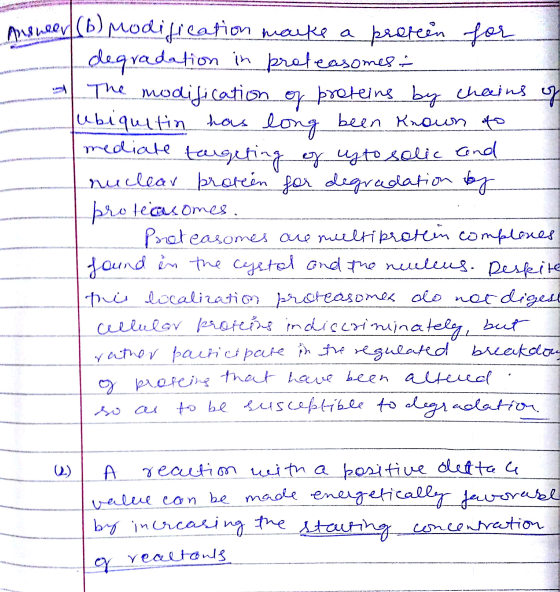
1.Which of the following modification marks a protein for degradation in proteasomes? A.) Phosphorylation B.)ubiquitinylation C.)...
1.Which of the following modification marks a protein for degradation in proteasomes?
A.) Phosphorylation B.)ubiquitinylation C.) acetylation D.) glycosylation
2. A reaction with a positive ∆G value can be made energetically favorable by increasing the
A.) Delta G B.)starting concentration of products C.) strting concentration of freactants (substrates) D.) a or b
Homework Answers
Add Answer to:
1.Which of the following modification marks a protein for
degradation in proteasomes?
A.) Phosphorylation B.)ubiquitinylation C.)...
9) Which posttranslational modification does not occur on histone tails? (a) Phosphorylation (b) Germination (c) Acetylation...
9) Which posttranslational modification does not occur on histone tails? (a) Phosphorylation (b) Germination (c) Acetylation (d) Methylation
answer questions 15) An apoenzyme + cofactor(s) - a) Inhibitor b) active site c) substrate d)...
 answer questions
15) An apoenzyme + cofactor(s) - a) Inhibitor b) active site c) substrate d) holoenzyme 16) Aspartate-transcarbamylase is an enveloved in a pathway that may produces molecule called Cytidine triphosphate. Cytidine triphosphate can bind to anot t o this enzyme, rendering the active site nonfunctional. This is an example of a) ATP hydrolysis b) competitive inhibition c) feedback inhibition d) allosteric activation 17) Which of the following is false regarding fermentation? a) fermentation occurs in the absence of...
answer questions
15) An apoenzyme + cofactor(s) - a) Inhibitor b) active site c) substrate d) holoenzyme 16) Aspartate-transcarbamylase is an enveloved in a pathway that may produces molecule called Cytidine triphosphate. Cytidine triphosphate can bind to anot t o this enzyme, rendering the active site nonfunctional. This is an example of a) ATP hydrolysis b) competitive inhibition c) feedback inhibition d) allosteric activation 17) Which of the following is false regarding fermentation? a) fermentation occurs in the absence of...
please answer the following Microbiology question. Which of the following statements is FALSE? A. The activity...
 please answer the following Microbiology question.
Which of the following statements is FALSE? A. The activity of GTPases is regulated by the association of GTP or GDP with the protein B. Proteolytic cleavage of proteins can activate their activity ° C. Phosphorylation by kinases is an irreversible covalent modification that alters protein function D. Ubiquitinylation of a protein can result in protein degradation, immune system regulation or cell division regulation
please answer the following Microbiology question.
Which of the following statements is FALSE? A. The activity of GTPases is regulated by the association of GTP or GDP with the protein B. Proteolytic cleavage of proteins can activate their activity ° C. Phosphorylation by kinases is an irreversible covalent modification that alters protein function D. Ubiquitinylation of a protein can result in protein degradation, immune system regulation or cell division regulation
21: Met c aion of the Polamino 21. Which of the following would NOT Change the...
 21: Met c aion of the Polamino 21. Which of the following would NOT Change the structure and function of a protein A Methylation of a protein B. Lipid modification of a protein C. Change in the length of the Poly A tail of the mRNA transcript encoding a protein D. Change in the position of reactive amino acids E. Proteolysis 22. Two peptides have almost the exact same primary structure, except that one has about 10 fewer amino acids...
Which protein is regulated by phosphorylation? ect one: a. glycogen phosphorylase b. myoglobin C. collagen d....
 Which protein is regulated by phosphorylation? ect one: a. glycogen phosphorylase b. myoglobin C. collagen d. All of the above. e. None of the above.
For a protein such as ribonuclease, for the process of protein folding under native (non-denaturing) conditions,...
For a protein such as ribonuclease, for the process of protein folding under native (non-denaturing) conditions, Punfolded → Pfolded Select the appropriate description for each of the thermodynamic parameters (for the folding reaction as shown above, from left to right): What is the value of ∆G? What is the value of ∆Sconformational? The value of ∆S hydrophobic? The choices for each question A. positive, favorable for folding B. positive, unfavorable for folding C. negative, favorable for folding D. negative, unfavorable...
all please 2. Which of the following is an example of posttranslational modification? a. Glycosylation b....
 all please
2. Which of the following is an example of posttranslational modification? a. Glycosylation b. Protcolysis c. Palmitoylation d. All of the above 3. The growing polypeptide chain coming off the ribosomal complex is fairly unstable. It has a tendency to fold back on itself and can aggregate with adjacent polypeptides, and these processes, if allowed to occur, would yield degraded, improperly folded, or large aggregates of nonfunctional proteins. How does the cell prevent this from occurring? 4. Transcriptionally...
all please
2. Which of the following is an example of posttranslational modification? a. Glycosylation b. Protcolysis c. Palmitoylation d. All of the above 3. The growing polypeptide chain coming off the ribosomal complex is fairly unstable. It has a tendency to fold back on itself and can aggregate with adjacent polypeptides, and these processes, if allowed to occur, would yield degraded, improperly folded, or large aggregates of nonfunctional proteins. How does the cell prevent this from occurring? 4. Transcriptionally...
For the following exothermic reaction at equilibrium A(g) + B(g) ⇌ 2 C(g) Which of the...
For the following exothermic reaction at equilibrium A(g) + B(g) ⇌ 2 C(g) Which of the following conditions will cause the reaction to produce more products? Select as many answers as are appropriate however marks will be deducted for incorrect guesses. Select one or more: a)Increasing the volume b)Raising the temperature c)Lowering the temperature d)Increasing partial pressure of "C" d) Increasing partial pressure of "B" Decreasing the volume Increasing partial pressure of "A"
Which of the following statements is TRUE about the TCA cycle? a. oxygen is not used...
 Which of the following statements is TRUE about the TCA cycle? a. oxygen is not used and so the TCA cycle can occur in anaerobic conditions b. The TCA cycle produces two water molecules per glucose molecule c. The carbons from a pyruvate are released in one full turn of the TCA cycle d. FAD is a covalently bound coenzyme in the TCA cycle e. More than one of these statements is true In glycolysis, fructose 1, 6-bisphosphate is converted...
For the following exothermic reaction at equilibrium A(g) + B(g) ⇌ C(g) Which of the following...
For the following exothermic reaction at equilibrium A(g) + B(g) ⇌ C(g) Which of the following conditions will cause the reaction to produce more products? Select as many answers as are appropriate however marks will be deducted for incorrect guesses. Select one or more: Increasing the volume Increasing partial pressure of "A" Raising the temperature Decreasing the volume Increasing partial pressure of "C" Increasing partial pressure of "B" Lowering the temperature
 answer questions
15) An apoenzyme + cofactor(s) - a) Inhibitor b) active site c) substrate d) holoenzyme 16) Aspartate-transcarbamylase is an enveloved in a pathway that may produces molecule called Cytidine triphosphate. Cytidine triphosphate can bind to anot t o this enzyme, rendering the active site nonfunctional. This is an example of a) ATP hydrolysis b) competitive inhibition c) feedback inhibition d) allosteric activation 17) Which of the following is false regarding fermentation? a) fermentation occurs in the absence of...
answer questions
15) An apoenzyme + cofactor(s) - a) Inhibitor b) active site c) substrate d) holoenzyme 16) Aspartate-transcarbamylase is an enveloved in a pathway that may produces molecule called Cytidine triphosphate. Cytidine triphosphate can bind to anot t o this enzyme, rendering the active site nonfunctional. This is an example of a) ATP hydrolysis b) competitive inhibition c) feedback inhibition d) allosteric activation 17) Which of the following is false regarding fermentation? a) fermentation occurs in the absence of...
 please answer the following Microbiology question.
Which of the following statements is FALSE? A. The activity of GTPases is regulated by the association of GTP or GDP with the protein B. Proteolytic cleavage of proteins can activate their activity ° C. Phosphorylation by kinases is an irreversible covalent modification that alters protein function D. Ubiquitinylation of a protein can result in protein degradation, immune system regulation or cell division regulation
please answer the following Microbiology question.
Which of the following statements is FALSE? A. The activity of GTPases is regulated by the association of GTP or GDP with the protein B. Proteolytic cleavage of proteins can activate their activity ° C. Phosphorylation by kinases is an irreversible covalent modification that alters protein function D. Ubiquitinylation of a protein can result in protein degradation, immune system regulation or cell division regulation
 21: Met c aion of the Polamino 21. Which of the following would NOT Change the structure and function of a protein A Methylation of a protein B. Lipid modification of a protein C. Change in the length of the Poly A tail of the mRNA transcript encoding a protein D. Change in the position of reactive amino acids E. Proteolysis 22. Two peptides have almost the exact same primary structure, except that one has about 10 fewer amino acids...
 Which protein is regulated by phosphorylation? ect one: a. glycogen phosphorylase b. myoglobin C. collagen d. All of the above. e. None of the above.
 all please
2. Which of the following is an example of posttranslational modification? a. Glycosylation b. Protcolysis c. Palmitoylation d. All of the above 3. The growing polypeptide chain coming off the ribosomal complex is fairly unstable. It has a tendency to fold back on itself and can aggregate with adjacent polypeptides, and these processes, if allowed to occur, would yield degraded, improperly folded, or large aggregates of nonfunctional proteins. How does the cell prevent this from occurring? 4. Transcriptionally...
all please
2. Which of the following is an example of posttranslational modification? a. Glycosylation b. Protcolysis c. Palmitoylation d. All of the above 3. The growing polypeptide chain coming off the ribosomal complex is fairly unstable. It has a tendency to fold back on itself and can aggregate with adjacent polypeptides, and these processes, if allowed to occur, would yield degraded, improperly folded, or large aggregates of nonfunctional proteins. How does the cell prevent this from occurring? 4. Transcriptionally...
 Which of the following statements is TRUE about the TCA cycle? a. oxygen is not used and so the TCA cycle can occur in anaerobic conditions b. The TCA cycle produces two water molecules per glucose molecule c. The carbons from a pyruvate are released in one full turn of the TCA cycle d. FAD is a covalently bound coenzyme in the TCA cycle e. More than one of these statements is true In glycolysis, fructose 1, 6-bisphosphate is converted...
Most questions answered within 3 hours.
-
Where is the error in this code sequence?
String s1 = "Hello";
String s2 = "ello";...
asked 10 months ago -
Financial data for Joel de Paris, Inc., for last year
follow:
Joel de Paris, Inc.
Balance...
asked 10 months ago -
Consider this reaction:
Al2(SO4)3 (aq)+ BaCl3
(aq) Al2Cl6 (aq)- +
3BaSO4(s) . What is the...
asked 10 months ago -
Suppose that Savneet is considering increasing her
recent random sample from 20 car rentals to 40...
asked 10 months ago -
Trucks arrive at an unloading terminal at an average rate of 120
per hour.
Trucks arrive...
asked 10 months ago -
Why are methanol and ethanol completely soluble in water while
octanol is not very little soluble....
asked 10 months ago -
A facilities manager at a university reads in a research report
that the mean amount of...
asked 10 months ago -
When the CuSO4 is rehydrated by adding water to the anhydrous
compound, is this an endothermic...
asked 10 months ago -
A ray of sunlight is passing from diamond into crown glass; the
angle of incidence is...
asked 10 months ago -
A block of mass 0.249 kg is placed on top of a light, vertical
spring of...
asked 10 months ago -
how do the kidneys compensate in the presences of acidosis
a) trigger hyperventilate
b) reserve acid...
asked 10 months ago -
Question 501 pts
The rental rate of capital to the firm increases. Which of the
following...
asked 10 months ago