In the small country of Fictionia, there are 30 workers. Each worker can produce 4 shirts...
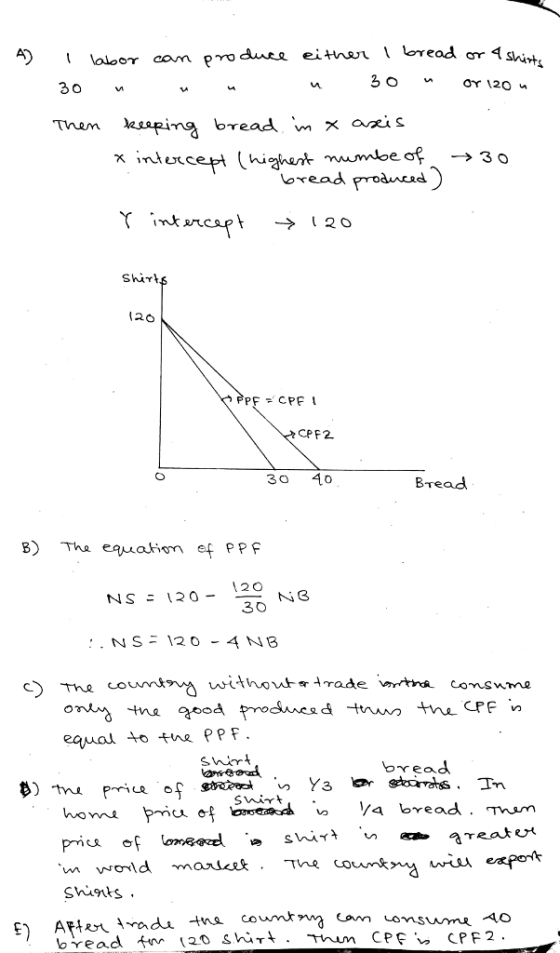
In the small country of Fictionia, there are 30 workers. Each worker can produce 4 shirts in one day, or bake 1 loaf of bread. These are the only two goods the can be produced.
Part A) Draw the production possibility frontier (PPF) for Fictionia, showing the combinations of shirts (S) and bread (B) that can be produced in a day. Put shirts on the vertical axis. Label both intercepts, and label the curve as “PPF”.
Part B) What is the equation for the production possibility frontier? You can derive this equation using the following idea:
1. Let WS be the number of workers allocated to shirt production. What is the relationship between WS and NS, the number of shirts produced?
2. Similarly, what is the relationship between WB, the number of workers allocated to bread production, and NB, the amount of bread produced?
3. The total number of workers in Fictionia is 30. Use this information to derive an equation relating NS and NB.
Part C) The consumption possibility frontier (CPF) describes the combinations of shirts and bread that Fictionia can feasibly consume in a day. On the same diagram as Part A, draw Fictionia’s CPF, assuming that it does not trade with any other country. Label this curve “CPF 1”.
Part D) Suppose that the world price of bread is 3 shirts. So that 1 loaf of bread is sold for 3 shirts. What is the price of shirts, in loaves of bread? If Fictionia can trade any amount of shirts or bread at these prices, will it choose to trade with the rest of the world? If so, what will it export?
Part E) Draw the CPF if Fictionia trades with the rest of the world. Label both intercepts, and label the curve as “CPF 2”.
Homework Answers
Add Answer to:
In the small country of Fictionia, there are 30 workers. Each
worker can produce 4 shirts...
Answer question 4 based on previous information. 1. Suppose that each worker in the home country...
 Answer question 4 based on previous information.
1. Suppose that each worker in the home country can produce three loaves of bread or two shirts. Assume that Home has four workers a. Graph the production possiblities frontier for the Home country. b. What is the no-trade relative price for bread at Home? 2. Suppose that each worker in the Foreign country can produce two loaves of bread or three shirts. Assume that Foreign also has four workers. a. Graph the...
Answer question 4 based on previous information.
1. Suppose that each worker in the home country can produce three loaves of bread or two shirts. Assume that Home has four workers a. Graph the production possiblities frontier for the Home country. b. What is the no-trade relative price for bread at Home? 2. Suppose that each worker in the Foreign country can produce two loaves of bread or three shirts. Assume that Foreign also has four workers. a. Graph the...
1. Each country has 10 workers who can produce either microchips or brooms. A worker in...
 1. Each country has 10 workers who can produce either microchips or brooms. A worker in U.S can produce 9 microchips a day or 1 broom a day. A worker in Mexico can produce 1 microchip or 9 brooms a day. 1. a) Draw the production possibilities frontier (PPF) of microchips and brooms for U.S. 1. b) Draw the production possibilities frontier (PPF) of microchips and brooms for Mexico 1. c) Explain how trade can benefit both the U.S and...
Suppose that in a year an American worker can produce 60 shirts or 30 computers and...
 Suppose that in a year an American worker can produce 60 shirts
or 30 computers and a Chinese worker can produce 60 shirts or 12
computers. There are 1 million workers in each country.
Use the blue line (circle symbol) to graph the production
possibilities frontier (PPF) for the United States, and use the
green line (triangle symbol) to graph the production possibilities
frontier for China.
Suppose that without trade the workers in each country spend
half their time producing...
Suppose that in a year an American worker can produce 60 shirts
or 30 computers and a Chinese worker can produce 60 shirts or 12
computers. There are 1 million workers in each country.
Use the blue line (circle symbol) to graph the production
possibilities frontier (PPF) for the United States, and use the
green line (triangle symbol) to graph the production possibilities
frontier for China.
Suppose that without trade the workers in each country spend
half their time producing...
The following table shows the outputs per worker per day in two countries that can produce...
The following table shows the outputs per worker per day in two countries that can produce two goods, bicycles & coffeemakers, only: Bicycles Coffeemakers Ambrosia 20 10 Bandaria 2 5 Ambrosia has 100 workers & Bandaria has 100 workers. Draw the production possibility frontiers for the two countries (output per day). Which country has the absolute advantage in producing the bicycles, and which one has the absolute advantage in producing the coffeemakers? Which country has the comparative...
Suppose that in a year an American worker can produce 80 shirts or 20 computers and...
 Suppose that in a year an American worker can produce 80 shirts or 20 computers and a Chinese worker can produce 60 shirts or 20 computers. There are 1 million workers in each country. Use the blue line (circle symbol) to graph the production possibilities frontier (PPF) for the United States, and use the green line (triangle symbol) to graph the production psies frontier for China 30 27 24 21 18 China PPF 15 U.S. without Trade China without Trade...
8. Problems and Applications Q8 Suppose that in a year an American worker can produce 60...
 8. Problems and Applications Q8 Suppose that in a year an American worker can produce 60 shirts or 30 computers and a Chinese worker can produce 60 shirts or 12 computers. There are 1 million workers in each country. Use the blue line (circle symbol) to graph the production possibilities frontier (PPF) for the United States, and use the green line (triangle symbol) to graph the production possibilities frontier for China. U.S. PPF China PPF Quantity of Computers (Millions) HHHHHHHHHH...
8. Problems and Applications Q8 Suppose that in a year an American worker can produce 60...
 8. Problems and Applications Q8 Suppose that in a year an American worker can produce 60 shirts or 30 computers and a Chinese worker can produce 60 shirts or 12 computers There are 1 million workers in each country Use the blue line (circle symbol) to graph the production possibilities frontier (PPF) for the United States, and use the green line (triangle symbol) to graph the production possibilities frontier for China U.S. PPF 21 18 S15 China PPF U.S. without...
Suppose that in a year an American worker can produce 100 shirts or 20 computers and...
Suppose that in a year an American worker can produce 100 shirts or 20 computers and a Chinese worker can produce 100 shirts or 10 computers. 1. For each country, graph the production possibilities frontier. Suppose that without trade the workers in each country spend half their time producing each good. Identify this point in your graphs. 2. Who has the comparative advantage in the production of shirts? What about for computers? 3. If these countries were open to...
*MULTIPLE PART QUESTION* There are two countries in the world, France and Germany, and both can...
 *MULTIPLE PART QUESTION*
There are two countries in the world, France and Germany, and
both can use workers to produce either cheese or bread. France can
produce either a ton of cheese or a ton of bread with 3 workers.
Germany can produce a ton of cheese with 6 workers and a ton of
bread with 3 workers. France has 120 workers; Germany has 150
workers. Initially, there is no trade between the two
countries.
There are two countries in...
*MULTIPLE PART QUESTION*
There are two countries in the world, France and Germany, and
both can use workers to produce either cheese or bread. France can
produce either a ton of cheese or a ton of bread with 3 workers.
Germany can produce a ton of cheese with 6 workers and a ton of
bread with 3 workers. France has 120 workers; Germany has 150
workers. Initially, there is no trade between the two
countries.
There are two countries in...
Question 01. Suppose that both the U.S. and Japan can produce computers and bushels of wheat...
Question 01. Suppose that both the U.S. and Japan can produce computers and bushels of wheat using only labor (i.e., two countries, two goods, one factor Ricardian model). One U.S. worker can produce 3 computers or 10 bushels of wheat. One Japanese worker can produce 2 computers or 5 bushels of wheat. Given that the U.S. has 100 workers and Japan has 180 workers, answer each of the following parts. Show your work for credit. A. Which country has the...
 Answer question 4 based on previous information.
1. Suppose that each worker in the home country can produce three loaves of bread or two shirts. Assume that Home has four workers a. Graph the production possiblities frontier for the Home country. b. What is the no-trade relative price for bread at Home? 2. Suppose that each worker in the Foreign country can produce two loaves of bread or three shirts. Assume that Foreign also has four workers. a. Graph the...
Answer question 4 based on previous information.
1. Suppose that each worker in the home country can produce three loaves of bread or two shirts. Assume that Home has four workers a. Graph the production possiblities frontier for the Home country. b. What is the no-trade relative price for bread at Home? 2. Suppose that each worker in the Foreign country can produce two loaves of bread or three shirts. Assume that Foreign also has four workers. a. Graph the...
 1. Each country has 10 workers who can produce either microchips or brooms. A worker in U.S can produce 9 microchips a day or 1 broom a day. A worker in Mexico can produce 1 microchip or 9 brooms a day. 1. a) Draw the production possibilities frontier (PPF) of microchips and brooms for U.S. 1. b) Draw the production possibilities frontier (PPF) of microchips and brooms for Mexico 1. c) Explain how trade can benefit both the U.S and...
 Suppose that in a year an American worker can produce 60 shirts
or 30 computers and a Chinese worker can produce 60 shirts or 12
computers. There are 1 million workers in each country.
Use the blue line (circle symbol) to graph the production
possibilities frontier (PPF) for the United States, and use the
green line (triangle symbol) to graph the production possibilities
frontier for China.
Suppose that without trade the workers in each country spend
half their time producing...
Suppose that in a year an American worker can produce 60 shirts
or 30 computers and a Chinese worker can produce 60 shirts or 12
computers. There are 1 million workers in each country.
Use the blue line (circle symbol) to graph the production
possibilities frontier (PPF) for the United States, and use the
green line (triangle symbol) to graph the production possibilities
frontier for China.
Suppose that without trade the workers in each country spend
half their time producing...
 Suppose that in a year an American worker can produce 80 shirts or 20 computers and a Chinese worker can produce 60 shirts or 20 computers. There are 1 million workers in each country. Use the blue line (circle symbol) to graph the production possibilities frontier (PPF) for the United States, and use the green line (triangle symbol) to graph the production psies frontier for China 30 27 24 21 18 China PPF 15 U.S. without Trade China without Trade...
 8. Problems and Applications Q8 Suppose that in a year an American worker can produce 60 shirts or 30 computers and a Chinese worker can produce 60 shirts or 12 computers. There are 1 million workers in each country. Use the blue line (circle symbol) to graph the production possibilities frontier (PPF) for the United States, and use the green line (triangle symbol) to graph the production possibilities frontier for China. U.S. PPF China PPF Quantity of Computers (Millions) HHHHHHHHHH...
 8. Problems and Applications Q8 Suppose that in a year an American worker can produce 60 shirts or 30 computers and a Chinese worker can produce 60 shirts or 12 computers There are 1 million workers in each country Use the blue line (circle symbol) to graph the production possibilities frontier (PPF) for the United States, and use the green line (triangle symbol) to graph the production possibilities frontier for China U.S. PPF 21 18 S15 China PPF U.S. without...
 *MULTIPLE PART QUESTION*
There are two countries in the world, France and Germany, and
both can use workers to produce either cheese or bread. France can
produce either a ton of cheese or a ton of bread with 3 workers.
Germany can produce a ton of cheese with 6 workers and a ton of
bread with 3 workers. France has 120 workers; Germany has 150
workers. Initially, there is no trade between the two
countries.
There are two countries in...
*MULTIPLE PART QUESTION*
There are two countries in the world, France and Germany, and
both can use workers to produce either cheese or bread. France can
produce either a ton of cheese or a ton of bread with 3 workers.
Germany can produce a ton of cheese with 6 workers and a ton of
bread with 3 workers. France has 120 workers; Germany has 150
workers. Initially, there is no trade between the two
countries.
There are two countries in...
Most questions answered within 3 hours.
-
Where is the error in this code sequence?
String s1 = "Hello";
String s2 = "ello";...
asked 11 months ago -
Financial data for Joel de Paris, Inc., for last year
follow:
Joel de Paris, Inc.
Balance...
asked 11 months ago -
Consider this reaction:
Al2(SO4)3 (aq)+ BaCl3
(aq) Al2Cl6 (aq)- +
3BaSO4(s) . What is the...
asked 11 months ago -
Suppose that Savneet is considering increasing her
recent random sample from 20 car rentals to 40...
asked 11 months ago -
Trucks arrive at an unloading terminal at an average rate of 120
per hour.
Trucks arrive...
asked 11 months ago -
Why are methanol and ethanol completely soluble in water while
octanol is not very little soluble....
asked 11 months ago -
A facilities manager at a university reads in a research report
that the mean amount of...
asked 11 months ago -
When the CuSO4 is rehydrated by adding water to the anhydrous
compound, is this an endothermic...
asked 11 months ago -
A ray of sunlight is passing from diamond into crown glass; the
angle of incidence is...
asked 11 months ago -
A block of mass 0.249 kg is placed on top of a light, vertical
spring of...
asked 11 months ago -
how do the kidneys compensate in the presences of acidosis
a) trigger hyperventilate
b) reserve acid...
asked 11 months ago -
Question 501 pts
The rental rate of capital to the firm increases. Which of the
following...
asked 11 months ago