
Homework Answers
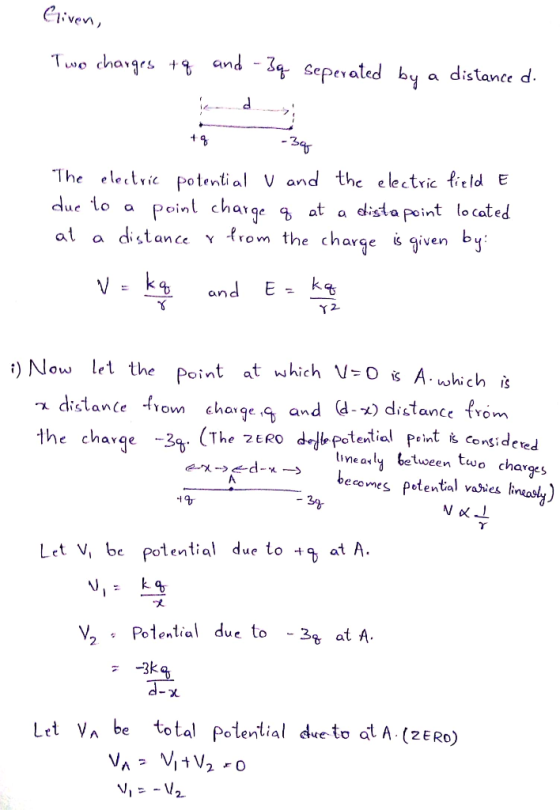
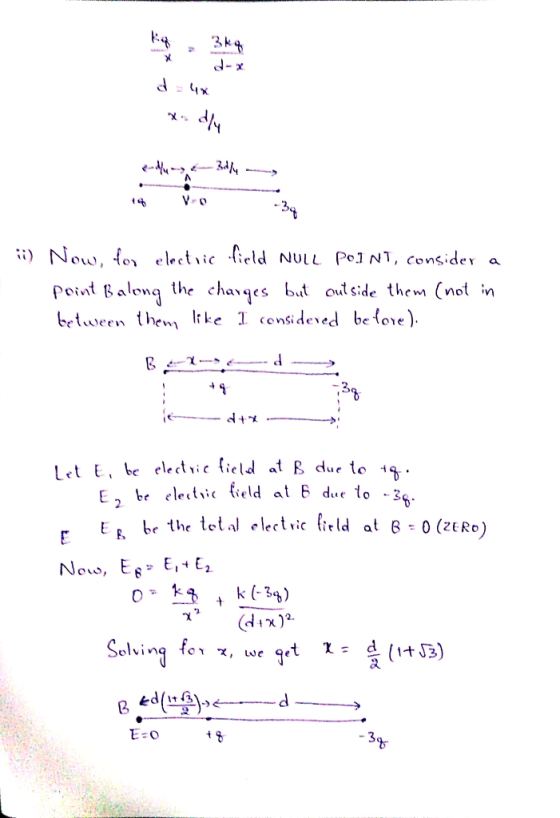
4. In the figure below locate the points or points at which the electric field is...
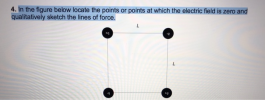 4. In the figure below locate the points or points at which the electric field is zero and qualitatively sketch the lines of force tq .q tq
4. Find the potential as a function of position in an electric field given by E...
4. Find the potential as a function of position in an electric field given by E = a x i, where a is a constant and where V = 0 at x = 0. 5. A charge +Q lies at the origin, and a charge –3Q at x = a. Find two points on the x – axis where V = 0.
4. Field transformations: In the lab frame E 4 V/m, B -3y T, and a point...
 4. Field transformations: In the lab frame E 4 V/m, B -3y T, and a point charge q = 1C is observed to be moving with velocity v 2 m/s. a) What is the electric field E' measured in the frame of reference of q? Determine E' by ensuring that the Lorentz force applied on charge q is identical in both reference frames. b) Is this charge being accelerated or not under the influence of fields E and B? Discuss...
be the set of all points a + bi, where a, b E Q and which...
 be the set of all points a + bi, where a, b E Q and which lie inside the shaded square shown (a) Is bounded? (b) What are the limit points of , if any? |(c) Is closed? (d) What are its interior and boundary points? (e) Is open? (f) Is connected? (g) Is a region? (h) What is the closure of 0? (i) Is compact? (i) Is the closure of 2 compact? 8. Let
H4) Locate specific a(x),b() Z with b) 0 such that it is impossible to write a(x))b(z) r(n) with ...
 H4) Locate specific a(x),b() Z with b) 0 such that it is impossible to write a(x))b(z) r(n) with q(z), r(x) E Zz] and deg r(x) < deg b(x). Why does this not contradict Theorem 4.6?
H4) Locate specific a(x),b() Z with b) 0 such that it is impossible to write a(x))b(z) r(n) with q(z), r(x) E Zz] and deg r(x)
H4) Locate specific a(x),b() Z with b) 0 such that it is impossible to write a(x))b(z) r(n) with q(z), r(x) E Zz] and deg r(x) < deg b(x). Why does this not contradict Theorem 4.6?
H4) Locate specific a(x),b() Z with b) 0 such that it is impossible to write a(x))b(z) r(n) with q(z), r(x) E Zz] and deg r(x)
Question 5 1 pts Four points charges of magnitude +3q, -q, +2q; -4q are arranged in...
 Question 5 1 pts Four points charges of magnitude +3q, -q, +2q; -4q are arranged in the corners of a square of side l. Charge -q creates at the center potential (relatively to infinity) 1V. What is the total potential created in the center of a square by all 4 charges? 0 V 1 V 10 V 5 V
Question 4 Which of the 3-dimensional surfaces in the figure below has the greatest net flux...
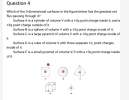 Question 4 Which of the 3-dimensional surfaces in the figure below has the greatest net flux passing through it? Surface A is a cylinder of volume V with a +3q point charge inside it, and a +3q point charge outside of it. Surface B is a sphere of volume V with a +3q point charge inside of it. Surface C is a large pyramid of volume V with a +3q point charge inside of Surface D is a cube of...
toward a Problem 4 (30 points): Consider a current of particles of energy E moving from...
 toward a Problem 4 (30 points): Consider a current of particles of energy E moving from x = - potential step as shown in the figure. x > 0 V(x) = {v. x<0 TE Where E > V a) (8 points) Derive the general solution of Schrödinger equation for x < 0 and for x > 0 b) (14 points) Apply the boundary conditions and calculate the transmission and the reflection coefficients. c) (8 points) What is the value of...
Problem 8. (2+4+4 points each) A bipartite graph G = (V. E) is a graph whose...
 Problem 8. (2+4+4 points each) A bipartite graph G = (V. E) is a graph whose vertices can be partitioned into two (disjoint) sets V1 and V2, such that every edge joins a vertex in V1 with a vertex in V2. This means no edges are within V1 or V2 (or symbolically: Vu, v E V1. {u, u} &E and Vu, v E V2.{u,v} &E). 8(a) Show that the complete graph K, is a bipartite graph. 8(b) Prove that no...
Problem 1 (a) Find the elasticity, using calculus, of P = -3Q + 18 when Q-4...
 Problem 1 (a) Find the elasticity, using calculus, of P = -3Q + 18 when Q-4 (b) Find the elasticity, using calculus, of P = Q? - 8Q + 16 when Q = 2
 4. In the figure below locate the points or points at which the electric field is zero and qualitatively sketch the lines of force tq .q tq
 4. Field transformations: In the lab frame E 4 V/m, B -3y T, and a point charge q = 1C is observed to be moving with velocity v 2 m/s. a) What is the electric field E' measured in the frame of reference of q? Determine E' by ensuring that the Lorentz force applied on charge q is identical in both reference frames. b) Is this charge being accelerated or not under the influence of fields E and B? Discuss...
 be the set of all points a + bi, where a, b E Q and which lie inside the shaded square shown (a) Is bounded? (b) What are the limit points of , if any? |(c) Is closed? (d) What are its interior and boundary points? (e) Is open? (f) Is connected? (g) Is a region? (h) What is the closure of 0? (i) Is compact? (i) Is the closure of 2 compact? 8. Let
 H4) Locate specific a(x),b() Z with b) 0 such that it is impossible to write a(x))b(z) r(n) with q(z), r(x) E Zz] and deg r(x) < deg b(x). Why does this not contradict Theorem 4.6?
H4) Locate specific a(x),b() Z with b) 0 such that it is impossible to write a(x))b(z) r(n) with q(z), r(x) E Zz] and deg r(x)
H4) Locate specific a(x),b() Z with b) 0 such that it is impossible to write a(x))b(z) r(n) with q(z), r(x) E Zz] and deg r(x) < deg b(x). Why does this not contradict Theorem 4.6?
H4) Locate specific a(x),b() Z with b) 0 such that it is impossible to write a(x))b(z) r(n) with q(z), r(x) E Zz] and deg r(x)
 Question 5 1 pts Four points charges of magnitude +3q, -q, +2q; -4q are arranged in the corners of a square of side l. Charge -q creates at the center potential (relatively to infinity) 1V. What is the total potential created in the center of a square by all 4 charges? 0 V 1 V 10 V 5 V
 Question 4 Which of the 3-dimensional surfaces in the figure below has the greatest net flux passing through it? Surface A is a cylinder of volume V with a +3q point charge inside it, and a +3q point charge outside of it. Surface B is a sphere of volume V with a +3q point charge inside of it. Surface C is a large pyramid of volume V with a +3q point charge inside of Surface D is a cube of...
 toward a Problem 4 (30 points): Consider a current of particles of energy E moving from x = - potential step as shown in the figure. x > 0 V(x) = {v. x<0 TE Where E > V a) (8 points) Derive the general solution of Schrödinger equation for x < 0 and for x > 0 b) (14 points) Apply the boundary conditions and calculate the transmission and the reflection coefficients. c) (8 points) What is the value of...
 Problem 8. (2+4+4 points each) A bipartite graph G = (V. E) is a graph whose vertices can be partitioned into two (disjoint) sets V1 and V2, such that every edge joins a vertex in V1 with a vertex in V2. This means no edges are within V1 or V2 (or symbolically: Vu, v E V1. {u, u} &E and Vu, v E V2.{u,v} &E). 8(a) Show that the complete graph K, is a bipartite graph. 8(b) Prove that no...
 Problem 1 (a) Find the elasticity, using calculus, of P = -3Q + 18 when Q-4 (b) Find the elasticity, using calculus, of P = Q? - 8Q + 16 when Q = 2
Most questions answered within 3 hours.
-
Where is the error in this code sequence?
String s1 = "Hello";
String s2 = "ello";...
asked 10 months ago -
Financial data for Joel de Paris, Inc., for last year
follow:
Joel de Paris, Inc.
Balance...
asked 10 months ago -
Consider this reaction:
Al2(SO4)3 (aq)+ BaCl3
(aq) Al2Cl6 (aq)- +
3BaSO4(s) . What is the...
asked 10 months ago -
Suppose that Savneet is considering increasing her
recent random sample from 20 car rentals to 40...
asked 10 months ago -
Trucks arrive at an unloading terminal at an average rate of 120
per hour.
Trucks arrive...
asked 10 months ago -
Why are methanol and ethanol completely soluble in water while
octanol is not very little soluble....
asked 10 months ago -
A facilities manager at a university reads in a research report
that the mean amount of...
asked 10 months ago -
When the CuSO4 is rehydrated by adding water to the anhydrous
compound, is this an endothermic...
asked 10 months ago -
A ray of sunlight is passing from diamond into crown glass; the
angle of incidence is...
asked 10 months ago -
A block of mass 0.249 kg is placed on top of a light, vertical
spring of...
asked 10 months ago -
how do the kidneys compensate in the presences of acidosis
a) trigger hyperventilate
b) reserve acid...
asked 10 months ago -
Question 501 pts
The rental rate of capital to the firm increases. Which of the
following...
asked 10 months ago