
Homework Answers


Add Answer to:
A container of water has a cross-sectional area of A = 0.1 m^2. A piston sits...
A piston/cylinder with a cross- sectional area of .01 m^2 has a piston mass of 100...
A piston/cylinder with a cross- sectional area of .01 m^2 has a piston mass of 100 kg resting on stops. With an outside atmospheric pressure of 120 kPa , what should the water pressure be to lift the piston?
A piston having a cross-sectional area of 0.06 m2 is located in a cylinder containing water...
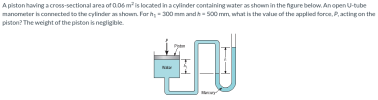 A piston having a
cross-sectional area of 0.06 m2 is located in a cylinder containing
water as shown in the figure below. An open U-tube manometer is
connected to the cylinder as shown. For h1 = 300 mm and h = 500 mm,
what is the value of the applied force, P, acting on the piston?
The weight of the piston is negligible.
A piston having a cross-sectional area of 0.06 m2 is located in a cylinder containing water as...
A piston having a
cross-sectional area of 0.06 m2 is located in a cylinder containing
water as shown in the figure below. An open U-tube manometer is
connected to the cylinder as shown. For h1 = 300 mm and h = 500 mm,
what is the value of the applied force, P, acting on the piston?
The weight of the piston is negligible.
A piston having a cross-sectional area of 0.06 m2 is located in a cylinder containing water as...
1. As a stream of water flows, the cross-sectional area of the stream becomes smaller. If...
1. As a stream of water flows, the cross-sectional area of the stream becomes smaller. If it initially moves with a speed of 1.8 m/s and then the cross-sectional area decreases to one-fourth of the original area, what is the water speed in this narrowed part of the stream?____ m/s 2. (As water falls, its speed increases, due to the acceleration of gravity. If you make a steady stream of water flow from a faucet, you will see that the...
Water flows straight down from an open faucet. The cross-sectional area of the faucet is 2.3...
Water flows straight down from an open faucet. The cross-sectional area of the faucet is 2.3 × 10⁻⁴m2 and the speed of the water is 0.65 m/s as it leaves the faucet. Ignoring air resistance, find the cross-sectional area of the water stream at a point 0.09 m below the faucet.
Water flows straight down from an open faucet. The cross-sectional area of the faucet is 2.5 × 10⁻⁴m2 and the speed of t...
Water flows straight down from an open faucet. The cross-sectional area of the faucet is 2.5 × 10⁻⁴m2 and the speed of the water is 0.65 m/s as it leaves the faucet. Ignoring air resistance, find the cross-sectional area of the water stream at a point 0.08 m below the faucet.
A large pipe with a cross sectional area A1=1.2 m2 has water flowing through it. The...
A large pipe with a cross sectional area A1=1.2 m2 has water flowing through it. The pressure in the pipe there is maintained at atmospheric pressure. The pipe then descends 3.7 m and narrows to a new cross sectional area A2. Water exits the pipe there into an environment at atmospheric pressure. What must the cross sectional area A2 of the pipe be in m2 if the water is exiting the pipe with a speed of 9.8 m/s?
A cylindrical container with a cross sectional area of 61.2 cm^2 holds a fluid of density...
A cylindrical container with a cross sectional area of 61.2 cm^2 holds a fluid of density 846 kg/m^3. At the bottom of the container the pressure is 126 kPa. (a) What is the depth of the fluid? (b) Find the pressure at the bottom of the container after an additional 2.05 X 10^-3 m^3 of this fluid is added to the container. Assume that no fluid spills out of the container.
Water flows through a rectangular pipe at a speed of 3.73 m/s. The cross-sectional area of...
Water flows through a rectangular pipe at a speed of 3.73 m/s. The cross-sectional area of the pipe has a width W = 1.84 cm and a length L = 25.0 cm. The pipe then runs through a connection that changes the cross sectional area of the pipe to a circle. If the speed of water in the circular pipe is now 20.0 m/s, what is the radius R of the new pipe? Give your answer in cm. Note: ignore...
A tank containing water has a cross section area of 4 m2 and is open to...
 A tank containing water has a cross section area of 4 m2 and is open to atmosphere. If the bottom pressure is 101 kPa (gauge), a) Draw the tank showing the differential pressure reading b) What will be the level of water in the tank? c) What is the new level is the surface area is 2m??
A piston-cylinder apparatus contains 5 kg of saturated water at 55˚C. The piston’s cross sectional area...
A piston-cylinder apparatus contains 5 kg of saturated water at 55˚C. The piston’s cross sectional area is 0.04 m2, and initially is resting on stops, enclosing a volume of 0.02 m3. To raise the piston, a pressure of 500 kPa has to be applied. When the volume is 0.05 m3, the piston encounters a linear spring. To deflect the spring 1 m, a force of 400 kN is required. More heat is transferred until the final pressure is 3 MPa....
 A piston having a
cross-sectional area of 0.06 m2 is located in a cylinder containing
water as shown in the figure below. An open U-tube manometer is
connected to the cylinder as shown. For h1 = 300 mm and h = 500 mm,
what is the value of the applied force, P, acting on the piston?
The weight of the piston is negligible.
A piston having a cross-sectional area of 0.06 m2 is located in a cylinder containing water as...
A piston having a
cross-sectional area of 0.06 m2 is located in a cylinder containing
water as shown in the figure below. An open U-tube manometer is
connected to the cylinder as shown. For h1 = 300 mm and h = 500 mm,
what is the value of the applied force, P, acting on the piston?
The weight of the piston is negligible.
A piston having a cross-sectional area of 0.06 m2 is located in a cylinder containing water as...
 A tank containing water has a cross section area of 4 m2 and is open to atmosphere. If the bottom pressure is 101 kPa (gauge), a) Draw the tank showing the differential pressure reading b) What will be the level of water in the tank? c) What is the new level is the surface area is 2m??
Most questions answered within 3 hours.
-
Where is the error in this code sequence?
String s1 = "Hello";
String s2 = "ello";...
asked 10 months ago -
Financial data for Joel de Paris, Inc., for last year
follow:
Joel de Paris, Inc.
Balance...
asked 10 months ago -
Consider this reaction:
Al2(SO4)3 (aq)+ BaCl3
(aq) Al2Cl6 (aq)- +
3BaSO4(s) . What is the...
asked 10 months ago -
Suppose that Savneet is considering increasing her
recent random sample from 20 car rentals to 40...
asked 10 months ago -
Trucks arrive at an unloading terminal at an average rate of 120
per hour.
Trucks arrive...
asked 10 months ago -
Why are methanol and ethanol completely soluble in water while
octanol is not very little soluble....
asked 10 months ago -
A facilities manager at a university reads in a research report
that the mean amount of...
asked 10 months ago -
When the CuSO4 is rehydrated by adding water to the anhydrous
compound, is this an endothermic...
asked 10 months ago -
A ray of sunlight is passing from diamond into crown glass; the
angle of incidence is...
asked 10 months ago -
A block of mass 0.249 kg is placed on top of a light, vertical
spring of...
asked 10 months ago -
how do the kidneys compensate in the presences of acidosis
a) trigger hyperventilate
b) reserve acid...
asked 10 months ago -
Question 501 pts
The rental rate of capital to the firm increases. Which of the
following...
asked 10 months ago