which of the phenotypes would you designate as a mutant for hermaphroditc gametophytes?
which of the phenotypes would you designate as a mutant for hermaphroditc gametophytes?
Homework Answers
1)polka dot
2) glyphosate tolerant
3) paraquat tolerant
4) dark germinator
5) maleless
6) Abscisic acid tolerant
7)non etiolated
8) Salt tolerant
9) FUDR tolerant
These are mutant types
Add Answer to:
which of the phenotypes would you designate as a mutant for
hermaphroditc gametophytes?
You discovered two Drosophila mutants which have identical mutant embryonic phenotypes and found out that the...
You discovered two Drosophila mutants which have identical mutant embryonic phenotypes and found out that the affected genes have similar patterns of expression. One of the affected genes (gene A) encodes a putative transcription factor, and you suspect that the second gene (gene B) may be directly controlled by this transcription factor. You have already tested the 2.5-kb fragment upstream of the start codon of the gene B using a promoter-reporter assay, and this fragment seems to be sufficient to...
Three genes with recessive mutant phenotypes are located on the same chromosome in maize: waxy endosperm...
Three genes with recessive mutant phenotypes are located on the same chromosome in maize: waxy endosperm (wx), shrunken endosperm (sh), and virescent seedling (v). A plant with all three mutant phenotypes is crossed with a true-breeding, wild-type plant. Resulting F1 plants are then backcrossed to the parental mutant line to produce the following progeny: Waxy Shrunken Virescent Number wx sh + 89 + + v 92 + + + 1482 wx sh v 1475 + sh + 480 wx +...
Three genes with recessive mutant phenotypes are located on the same chromosome in maize: short stem...
Three genes with recessive mutant phenotypes are located on the same chromosome in maize: short stem (ss), defective endosperm (de), and virescent seedling (v). A plant with all three mutant phenotypes is crossed with a true-breeding, wild-type plant. Resulting F1 plants are then backcrossed to the parental mutant line to produce the following progeny: Waxy Shrunken Virescent Number ss + + 290 + de v 282 ss de + 89 + ...
a) In your own words and referring to phenotypes, not proteins, explain what a conditional mutant...
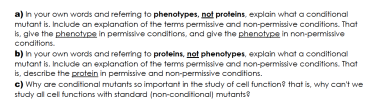 a) In your own words and referring to phenotypes, not proteins, explain what a conditional mutant is. Include an explanation of the terms permissive and non-permissive conditions. That is, give the phenotype in permissive conditions, and give the phenotype in non-permissive conditions. b) In your own words and referring to proteins, not phenotypes, explain what a conditional mutant is. Include an explanation of the terms permissive and non-permissive conditions. That is, describe the protein in permissive and non-permissive conditions. c)...
As a student project, you have isolated six new mutant strains of E. coli with altered...
 As a student project, you have isolated six new mutant strains
of E. coli with altered behavior of the lactose operon. The strains
are listed in the table below, together with their phenotypes (with
regard to significant ?-galactosidase synthesis) in three specific
situations.
Columns 1 and 2 present the phenotypes of each mutant haploid
strain. In column 1, the mutant is in an otherwise wild-type
genome. In column 2, the genome also carries a nonsense-suppressor
mutation (that is not present...
As a student project, you have isolated six new mutant strains
of E. coli with altered behavior of the lactose operon. The strains
are listed in the table below, together with their phenotypes (with
regard to significant ?-galactosidase synthesis) in three specific
situations.
Columns 1 and 2 present the phenotypes of each mutant haploid
strain. In column 1, the mutant is in an otherwise wild-type
genome. In column 2, the genome also carries a nonsense-suppressor
mutation (that is not present...
3. Initial cross: Now become familiar with the phenotype of Cy/Pm D/Sh fties and with the...
 3. Initial cross: Now become familiar with the phenotype of Cy/Pm D/Sh fties and with the phenot of the mutant stock of flies your instructor has chosen for you to identify as to linkage group To locate the selected mutant gene in its linkage group or chromosome, roceed as follows: Select virgin females homozygous for the mutant gene arbitrarily designate the allele as m) that you are to locate. Mate such virgin mutant females to Cy/Pm D/Sb males. 4. What...
Match the following phenotypes with the mutation that would be the most likely to be its...
 Match the following phenotypes with the mutation that would be the most likely to be its cause. The mutant proteins are listed below, followed by the protein domain that is mutated in each case, followed by the amino acid change that is a result of the mutation Try to answer each question by using the following reasoning: if you observe a phenotype, then that could be due to a mutation in protein in which the domain has had an amino...
Two phenotypically wild-type Drosophila (with long wings and red eyes) are crossed, and two mutant phenotypes...
Two phenotypically wild-type Drosophila (with long wings and red eyes) are crossed, and two mutant phenotypes (curved wings and lozenge eyes) are seen to segregate among the progeny as follows: Females: 900 long wing, red eyes 300 curved wing, red eyes Males: 450 long wing, red eyes 450 long wing, lozenge eyes 150 curved wing, red eyes 150 curved wing, lozenge eyes propose a genetic model for the two traits and determine the genotypes of the two wild-type parents
You have isolated an E. coli mutant which is not able to complete DNA replication. Instead,...
You have isolated an E. coli mutant which is not able to complete DNA replication. Instead, only short fragments of DNA are made. Which enzyme would you suspect is mutated? A. Ligase B. Primase C. Helicase
Q6. You have identified a yeast mutant that accumulates a vacuolar protein in the Golgi. Which...
Q6. You have identified a yeast mutant that accumulates a vacuolar protein in the Golgi. Which trafficking step would you conclude is blocked? A. ER to Golgi B. Golgi to ER C. Golgi to vacuole D. Golgi to plasma membrane
 a) In your own words and referring to phenotypes, not proteins, explain what a conditional mutant is. Include an explanation of the terms permissive and non-permissive conditions. That is, give the phenotype in permissive conditions, and give the phenotype in non-permissive conditions. b) In your own words and referring to proteins, not phenotypes, explain what a conditional mutant is. Include an explanation of the terms permissive and non-permissive conditions. That is, describe the protein in permissive and non-permissive conditions. c)...
 As a student project, you have isolated six new mutant strains
of E. coli with altered behavior of the lactose operon. The strains
are listed in the table below, together with their phenotypes (with
regard to significant ?-galactosidase synthesis) in three specific
situations.
Columns 1 and 2 present the phenotypes of each mutant haploid
strain. In column 1, the mutant is in an otherwise wild-type
genome. In column 2, the genome also carries a nonsense-suppressor
mutation (that is not present...
As a student project, you have isolated six new mutant strains
of E. coli with altered behavior of the lactose operon. The strains
are listed in the table below, together with their phenotypes (with
regard to significant ?-galactosidase synthesis) in three specific
situations.
Columns 1 and 2 present the phenotypes of each mutant haploid
strain. In column 1, the mutant is in an otherwise wild-type
genome. In column 2, the genome also carries a nonsense-suppressor
mutation (that is not present...
 3. Initial cross: Now become familiar with the phenotype of Cy/Pm D/Sh fties and with the phenot of the mutant stock of flies your instructor has chosen for you to identify as to linkage group To locate the selected mutant gene in its linkage group or chromosome, roceed as follows: Select virgin females homozygous for the mutant gene arbitrarily designate the allele as m) that you are to locate. Mate such virgin mutant females to Cy/Pm D/Sb males. 4. What...
 Match the following phenotypes with the mutation that would be the most likely to be its cause. The mutant proteins are listed below, followed by the protein domain that is mutated in each case, followed by the amino acid change that is a result of the mutation Try to answer each question by using the following reasoning: if you observe a phenotype, then that could be due to a mutation in protein in which the domain has had an amino...
Most questions answered within 3 hours.
-
Where is the error in this code sequence?
String s1 = "Hello";
String s2 = "ello";...
asked 11 months ago -
Financial data for Joel de Paris, Inc., for last year
follow:
Joel de Paris, Inc.
Balance...
asked 11 months ago -
Consider this reaction:
Al2(SO4)3 (aq)+ BaCl3
(aq) Al2Cl6 (aq)- +
3BaSO4(s) . What is the...
asked 11 months ago -
Suppose that Savneet is considering increasing her
recent random sample from 20 car rentals to 40...
asked 11 months ago -
Trucks arrive at an unloading terminal at an average rate of 120
per hour.
Trucks arrive...
asked 11 months ago -
Why are methanol and ethanol completely soluble in water while
octanol is not very little soluble....
asked 11 months ago -
A facilities manager at a university reads in a research report
that the mean amount of...
asked 11 months ago -
When the CuSO4 is rehydrated by adding water to the anhydrous
compound, is this an endothermic...
asked 11 months ago -
A ray of sunlight is passing from diamond into crown glass; the
angle of incidence is...
asked 11 months ago -
A block of mass 0.249 kg is placed on top of a light, vertical
spring of...
asked 11 months ago -
how do the kidneys compensate in the presences of acidosis
a) trigger hyperventilate
b) reserve acid...
asked 11 months ago -
Question 501 pts
The rental rate of capital to the firm increases. Which of the
following...
asked 11 months ago