
Homework Answers
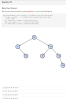
Answer: A ( C, B )
A tree is a collection of nodes and each node is liked with another
node with the help of a branch. The nodes are connected in such a
way that there are no loops. The process of visiting each node is
called traversing. Recursion is the best process for performing
traversal. A function call itself is known as recursive function
and this process is called recursion..
In the above example, the printTree() function called itself, first
it print root node value, then it called for right child, when the
leaf right child is traversed, it again call for left child until
the traversal process is completed.
Therefore, the trees will be printed in the order: A(C, B)
Add Answer to:
The nodes in which of the trees below will be printed in alphabetical order by the...
Answer the following question(s) concerning implementing recursive functions to perform operations on linked lists of nodes...
Answer the following question(s) concerning implementing recursive functions to perform operations on linked lists of nodes arranged as binary trees. For these questions, use the following struct definition for the nodes of the tree (we will not templatize the node here, so you do not have to write template functions for these questions, just assume trees of <int> values): struct BinaryTreeNode { int item; BinaryTreeNode* left; BinaryTreeNode* right; }; ---------------------------------------------- Given a node for a Binary Tree and an (integer)...
C++ Data Structures and Algorithms Binary Trees: Implementation Answer the following question(s) concerning implementing recursive functions...
C++ Data Structures and Algorithms Binary Trees: Implementation Answer the following question(s) concerning implementing recursive functions to perform operations on linked lists of nodes arranged as binary trees. For these questions, use the following struct definition for the nodes of the tree (we will not templatize the node here, so you do not have to write template functions for these questions, just assume trees of <int>values): struct BinaryTreeNode { int item; BinaryTreeNode* left; BinaryTreeNode* right; }; Write a recursive function...
1. Given the two binary trees below: 14 16 Write a method called swapSubtrees, which swaps all of...
 in java ..write all complete program from a- e
1. Given the two binary trees below: 14 16 Write a method called swapSubtrees, which swaps all of the left and right subtrees in the above binary trees. Add this method to the class BinaryTree and create a program to test this method for these 2 trees. Show the original trees and the resulting trees. Note: To test your algorithm, first create a binary search tree. Write a method called singleParent,...
in java ..write all complete program from a- e
1. Given the two binary trees below: 14 16 Write a method called swapSubtrees, which swaps all of the left and right subtrees in the above binary trees. Add this method to the class BinaryTree and create a program to test this method for these 2 trees. Show the original trees and the resulting trees. Note: To test your algorithm, first create a binary search tree. Write a method called singleParent,...
6. T or F: There can be two or more nodes in a heap with exactly...
6. T or F: There can be two or more nodes in a heap with exactly one child. 7. T or F: A heap can have no nodes with exactly one child. 8. T or F: All heaps are perfect trees. 9. T or F: No heaps are perfect trees. 10. T or F: All heaps are complete trees. 11. T or F: No heaps are complete trees. 12. T or F: A binary tree with one node must be...
Implement downHeap(Node *n) for a min heap implemented as an ordinary binary tree with an integer...
Implement downHeap(Node *n) for a min heap implemented as an ordinary binary tree with an integer member variable "value" and left and right child pointers. Any node might have only a left child, only a right child, both, or neither. The starter code below defines a class called "Node" that has two child pointers ("left" , "right") and an integer "value" member variable. There is also a constructor Node(int val) that initializes the children to nullptr and the node's value...
Question 39 Binary Trees: Traversal Describe the binary tree shown using depth-first, in order traversal (image...
 Question 39 Binary Trees: Traversal Describe the binary tree shown using depth-first, in order traversal (image t) void print TreeNode * start = nullptr){ // by default, we'll print from the head if (start == nullptr) // if nullptr, then we should start from the head start = head; if ( start->left != nullptr) printTree( start->left ) cout<< start-value << ", "; // print the current node if ( start->right != nullptr) printTree( start->right) } 12 15 10 14 18...
Write a recursive function that compares two given binary trees. It returns 1 if the two...
 Write a recursive function that compares two given binary trees. It returns 1 if the two trees are different, and it returns 0 otherwise. The function signature is: int treeDiff (node "a, node *b); Write a recursive function that counts how many nodes in a tree have a single child. The function signature is: int countoneChild(node "root);
Attention!!!!!!! I need python method!!!!!!!!! the part which need to edit is below: i nee...
 attention!!!!!!! I need python method!!!!!!!!!
the part which need to edit is below: i need python
one!!!!!!!!!
the part below is interface for the range search tree which
don’t need to modify it.
Week 3: Working with a BST TODO: Implement a Binary Search Tree (Class Name: RangesizeTree) Choose one language fromJava or Python. Iin both languages,there is an empty main function in the Range Size Tree file. The main function is not tested, however, it is provided for you...
attention!!!!!!! I need python method!!!!!!!!!
the part which need to edit is below: i need python
one!!!!!!!!!
the part below is interface for the range search tree which
don’t need to modify it.
Week 3: Working with a BST TODO: Implement a Binary Search Tree (Class Name: RangesizeTree) Choose one language fromJava or Python. Iin both languages,there is an empty main function in the Range Size Tree file. The main function is not tested, however, it is provided for you...
I need Help Plz In a tree, the leaves are called external nodes. Accordingly, internal nodes...
I need Help Plz In a tree, the leaves are called external nodes. Accordingly, internal nodes are exactly the nodes that are not external nodes. An edge or connection exists between two nodes if the two nodes are in `` father-child relationship ''. A true binary tree is a tree with the property that every internal node has exactly two children. Prove the following two sentences for nonempty real binary trees: a) A non-empty real binary tree with N internal...
Trees and Heaps 1. Show that the maximum number of nodes in a binary tree of...
Trees and Heaps 1. Show that the maximum number of nodes in a binary tree of height h is 2h+1 − 1. 2. A full node is a node with two children. Prove that the number of full nodes plus one is equal to the number of leaves in a nonempty binary tree. 3. What is the minimum number of nodes in an AVL tree of height 15? 4. Show the result of inserting 14, 12, 18, 20, 27, 16,...
 in java ..write all complete program from a- e
1. Given the two binary trees below: 14 16 Write a method called swapSubtrees, which swaps all of the left and right subtrees in the above binary trees. Add this method to the class BinaryTree and create a program to test this method for these 2 trees. Show the original trees and the resulting trees. Note: To test your algorithm, first create a binary search tree. Write a method called singleParent,...
in java ..write all complete program from a- e
1. Given the two binary trees below: 14 16 Write a method called swapSubtrees, which swaps all of the left and right subtrees in the above binary trees. Add this method to the class BinaryTree and create a program to test this method for these 2 trees. Show the original trees and the resulting trees. Note: To test your algorithm, first create a binary search tree. Write a method called singleParent,...
 Question 39 Binary Trees: Traversal Describe the binary tree shown using depth-first, in order traversal (image t) void print TreeNode * start = nullptr){ // by default, we'll print from the head if (start == nullptr) // if nullptr, then we should start from the head start = head; if ( start->left != nullptr) printTree( start->left ) cout<< start-value << ", "; // print the current node if ( start->right != nullptr) printTree( start->right) } 12 15 10 14 18...
 Write a recursive function that compares two given binary trees. It returns 1 if the two trees are different, and it returns 0 otherwise. The function signature is: int treeDiff (node "a, node *b); Write a recursive function that counts how many nodes in a tree have a single child. The function signature is: int countoneChild(node "root);
 attention!!!!!!! I need python method!!!!!!!!!
the part which need to edit is below: i need python
one!!!!!!!!!
the part below is interface for the range search tree which
don’t need to modify it.
Week 3: Working with a BST TODO: Implement a Binary Search Tree (Class Name: RangesizeTree) Choose one language fromJava or Python. Iin both languages,there is an empty main function in the Range Size Tree file. The main function is not tested, however, it is provided for you...
attention!!!!!!! I need python method!!!!!!!!!
the part which need to edit is below: i need python
one!!!!!!!!!
the part below is interface for the range search tree which
don’t need to modify it.
Week 3: Working with a BST TODO: Implement a Binary Search Tree (Class Name: RangesizeTree) Choose one language fromJava or Python. Iin both languages,there is an empty main function in the Range Size Tree file. The main function is not tested, however, it is provided for you...
Most questions answered within 3 hours.
-
Where is the error in this code sequence?
String s1 = "Hello";
String s2 = "ello";...
asked 10 months ago -
Financial data for Joel de Paris, Inc., for last year
follow:
Joel de Paris, Inc.
Balance...
asked 10 months ago -
Consider this reaction:
Al2(SO4)3 (aq)+ BaCl3
(aq) Al2Cl6 (aq)- +
3BaSO4(s) . What is the...
asked 10 months ago -
Suppose that Savneet is considering increasing her
recent random sample from 20 car rentals to 40...
asked 10 months ago -
Trucks arrive at an unloading terminal at an average rate of 120
per hour.
Trucks arrive...
asked 10 months ago -
Why are methanol and ethanol completely soluble in water while
octanol is not very little soluble....
asked 10 months ago -
A facilities manager at a university reads in a research report
that the mean amount of...
asked 10 months ago -
When the CuSO4 is rehydrated by adding water to the anhydrous
compound, is this an endothermic...
asked 10 months ago -
A ray of sunlight is passing from diamond into crown glass; the
angle of incidence is...
asked 10 months ago -
A block of mass 0.249 kg is placed on top of a light, vertical
spring of...
asked 10 months ago -
how do the kidneys compensate in the presences of acidosis
a) trigger hyperventilate
b) reserve acid...
asked 10 months ago -
Question 501 pts
The rental rate of capital to the firm increases. Which of the
following...
asked 10 months ago