With a total flow of 0.4 m3/s, determine the division of flow and the head loss...
With a total flow of 0.4 m3/s, determine the division of flow and the head loss from A to B.

Homework Answers
1)Total flow Q = flow in upper pipe Q1+ flow in in lower pipe Q2
2) Flow Q = Area of pipe A * velocity of flow V
From 1 and 2 ,
Q = A1 * v1 + A2 *v2


 ------------ Equation A
3) The head loss in each branch pipe WILL BE THE SAME!
hL = h1 = h2
4) 
From 3 and 4


Cancelling 2g on both sides

 ----- Equation B
Solving equation A and B


Then, 

Flow in upper pipe Q1 = A1 * v1
=  = 0.289 m3/ s
Q2 = A2 * v2 = = 0.11 m3/s
Head loss from A to B =
 = 4.47 m
Add Answer to:
With a total flow of 0.4 m3/s, determine the division of flow
and the head loss...
Find Pipe Velocity, volumetric flow rate, head delivered by pump and convert to Kj/s. Head loss...
 Find Pipe Velocity, volumetric
flow rate, head delivered by pump and convert to Kj/s. Head loss is
50m or 27V^2/2g
Z2=100m
dit View Favorites Tools Help ¡Southwest Airlines My Ac., ?? Web Slice Gallery ? Zi-70 ml D-0.25 m Pump Click to see additional instructions In the figure, water is pumped from a lower reservoir to a higher reservoir through a pipe at a steady rate of flow. The pipe head loss is g Determine the pipe velocity, in units...
Find Pipe Velocity, volumetric
flow rate, head delivered by pump and convert to Kj/s. Head loss is
50m or 27V^2/2g
Z2=100m
dit View Favorites Tools Help ¡Southwest Airlines My Ac., ?? Web Slice Gallery ? Zi-70 ml D-0.25 m Pump Click to see additional instructions In the figure, water is pumped from a lower reservoir to a higher reservoir through a pipe at a steady rate of flow. The pipe head loss is g Determine the pipe velocity, in units...
QUESTION 2 Calculate the head loss in an oil pipe line of length 1,976 m and...
QUESTION 2 Calculate the head loss in an oil pipe line of length 1,976 m and diameter 0.4 m for a flow rate of 1.7 l/s. Density: 854 kg/m3 ; dynamic viscosity: 0.039 kg/ (ms) Give the answer in metre fluid head to +/- 0.0001 m.
Determine the head loss and velocity of flow in a water supply main of 15.0 cm...
Determine the head loss and velocity of flow in a water supply main of 15.0 cm diameter pipe with a discharge of 22 l/s using the nomograph chart and verify the result using appropriate equation. Assuming f = 0.0155.
A flow nozzle equipped with a differential pressure gage is used to measure the flow rate of water at 10°C (p 9997 kg/m3 and p 1.307 x 10⁻³ kg/m s) through a 3-cm-diameter horizontal pipe. The nozzle...
 A flow nozzle equipped with a differential pressure gage is used to measure the flow rate of water at 10°C (p 9997 kg/m3 and p 1.307 x 10⁻³ kg/m s) through a 3-cm-diameter horizontal pipe. The nozzle exit diameter is 1.5 cm, and the measured pressure drop is 3.3 kPa. Determine the volume flow rate of water, the average velocity through the pipe, and the head loss 1.5 cm Differential pressure gage -3 m3(s m/s The volume flow rate of...
Water with a volume flow rate of 0.05 m3/s, flows inside a horizontal pipe made of...
 Water with a volume flow rate of 0.05 m3/s, flows inside a horizontal pipe made of cast iron with a diameter of 20 cm. Calculate the friction head loss per kilometer of the pipe.
7.14 The pump in Fig. 7.20 delivers water from the lower to the upper reservoir at the rate of 0.057 m3/s. The energy loss between the suction pipe inlet and the pump is 1.83 m and that between t...
 7.14 The pump in Fig. 7.20 delivers water from the lower to the upper reservoir at the rate of 0.057 m3/s. The energy loss between the suction pipe inlet and the pump is 1.83 m and that between the pump outlet and the upper reservoir is 3.66 m. Both pipes are 6-in Schedule 40 steel pipe. Calculate (a) the pressure at the pump inlet, (b) the pressure at the pump outlet, (c) the total head on the pump, and (d)...
Question 2 -Laminar Flow A liquid (ρ = 1000 kg/m3; μ = 10-1 N . s/2...
 Question 2 -Laminar Flow A liquid (ρ = 1000 kg/m3; μ = 10-1 N . s/2 m: v-104 m2/s) flows uniformly with a mean velocity of 1.5 m/s in a pipe with a diameter of 100 mm. Show that the flow is laminar. Also, find the friction factor fand the head loss per meter of pipe length.
uB/Yw Total head loss, Ah ZA en Zc; 1B Water flow through a pipe. FIGURE 6.1
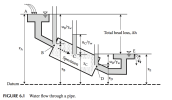 uB/Yw Total head loss, Ah ZA en Zc; 1B Water flow through a pipe. FIGURE 6.1
1. Calculate the experimental head loss from the readings taken in the manometer below and compare...
 1. Calculate the experimental head loss from the
readings taken in the manometer below and compare them with
theoretical predictions. NOTE: The table is only provided
for inputting the answers. The only given parameters are the
temperature of the water, flow rate and manometer reading.
Calculate the velocity, Reynolds Number, Darcy Friction
Factor, Theoretical Head Loss and Experimental Head
Loss.
2. Compare the differences of using a
Moody Chart and the Haaland Approximation
of the Darcy Friction Factor by calculating...
1. Calculate the experimental head loss from the
readings taken in the manometer below and compare them with
theoretical predictions. NOTE: The table is only provided
for inputting the answers. The only given parameters are the
temperature of the water, flow rate and manometer reading.
Calculate the velocity, Reynolds Number, Darcy Friction
Factor, Theoretical Head Loss and Experimental Head
Loss.
2. Compare the differences of using a
Moody Chart and the Haaland Approximation
of the Darcy Friction Factor by calculating...
Using Hazen Williams and Manning's equation, determine the friction head loss in a 1.6 m diameter,...
 Using Hazen Williams and Manning's equation, determine the friction head loss in a 1.6 m diameter, 1000 m long pipe made of cement mortar to carry a flow rate of 3 m/s.
 Find Pipe Velocity, volumetric
flow rate, head delivered by pump and convert to Kj/s. Head loss is
50m or 27V^2/2g
Z2=100m
dit View Favorites Tools Help ¡Southwest Airlines My Ac., ?? Web Slice Gallery ? Zi-70 ml D-0.25 m Pump Click to see additional instructions In the figure, water is pumped from a lower reservoir to a higher reservoir through a pipe at a steady rate of flow. The pipe head loss is g Determine the pipe velocity, in units...
Find Pipe Velocity, volumetric
flow rate, head delivered by pump and convert to Kj/s. Head loss is
50m or 27V^2/2g
Z2=100m
dit View Favorites Tools Help ¡Southwest Airlines My Ac., ?? Web Slice Gallery ? Zi-70 ml D-0.25 m Pump Click to see additional instructions In the figure, water is pumped from a lower reservoir to a higher reservoir through a pipe at a steady rate of flow. The pipe head loss is g Determine the pipe velocity, in units...
 A flow nozzle equipped with a differential pressure gage is used to measure the flow rate of water at 10°C (p 9997 kg/m3 and p 1.307 x 10⁻³ kg/m s) through a 3-cm-diameter horizontal pipe. The nozzle exit diameter is 1.5 cm, and the measured pressure drop is 3.3 kPa. Determine the volume flow rate of water, the average velocity through the pipe, and the head loss 1.5 cm Differential pressure gage -3 m3(s m/s The volume flow rate of...
 Water with a volume flow rate of 0.05 m3/s, flows inside a horizontal pipe made of cast iron with a diameter of 20 cm. Calculate the friction head loss per kilometer of the pipe.
 7.14 The pump in Fig. 7.20 delivers water from the lower to the upper reservoir at the rate of 0.057 m3/s. The energy loss between the suction pipe inlet and the pump is 1.83 m and that between the pump outlet and the upper reservoir is 3.66 m. Both pipes are 6-in Schedule 40 steel pipe. Calculate (a) the pressure at the pump inlet, (b) the pressure at the pump outlet, (c) the total head on the pump, and (d)...
 Question 2 -Laminar Flow A liquid (ρ = 1000 kg/m3; μ = 10-1 N . s/2 m: v-104 m2/s) flows uniformly with a mean velocity of 1.5 m/s in a pipe with a diameter of 100 mm. Show that the flow is laminar. Also, find the friction factor fand the head loss per meter of pipe length.
 uB/Yw Total head loss, Ah ZA en Zc; 1B Water flow through a pipe. FIGURE 6.1
 1. Calculate the experimental head loss from the
readings taken in the manometer below and compare them with
theoretical predictions. NOTE: The table is only provided
for inputting the answers. The only given parameters are the
temperature of the water, flow rate and manometer reading.
Calculate the velocity, Reynolds Number, Darcy Friction
Factor, Theoretical Head Loss and Experimental Head
Loss.
2. Compare the differences of using a
Moody Chart and the Haaland Approximation
of the Darcy Friction Factor by calculating...
1. Calculate the experimental head loss from the
readings taken in the manometer below and compare them with
theoretical predictions. NOTE: The table is only provided
for inputting the answers. The only given parameters are the
temperature of the water, flow rate and manometer reading.
Calculate the velocity, Reynolds Number, Darcy Friction
Factor, Theoretical Head Loss and Experimental Head
Loss.
2. Compare the differences of using a
Moody Chart and the Haaland Approximation
of the Darcy Friction Factor by calculating...
 Using Hazen Williams and Manning's equation, determine the friction head loss in a 1.6 m diameter, 1000 m long pipe made of cement mortar to carry a flow rate of 3 m/s.
Most questions answered within 3 hours.
-
Where is the error in this code sequence?
String s1 = "Hello";
String s2 = "ello";...
asked 10 months ago -
Financial data for Joel de Paris, Inc., for last year
follow:
Joel de Paris, Inc.
Balance...
asked 10 months ago -
Consider this reaction:
Al2(SO4)3 (aq)+ BaCl3
(aq) Al2Cl6 (aq)- +
3BaSO4(s) . What is the...
asked 10 months ago -
Suppose that Savneet is considering increasing her
recent random sample from 20 car rentals to 40...
asked 10 months ago -
Trucks arrive at an unloading terminal at an average rate of 120
per hour.
Trucks arrive...
asked 10 months ago -
Why are methanol and ethanol completely soluble in water while
octanol is not very little soluble....
asked 10 months ago -
A facilities manager at a university reads in a research report
that the mean amount of...
asked 10 months ago -
When the CuSO4 is rehydrated by adding water to the anhydrous
compound, is this an endothermic...
asked 10 months ago -
A ray of sunlight is passing from diamond into crown glass; the
angle of incidence is...
asked 10 months ago -
A block of mass 0.249 kg is placed on top of a light, vertical
spring of...
asked 10 months ago -
how do the kidneys compensate in the presences of acidosis
a) trigger hyperventilate
b) reserve acid...
asked 10 months ago -
Question 501 pts
The rental rate of capital to the firm increases. Which of the
following...
asked 10 months ago