
Homework Answers


Add Answer to:
Please write in pencil to write neatly without scribbles,
write simple
(a) Convert the following circuit...
1. Convert the decimal number 435.64 to binary, octal, and hexadecimal. L7 2. Part A. Convert...
 1. Convert the decimal number 435.64 to binary, octal, and hexadecimal. L7 2. Part A. Convert the circuit below into NAND gates. Insert or remove inverters as necessary. Part B. What is the propagation delay from any input to any output for both the original circuit and the NAND gate circuit from part A. Use 1 nS for inverters, 2 nS for NAND 3 nS for NOR, 4 ns for AND, and 5 nS for OR gates.
please solve all parts of the question Problem #1 The D latch is constructed with four...
 please solve all parts of the question
Problem #1 The D latch is constructed with four NAND gates and an inverter. Consider the following three other ways for obtaining a D latch. In each case, draw the logic diagram and verify the circuit operation. (a) Use NOR gates for the SR latch part and AND gates for the other two. An inverter may be needed. (b) Use NOR gates for all four gates. Inverters may be needed. (c) Use four...
please solve all parts of the question
Problem #1 The D latch is constructed with four NAND gates and an inverter. Consider the following three other ways for obtaining a D latch. In each case, draw the logic diagram and verify the circuit operation. (a) Use NOR gates for the SR latch part and AND gates for the other two. An inverter may be needed. (b) Use NOR gates for all four gates. Inverters may be needed. (c) Use four...
9. (15 points) The D latch shown in lecture 15 slide 15 is constructed with four NAND gates and a...
 9. (15 points) The D latch shown in lecture 15 slide 15 is constructed with four NAND gates and an inverter. Consider the following three other ways for obtaining a D latch, and in each case draw the logic diagram and verify the circuit operation Use NOR gates for the SR latch part and AND gates for the other two. An inverter may be needed. Use NOR gates for all four gates. Inverters may be needed. i. ii. Use four...
If only NOR gates can be used to build a circuit for the following expression (i.e.....
 If only NOR gates can be used to build a circuit for the following expression (i.e.. no INVERTERS are allowed... inverters must be built with NOR gates), how many NOR gates would be required? Note Do not try to simplify or change the expression... implement it as is. B+C+A
[BONUS] Convert the following circuit to use only NAND gates. A B C_out с C SUM
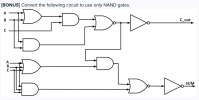 [BONUS] Convert the following circuit to use only NAND gates. A B C_out с C SUM
Please show all the steps? It is one question. If you can't do both, please do...
 Please show all the steps? It is one question. If you can't do
both, please do part B? Thanks!
Problem 5: (2 x 5 marks) Perform technology mapping to NAND and NOR gates on the given circuit. You need to show 4 figures (as shown in Lecture#11, slide#7) a, b, c, d as part of your solution. A. Implementation with NAND gates B. Implementation with NOR gates A. B C I D G E F-
Please show all the steps? It is one question. If you can't do
both, please do part B? Thanks!
Problem 5: (2 x 5 marks) Perform technology mapping to NAND and NOR gates on the given circuit. You need to show 4 figures (as shown in Lecture#11, slide#7) a, b, c, d as part of your solution. A. Implementation with NAND gates B. Implementation with NOR gates A. B C I D G E F-
[10] A combinational circuit is specified by the following three Boolean function: F1(A,B,C) = {(2,4,7) F2(A,...
 [10] A combinational circuit is specified by the following three Boolean function: F1(A,B,C) = {(2,4,7) F2(A, B, C) = 2(0,3) F3(A,B,C) = {(0,2,3,4,7) Implement the circuit with a decoder constructed with NAND gates and NAND or NOR gates connected to the decoder outputs. Use block diagram for the decoder. Minimize the number of inputs in the external gates.
Consider the following function. (8 <A ri eve n of products) expression. Don't draw the gate...
 Consider the following function. (8 <A ri eve n of products) expression. Don't draw the gate 1131 0 diagram yet. (b) Use De Morgan's Laws or "bubble pushing" to convert the SOP expression to something that can be directly implemented with only NAND/NOR/inverter gates. (c) Now draw the schematic (logic gates) for the resulting NAND/NOR/inverter circuit.
Draw the logic circuit realization of the following Boolean expression as stated. Do not simplify! You...
 Draw the logic circuit realization of the following Boolean expression as stated. Do not simplify! You may draw inverters explicitly or use inversion bubbles, as you choose. F(A,B,C) (A'+B+C)(A+B+C) b. Convert the Boolean equation of (a) to its De Morgan equivalent. c. Write the complete truth table for the Boolean expression of (b) a.
Please make the circuit Design a Mealy sequential circuit (Figure 16-27) which investigates an input sequence...
 Please make the circuit
Design a Mealy sequential circuit (Figure 16-27) which investigates an input sequence X and will produce an output of Z 16.8 1 for any input sequence ending in 0011 or 110 Example: X 101001 1 00 11 Z 0 00 0 001 1 0 0 1 Notice that the circuit does not reset to the start state when an output of Z1 occurs. However, your circuit should have a start state and should be provided with...
Please make the circuit
Design a Mealy sequential circuit (Figure 16-27) which investigates an input sequence X and will produce an output of Z 16.8 1 for any input sequence ending in 0011 or 110 Example: X 101001 1 00 11 Z 0 00 0 001 1 0 0 1 Notice that the circuit does not reset to the start state when an output of Z1 occurs. However, your circuit should have a start state and should be provided with...
 1. Convert the decimal number 435.64 to binary, octal, and hexadecimal. L7 2. Part A. Convert the circuit below into NAND gates. Insert or remove inverters as necessary. Part B. What is the propagation delay from any input to any output for both the original circuit and the NAND gate circuit from part A. Use 1 nS for inverters, 2 nS for NAND 3 nS for NOR, 4 ns for AND, and 5 nS for OR gates.
 please solve all parts of the question
Problem #1 The D latch is constructed with four NAND gates and an inverter. Consider the following three other ways for obtaining a D latch. In each case, draw the logic diagram and verify the circuit operation. (a) Use NOR gates for the SR latch part and AND gates for the other two. An inverter may be needed. (b) Use NOR gates for all four gates. Inverters may be needed. (c) Use four...
please solve all parts of the question
Problem #1 The D latch is constructed with four NAND gates and an inverter. Consider the following three other ways for obtaining a D latch. In each case, draw the logic diagram and verify the circuit operation. (a) Use NOR gates for the SR latch part and AND gates for the other two. An inverter may be needed. (b) Use NOR gates for all four gates. Inverters may be needed. (c) Use four...
 9. (15 points) The D latch shown in lecture 15 slide 15 is constructed with four NAND gates and an inverter. Consider the following three other ways for obtaining a D latch, and in each case draw the logic diagram and verify the circuit operation Use NOR gates for the SR latch part and AND gates for the other two. An inverter may be needed. Use NOR gates for all four gates. Inverters may be needed. i. ii. Use four...
 If only NOR gates can be used to build a circuit for the following expression (i.e.. no INVERTERS are allowed... inverters must be built with NOR gates), how many NOR gates would be required? Note Do not try to simplify or change the expression... implement it as is. B+C+A
 [BONUS] Convert the following circuit to use only NAND gates. A B C_out с C SUM
 Please show all the steps? It is one question. If you can't do
both, please do part B? Thanks!
Problem 5: (2 x 5 marks) Perform technology mapping to NAND and NOR gates on the given circuit. You need to show 4 figures (as shown in Lecture#11, slide#7) a, b, c, d as part of your solution. A. Implementation with NAND gates B. Implementation with NOR gates A. B C I D G E F-
Please show all the steps? It is one question. If you can't do
both, please do part B? Thanks!
Problem 5: (2 x 5 marks) Perform technology mapping to NAND and NOR gates on the given circuit. You need to show 4 figures (as shown in Lecture#11, slide#7) a, b, c, d as part of your solution. A. Implementation with NAND gates B. Implementation with NOR gates A. B C I D G E F-
 [10] A combinational circuit is specified by the following three Boolean function: F1(A,B,C) = {(2,4,7) F2(A, B, C) = 2(0,3) F3(A,B,C) = {(0,2,3,4,7) Implement the circuit with a decoder constructed with NAND gates and NAND or NOR gates connected to the decoder outputs. Use block diagram for the decoder. Minimize the number of inputs in the external gates.
 Consider the following function. (8 <A ri eve n of products) expression. Don't draw the gate 1131 0 diagram yet. (b) Use De Morgan's Laws or "bubble pushing" to convert the SOP expression to something that can be directly implemented with only NAND/NOR/inverter gates. (c) Now draw the schematic (logic gates) for the resulting NAND/NOR/inverter circuit.
 Draw the logic circuit realization of the following Boolean expression as stated. Do not simplify! You may draw inverters explicitly or use inversion bubbles, as you choose. F(A,B,C) (A'+B+C)(A+B+C) b. Convert the Boolean equation of (a) to its De Morgan equivalent. c. Write the complete truth table for the Boolean expression of (b) a.
 Please make the circuit
Design a Mealy sequential circuit (Figure 16-27) which investigates an input sequence X and will produce an output of Z 16.8 1 for any input sequence ending in 0011 or 110 Example: X 101001 1 00 11 Z 0 00 0 001 1 0 0 1 Notice that the circuit does not reset to the start state when an output of Z1 occurs. However, your circuit should have a start state and should be provided with...
Please make the circuit
Design a Mealy sequential circuit (Figure 16-27) which investigates an input sequence X and will produce an output of Z 16.8 1 for any input sequence ending in 0011 or 110 Example: X 101001 1 00 11 Z 0 00 0 001 1 0 0 1 Notice that the circuit does not reset to the start state when an output of Z1 occurs. However, your circuit should have a start state and should be provided with...
Most questions answered within 3 hours.
-
Where is the error in this code sequence?
String s1 = "Hello";
String s2 = "ello";...
asked 10 months ago -
Financial data for Joel de Paris, Inc., for last year
follow:
Joel de Paris, Inc.
Balance...
asked 10 months ago -
Consider this reaction:
Al2(SO4)3 (aq)+ BaCl3
(aq) Al2Cl6 (aq)- +
3BaSO4(s) . What is the...
asked 10 months ago -
Suppose that Savneet is considering increasing her
recent random sample from 20 car rentals to 40...
asked 10 months ago -
Trucks arrive at an unloading terminal at an average rate of 120
per hour.
Trucks arrive...
asked 10 months ago -
Why are methanol and ethanol completely soluble in water while
octanol is not very little soluble....
asked 10 months ago -
A facilities manager at a university reads in a research report
that the mean amount of...
asked 10 months ago -
When the CuSO4 is rehydrated by adding water to the anhydrous
compound, is this an endothermic...
asked 10 months ago -
A ray of sunlight is passing from diamond into crown glass; the
angle of incidence is...
asked 10 months ago -
A block of mass 0.249 kg is placed on top of a light, vertical
spring of...
asked 10 months ago -
how do the kidneys compensate in the presences of acidosis
a) trigger hyperventilate
b) reserve acid...
asked 10 months ago -
Question 501 pts
The rental rate of capital to the firm increases. Which of the
following...
asked 10 months ago