important muscles of the body (flexor and extension) including shortest and longest muscle
important muscles of the body (flexor and extension) including shortest and longest muscle
Homework Answers

Add Answer to:
important muscles of the body (flexor and extension)
including shortest and longest muscle
What muscles make up the hip flexor muscle group, hip extensor muscle group, hip adduction muscle...
What muscles make up the hip flexor muscle group, hip extensor muscle group, hip adduction muscle group, hip abduction muscle group? What muscles make up the hamstring muscle group? Quadriceps muscle group?
We have multiple important muscles or muscle groups in the body. Chose one of the following...
We have multiple important muscles or muscle groups in the body. Chose one of the following and detail its attachment, insertion, the part of the body it moves, and anything else of particular importance: quadriceps; biceps; triceps; hamstrings; gluteus maximus; gluteus minimus; gastrocnemius; Sartorius; rotator cuff; pectoral; wrist flexors; wrist extensors; or tibialis anterior flle in the nenvous system Choose one and detail its basic function
What is the function of the longest extension on a neuron? A. Support the function of...
 What is the function of the longest extension on a neuron? A. Support the function of a neuron. B. Interpret whether a signal needs to be continued and sent to other cells. C. Receive signals from other neurons and send them to the cell body. D. Send signals away from the cell body to other neurons muscle cells, or gland cells.
The concept of muscle groups (muscles helping other muscles) is important because: a. When you use...
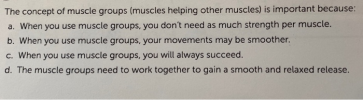 The concept of muscle groups (muscles helping other muscles) is important because: a. When you use muscle groups, you don't need as much strength per muscle. b. When you use muscle groups, your movements may be smoother. c. When you use muscle groups, you will always succeed. d. The muscle groups need to work together to gain a smooth and relaxed release.
Find the elbow joint reaction force (magnitude and direction) and the elbow flexor muscle force for...
Find the elbow joint reaction force (magnitude and direction) and the elbow flexor muscle force for the instant described below. Assume the forearm, hand, and ball to be a single rigid body. This rigid body has a mass of 3 kg; it has a mass moment of inertia about its center of mass of 0.018 kg*m2 ; its center of mass is 19 cm from the center of the elbow joint. The rigid body has an angular acceleration (α) of...
An athlete is measuring the force by their flexor muscle by pulling a rope horizontally at...
 An athlete is measuring the force by their flexor muscle by pulling a rope horizontally at a constant force. While pulling the rope the muscle applies a force on the forearm an angle of 71° as shown in the diagram. While keeping your forearm completely vertical, the tension in the rope is at 185N. The athlete's muscle is attached to the forearm 5 cm from the elbow joint and that the weight of your forearm is 22 N with a...
muscle is located and performs of the hip. 8. The iliopsoas is A. medially; adduction B....
 muscle is located and performs of the hip. 8. The iliopsoas is A. medially; adduction B. laterally; abduction C. anteriorly; flexion D. posteriorly; extension 9. The origin of the rectus femoris muscle is the anterior inferior iliac spine of the iliunm the groove above the A. ischiumm B. acetabulum C. fascia D. linea aspera of the hip. 10. The pectineus muscle is located A. medially; intemal rotation B. laterally; abduction C. anteriorly; flexion D. posteriorly; extension 11. Which of the...
27) If someone is avoiding full knee extension at initial contact due to pain, what muscle...
 27) If someone is avoiding full knee extension at initial contact due to pain, what muscle are than protecting from being stretched? a. Hip flexor b Hamstring c. Quadriceps d. Gluteus medius
Elbow Flexion: biceps brachii, brachialis, and brachioradialis muscles Hip Flexion: iliopsoas, sartorius muscles Extension: biceps femoris,...
 Elbow Flexion: biceps brachii, brachialis, and brachioradialis muscles Hip Flexion: iliopsoas, sartorius muscles Extension: biceps femoris, semitendinosus, semimembranosus, and gluteus maxim Abduction: tensor fasciae latae, sartorius, and gluteus medius muscles Adduction: gracilis and adductor muscles I Knee Flexion: biceps femoris, semitendinosus, semimembranosus, and gastrocnemius muscles .Extension: rectus femoris, vastus medialis, vastus intermedius, and vastus lateralis Ankle Dorsiflexion: tibialis anterior muscle Plantarflexion: gastrocnemius and soleus muscles Inversion: tibialis anterior and tibialis posterior muscles Eversion: fibularis brevis and fibularis longus muscles ke...
questions 2-4 1-4 Week 10 Topics: Muscle actions and naming conventions, major muscles of the human...
 questions 2-4
1-4 Week 10 Topics: Muscle actions and naming conventions, major muscles of the human body including origin, insertion, action, and innervation Reading: Chapter 10: The Muscular System Learning Objectives: 1. Define the following terms, prime mover, synergist, antagonist, origin, insertion, aponeurosis, sphincter 2. Describe the functions of prime movers, antagonists, and Synergists 3. List the criteria used in naming muscles. Provide examples of cach, 4. Name and identify key muscles of the human body, giving the origin, insertion,...
questions 2-4
1-4 Week 10 Topics: Muscle actions and naming conventions, major muscles of the human body including origin, insertion, action, and innervation Reading: Chapter 10: The Muscular System Learning Objectives: 1. Define the following terms, prime mover, synergist, antagonist, origin, insertion, aponeurosis, sphincter 2. Describe the functions of prime movers, antagonists, and Synergists 3. List the criteria used in naming muscles. Provide examples of cach, 4. Name and identify key muscles of the human body, giving the origin, insertion,...
 What is the function of the longest extension on a neuron? A. Support the function of a neuron. B. Interpret whether a signal needs to be continued and sent to other cells. C. Receive signals from other neurons and send them to the cell body. D. Send signals away from the cell body to other neurons muscle cells, or gland cells.
 The concept of muscle groups (muscles helping other muscles) is important because: a. When you use muscle groups, you don't need as much strength per muscle. b. When you use muscle groups, your movements may be smoother. c. When you use muscle groups, you will always succeed. d. The muscle groups need to work together to gain a smooth and relaxed release.
 An athlete is measuring the force by their flexor muscle by pulling a rope horizontally at a constant force. While pulling the rope the muscle applies a force on the forearm an angle of 71° as shown in the diagram. While keeping your forearm completely vertical, the tension in the rope is at 185N. The athlete's muscle is attached to the forearm 5 cm from the elbow joint and that the weight of your forearm is 22 N with a...
 muscle is located and performs of the hip. 8. The iliopsoas is A. medially; adduction B. laterally; abduction C. anteriorly; flexion D. posteriorly; extension 9. The origin of the rectus femoris muscle is the anterior inferior iliac spine of the iliunm the groove above the A. ischiumm B. acetabulum C. fascia D. linea aspera of the hip. 10. The pectineus muscle is located A. medially; intemal rotation B. laterally; abduction C. anteriorly; flexion D. posteriorly; extension 11. Which of the...
 27) If someone is avoiding full knee extension at initial contact due to pain, what muscle are than protecting from being stretched? a. Hip flexor b Hamstring c. Quadriceps d. Gluteus medius
 Elbow Flexion: biceps brachii, brachialis, and brachioradialis muscles Hip Flexion: iliopsoas, sartorius muscles Extension: biceps femoris, semitendinosus, semimembranosus, and gluteus maxim Abduction: tensor fasciae latae, sartorius, and gluteus medius muscles Adduction: gracilis and adductor muscles I Knee Flexion: biceps femoris, semitendinosus, semimembranosus, and gastrocnemius muscles .Extension: rectus femoris, vastus medialis, vastus intermedius, and vastus lateralis Ankle Dorsiflexion: tibialis anterior muscle Plantarflexion: gastrocnemius and soleus muscles Inversion: tibialis anterior and tibialis posterior muscles Eversion: fibularis brevis and fibularis longus muscles ke...
 questions 2-4
1-4 Week 10 Topics: Muscle actions and naming conventions, major muscles of the human body including origin, insertion, action, and innervation Reading: Chapter 10: The Muscular System Learning Objectives: 1. Define the following terms, prime mover, synergist, antagonist, origin, insertion, aponeurosis, sphincter 2. Describe the functions of prime movers, antagonists, and Synergists 3. List the criteria used in naming muscles. Provide examples of cach, 4. Name and identify key muscles of the human body, giving the origin, insertion,...
questions 2-4
1-4 Week 10 Topics: Muscle actions and naming conventions, major muscles of the human body including origin, insertion, action, and innervation Reading: Chapter 10: The Muscular System Learning Objectives: 1. Define the following terms, prime mover, synergist, antagonist, origin, insertion, aponeurosis, sphincter 2. Describe the functions of prime movers, antagonists, and Synergists 3. List the criteria used in naming muscles. Provide examples of cach, 4. Name and identify key muscles of the human body, giving the origin, insertion,...
Most questions answered within 3 hours.
-
Where is the error in this code sequence?
String s1 = "Hello";
String s2 = "ello";...
asked 11 months ago -
Financial data for Joel de Paris, Inc., for last year
follow:
Joel de Paris, Inc.
Balance...
asked 11 months ago -
Consider this reaction:
Al2(SO4)3 (aq)+ BaCl3
(aq) Al2Cl6 (aq)- +
3BaSO4(s) . What is the...
asked 11 months ago -
Suppose that Savneet is considering increasing her
recent random sample from 20 car rentals to 40...
asked 11 months ago -
Trucks arrive at an unloading terminal at an average rate of 120
per hour.
Trucks arrive...
asked 11 months ago -
Why are methanol and ethanol completely soluble in water while
octanol is not very little soluble....
asked 11 months ago -
A facilities manager at a university reads in a research report
that the mean amount of...
asked 11 months ago -
When the CuSO4 is rehydrated by adding water to the anhydrous
compound, is this an endothermic...
asked 11 months ago -
A ray of sunlight is passing from diamond into crown glass; the
angle of incidence is...
asked 11 months ago -
A block of mass 0.249 kg is placed on top of a light, vertical
spring of...
asked 11 months ago -
how do the kidneys compensate in the presences of acidosis
a) trigger hyperventilate
b) reserve acid...
asked 11 months ago -
Question 501 pts
The rental rate of capital to the firm increases. Which of the
following...
asked 11 months ago