Explain the use of genetic engineering techniques in analyzing or manipulation DNA (for what are the...
Explain the use of genetic engineering techniques in analyzing or manipulation DNA
(for what are the following processes used)
Genetic engineering
Electrophoresis
Polymerase chain reaction
Bacterial transformation
DNA sequencing
Homework Answers
1. Genetic engineering: Genetic engineering also called as DNA recombinant technology. This technology is used to form new heritable genetic material which involves cut off and join together genetic material (especially DNA) from different biological species and introduce a new hybrid DNA. Most typical manipulating DNA is done by isolating dna from cells, cleaving the dna using a specific enzyme called restriction endonuclease, mixing up of and join the two independent dna obtained from two different species using the enzyme DNA ligase and thus a hybrid dna is formed.
2. Electrophoresis: It is an electrokinetic process helps in separating charged particles relative to fluid under the influence of electric field. Electrophoresis of postively charged particels (cations) are called as cataphoresis and negatively cherged particles (anions) are called as anaphoresis. Electrophoresis consists of horizontal electrophoresis system (DNA and RNA analysis) and vertical electrophoresis system (Protein analysis).
Types of electrophoresis: 1. Agarose gel electrophoresis: Used for electrophoresis of DNA of large mocecular size.
2. Polyacrylamide gel electrophoresis (PAGE): Used to identify how protein binds to DNA . 3. 2D-electrophoresis helps in separating molecules along X-axis and Y-axis (separated by charge on one side and size on the other side).
3. Polymerase chain reaction: It is a technique rapidly used in molecular biology to make copies of specific DNA region of an organism. It is the fundamental test used in much of the genetic testing samples including ancient samples and to identify the causal organism. The polymerase chain reaction is carried out in thermal cycler which was invented in 1983 by an American Biochemist - Kary Banks Mullis, for which he was awarded Noble Prize in the same year. Applications of this technique: gene cloning and manipulation, DNA cloning for sequencing, gene mutation, amplification of anticancer DNA, analysis of genetic fingerprints for DNA profiling (forensic sciences), detection of pathogens in nucleic acids for the diagnosis of infectious diseases.
4. Bacterial transformation: It is a process of horizontal gene transfer by which some of the bacteria have the tendency to take up foreign genetic material from the environment. The process was first reported by Griffith in 1928 from Streptococcus pneumoniae. This is the key step in DNA cloning which occurs after restriction digest and ligation and thus tranfers newly formed plasmids to bacteria. Afer transformation, the bacteria are placed under antibiotic plates and the bacteria with antibiotic resistant will form colonies
5. DNA sequencing: It is a process of determining the nucleic acid sequence - the order of nucleotides (As, Ts, Cs and Gs) the building blocks called bases in a piece of DNA. In a DNA duble helix, the four neucleotides pairs as adenine always pairs with thymine with three bonds which is stable and cytosine pairs with cytosine with two bonds which is unstable. New sequencing tchnology involves DNA polymerase as copy DNA to make new copies in the cells. Another new technology is the use of nanopores to sequence DNA molecules.
Add Answer to:
Explain the use of genetic engineering techniques in analyzing
or manipulation DNA
(for what are the...
Research a genetic disease that may be cured through the use of genetic engineering. What techniques...
Research a genetic disease that may be cured through the use of genetic engineering. What techniques are being explored to correct the problem? How do concerns of designer embryos stem from this technology? How can DNA be fragmented into very specific sections? What is one practical lab application for cutting a DNA sequence into specific segments? Where do restriction enzymes come from? What is their function in nature? How are restriction enzymes used when performing gel electrophoresis? Investigate one way...
t Restriction enzymes can be useful for the following Biotech processes (check ALL that apply): DNA...
 t
Restriction enzymes can be useful for the following Biotech processes (check ALL that apply): DNA Replication DNA Fingerprinting Genetic Engineering Insulin production using E.coli Polymerase chain reaction
t
Restriction enzymes can be useful for the following Biotech processes (check ALL that apply): DNA Replication DNA Fingerprinting Genetic Engineering Insulin production using E.coli Polymerase chain reaction
Chapter 8: Microbial Genetics and Genetic Engineering Reading Assignment: Chapter 8 1. Describe the structure and...
 Chapter 8: Microbial Genetics and Genetic Engineering Reading Assignment: Chapter 8 1. Describe the structure and function of DNA in the microbial cell. List the chemical components of DNA including the nitrogen bases and the role of histones. 2. Define the following: genome, chromosome, gene, genotype, phenotype, and palindrome. 3. Describe the process of DNA replication in microbes. Explain the term semi-conservative replication 4. Describe the steps in protein synthesis. Compare and contrast transcription and translation. Describe the roles of...
Explain the process of DNA replication, including what enzymes are involved. Compare this with Polymerase Chain...
Explain the process of DNA replication, including what enzymes are involved. Compare this with Polymerase Chain Reaction and Sanger Sequencing.
28) le M ore Ullowing experiments transformation C) UV light mutation experiment B) Yeast Complementation experiment...
 28) le M ore Ullowing experiments transformation C) UV light mutation experiment B) Yeast Complementation experiment D) Transduction experiment 26) It red-colored flowers (Rare dominant over white colored flowers and wrinkled seeds (Ware dominant over smooth seeds, then the genotype RRww would appear as A) red, smooth ) white, smooth mooth red, wrinkled red, wrinkled D) white,wrinkled 29) Which of the following techniques is commonly used by Csi agents to solve crime, paternity cases, and identify victims, by matching human...
Bacteria are used extensively in Biotechnology/Genetic Engineering. Describe two different techniques or tools used in biotechnology/genetic...
Bacteria are used extensively in Biotechnology/Genetic Engineering. Describe two different techniques or tools used in biotechnology/genetic engineering that involve bacteria (i.e. whole cells, genetic information, protein products, etc.) Be sure to explain how bacteria are involved in the technique you described.
Write a concept map with the following terms. DNA Complementarity of bases Antiparallel Semiconservative replication Origin...
Write a concept map with the following terms. DNA Complementarity of bases Antiparallel Semiconservative replication Origin of replication Replication fork Helicase SSBP Topoisomerase RNA Primase Polymerization proceeds 5’ to 3’ DNA polymerase Leading strand Lagging strand Okasaki fragments DNA ligase Bidirectional replication Telomeres Telomerase PCR Gel electrophoresis Restriction enzymes Palindromic sequence Southern blots Sanger dideoxy sequencing Genetic engineering Recombinant DNA Transgenic Organism GMOs
RECOMBINANT DNA: PLASMID VECTOR engineering is the direct manipulation of an organism's DNA using nology. To...
 RECOMBINANT DNA: PLASMID VECTOR engineering is the direct manipulation of an organism's DNA using nology. To begin the recombinant DNA process, scientists must first ide at codes for the production of the protein they want to manufacture. One is to go backwards from the amino acid sequence of the desired protein to ide sequence of the gene. After scientists have identified the gene, they m it. Restriction enzymes or endonucleases from bacterial cells are key in th ia produce restriction...
42) What advancement in science led us to realize that archaea were not bacteria? A) polymerase...
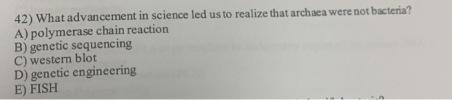 42) What advancement in science led us to realize that archaea were not bacteria? A) polymerase chain reaction B) genetic sequencing C) western blot D) genetic engineering E) FISH
DNA Technology What is biotechnology? • What is genetic engineering? How does it relate to recombinant...
DNA Technology What is biotechnology? • What is genetic engineering? How does it relate to recombinant DNA? • What are genetically modified organisms (GMOs)? • What are transgenic organisms? • What are some controversies surrounding GMOs? • What do the world’s leading health agencies think about GMOs? • What are some benefits of GMOs? • How does gene therapy work? • Describe the basic steps of making recombinant DNA. • What are the two major products that you get after...
 t
Restriction enzymes can be useful for the following Biotech processes (check ALL that apply): DNA Replication DNA Fingerprinting Genetic Engineering Insulin production using E.coli Polymerase chain reaction
t
Restriction enzymes can be useful for the following Biotech processes (check ALL that apply): DNA Replication DNA Fingerprinting Genetic Engineering Insulin production using E.coli Polymerase chain reaction
 Chapter 8: Microbial Genetics and Genetic Engineering Reading Assignment: Chapter 8 1. Describe the structure and function of DNA in the microbial cell. List the chemical components of DNA including the nitrogen bases and the role of histones. 2. Define the following: genome, chromosome, gene, genotype, phenotype, and palindrome. 3. Describe the process of DNA replication in microbes. Explain the term semi-conservative replication 4. Describe the steps in protein synthesis. Compare and contrast transcription and translation. Describe the roles of...
 28) le M ore Ullowing experiments transformation C) UV light mutation experiment B) Yeast Complementation experiment D) Transduction experiment 26) It red-colored flowers (Rare dominant over white colored flowers and wrinkled seeds (Ware dominant over smooth seeds, then the genotype RRww would appear as A) red, smooth ) white, smooth mooth red, wrinkled red, wrinkled D) white,wrinkled 29) Which of the following techniques is commonly used by Csi agents to solve crime, paternity cases, and identify victims, by matching human...
 RECOMBINANT DNA: PLASMID VECTOR engineering is the direct manipulation of an organism's DNA using nology. To begin the recombinant DNA process, scientists must first ide at codes for the production of the protein they want to manufacture. One is to go backwards from the amino acid sequence of the desired protein to ide sequence of the gene. After scientists have identified the gene, they m it. Restriction enzymes or endonucleases from bacterial cells are key in th ia produce restriction...
 42) What advancement in science led us to realize that archaea were not bacteria? A) polymerase chain reaction B) genetic sequencing C) western blot D) genetic engineering E) FISH
Most questions answered within 3 hours.
-
Where is the error in this code sequence?
String s1 = "Hello";
String s2 = "ello";...
asked 10 months ago -
Financial data for Joel de Paris, Inc., for last year
follow:
Joel de Paris, Inc.
Balance...
asked 10 months ago -
Consider this reaction:
Al2(SO4)3 (aq)+ BaCl3
(aq) Al2Cl6 (aq)- +
3BaSO4(s) . What is the...
asked 10 months ago -
Suppose that Savneet is considering increasing her
recent random sample from 20 car rentals to 40...
asked 10 months ago -
Trucks arrive at an unloading terminal at an average rate of 120
per hour.
Trucks arrive...
asked 10 months ago -
Why are methanol and ethanol completely soluble in water while
octanol is not very little soluble....
asked 10 months ago -
A facilities manager at a university reads in a research report
that the mean amount of...
asked 10 months ago -
When the CuSO4 is rehydrated by adding water to the anhydrous
compound, is this an endothermic...
asked 10 months ago -
A ray of sunlight is passing from diamond into crown glass; the
angle of incidence is...
asked 10 months ago -
A block of mass 0.249 kg is placed on top of a light, vertical
spring of...
asked 10 months ago -
how do the kidneys compensate in the presences of acidosis
a) trigger hyperventilate
b) reserve acid...
asked 10 months ago -
Question 501 pts
The rental rate of capital to the firm increases. Which of the
following...
asked 10 months ago