
Homework Answers
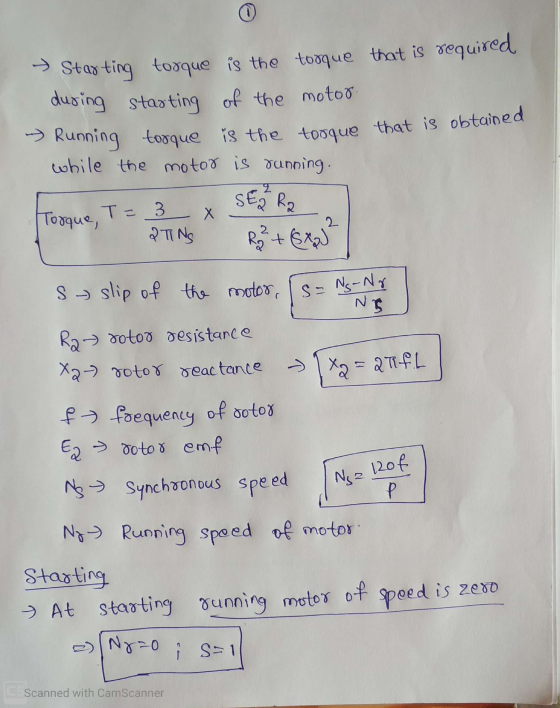
 As
the slip is different during running and starting condition, torque
is also different in both cases.
As
the slip is different during running and starting condition, torque
is also different in both cases.
Add Answer to:
(b) Explain why starting torque and running torque are different in three phase induction motor. (2...
A three phase induction motor draws a starting current which is five times the full load...
A three phase induction motor draws a starting current which is five times the full load current with direct on line starting, while developing twice the full load torque. Q2.1. Based on the two facts that starting current is proportional to the applied voltage and that the starting torque is proportional to the square of the applied voltage, determine voltage (as a per cent of rated voltage) required to obtain a starting torque equalling the full load torque. (10 marks)...
(b) (i) Explain briefly why an induction motor can never run at synchronous speed? (2 Marks)...
 (b) (i) Explain briefly why an induction motor can never run at synchronous speed? (2 Marks) (ii) If a six-pole induction motor supplied by a three-phase 50 Hz supply has a rotor frequency of 2.3 Hz, Calculate: (a)The percentage slip (b)The speed of the rotor in rpm (4 Marks) (iii)Draw a typical torque versus slip characteristic curve of an induction motor. If rotor resistance is increased show how the new torque versus slip curve deviates from the original one. (4...
how do we calculate ii and iii) - induction motor (25 marks) QUESTION 3 A three-phase,...
 how do we calculate ii and iii) - induction motor
(25 marks) QUESTION 3 A three-phase, 400 V, 50 Hz, 4-pole, 1370 rpm, star connected, squirrei-cage induction motor has the following parameters: R, 20, R2- 3 Q, X1-X2- 3.5 and Xm=40 .Motor is controlled by a voltage source inverter at constant V/f ratio. By using IEEE equivalent circuit; Calculate the starting torque and starting current at 10 Hz To- If the torque-speed to be a straight line calculate the slip...
how do we calculate ii and iii) - induction motor
(25 marks) QUESTION 3 A three-phase, 400 V, 50 Hz, 4-pole, 1370 rpm, star connected, squirrei-cage induction motor has the following parameters: R, 20, R2- 3 Q, X1-X2- 3.5 and Xm=40 .Motor is controlled by a voltage source inverter at constant V/f ratio. By using IEEE equivalent circuit; Calculate the starting torque and starting current at 10 Hz To- If the torque-speed to be a straight line calculate the slip...
Three-phase induction motor The three-phase induction motor nameplate gives the following informa...
Three-phase induction motor The three-phase induction motor nameplate gives the following information: 100 HP, 6 poles, 600 V, 60 Hz, PF =0.87. Rated motor slip s=0.0275 and rated motor current is 91.7 A. Measured at rated speed friction and ventilation losses are 1100 W. Measured between two motor terminals resistance is 0.305 Ω. f) For a load such where the motor rotates at the speed of 1180 r / min, determine shaft torque and calculate the mechanical power in HP,...
A 10 hp, 60 Hz, three-phase induction motor is delivering rated power while running at 864...
 A 10 hp, 60 Hz, three-phase induction motor is delivering rated power while running at 864 rpm. The motor is drawing power from a 208 V, three-phase source. DC tests determine: R1 0.2 ? and R2-0.15 ?, we do not know XI and X2. Ignore XM. The rotational and core losses are 200 W and 100 W respectively. Find: a) The output (shaft torque). b) The number of poles. c) The input power and efficiency d) The power factor at...
19. When the maximum torque of three phase induction motor is obtained at high slip: (3...
 19. When the maximum torque of three phase induction motor is obtained at high slip: (3 Points) The efficiency of the motor will be minimum The efficiency of the motor will decrease The efficiency of the motor does not change The efficiency of the motor will increase
A three-phase, 2.2 kV, 60 Hz, Y-connected induction motor has the following parameters: R1 = 0.2 ...
 A three-phase, 2.2 kV, 60 Hz,
Y-connected induction motor has the following parameters: R1 = 0.2
Ω R2` = 0.4 Ω X1 + X2` = 1.5 Ω The motor’s full load speed is 580
rpm. Ignore the rotational losses and calculate: a. Full load
torque b. Output power rating c. Starting current d. Starting
torque
No poles were provided
A three-phase, 2.2 kV, 60 Hz, Y-connected induction motor has the following parameters: The motor's full load speed is 580 rpm....
A three-phase, 2.2 kV, 60 Hz,
Y-connected induction motor has the following parameters: R1 = 0.2
Ω R2` = 0.4 Ω X1 + X2` = 1.5 Ω The motor’s full load speed is 580
rpm. Ignore the rotational losses and calculate: a. Full load
torque b. Output power rating c. Starting current d. Starting
torque
No poles were provided
A three-phase, 2.2 kV, 60 Hz, Y-connected induction motor has the following parameters: The motor's full load speed is 580 rpm....
Question 2 [10 marks) A six pole, three phase induction motor, with a star connected stator...
 Question 2 [10 marks) A six pole, three phase induction motor, with a star connected stator winding is energised from a 380V, 50Hz supply. The ratio of the stator to rotor turns is assumed 1.8 and a full load slip of 4%. If the respective per phase rotor resistance and standstill reactance are 0.120 and 0.8502, determine: a. Torque developed at full load b. The maximum torque and the speed at maximum torque
1. A 15 hp, 4 pole, 208 V, 60 Hz, Y-connected, three-phase squirrel cage induction motor has the ...
 1. A 15 hp, 4 pole, 208 V, 60 Hz, Y-connected, three-phase squirrel cage induction motor has the following parameters in Ω/phase referred to the stator: R,-0.220, Xi = 0.430, X,-15.0, R2 0.130 and X2-0.430. Mechanical and core losses amount to 300 W and 200 W respectively for rated voltage. (a) The motor is fed with a 60 Hz, 208 V voltage. It runs with a slip of 4.5 %. Find the speed, shaft torque and power, efficiency and power...
Problem # 2: Induction Motor Analysis Using The Thevenin Theorem [37 points] A three-phase, two p...
 Problem # 2: Induction Motor Analysis Using The Thevenin Theorem [37 points] A three-phase, two pole, 25hp, 460V (line-line), 60Hz, wye-connected, squirrel-cage induction motor has the following per-phase parameters: Ri 0.53 Ohm X2 0.80 Ohm Xi 1.80 Ohms R2 0.30 Ohm Re- 400 Ohms Xm 25.0 Ohms You cannot use any approximate circ uit or any approximation in the calculations. (1) Determine the parameters of the Thevenin equivalent circuit. Draw the equivalent circuit with the appropriate parameter values indicated on...
 (b) (i) Explain briefly why an induction motor can never run at synchronous speed? (2 Marks) (ii) If a six-pole induction motor supplied by a three-phase 50 Hz supply has a rotor frequency of 2.3 Hz, Calculate: (a)The percentage slip (b)The speed of the rotor in rpm (4 Marks) (iii)Draw a typical torque versus slip characteristic curve of an induction motor. If rotor resistance is increased show how the new torque versus slip curve deviates from the original one. (4...
 how do we calculate ii and iii) - induction motor
(25 marks) QUESTION 3 A three-phase, 400 V, 50 Hz, 4-pole, 1370 rpm, star connected, squirrei-cage induction motor has the following parameters: R, 20, R2- 3 Q, X1-X2- 3.5 and Xm=40 .Motor is controlled by a voltage source inverter at constant V/f ratio. By using IEEE equivalent circuit; Calculate the starting torque and starting current at 10 Hz To- If the torque-speed to be a straight line calculate the slip...
how do we calculate ii and iii) - induction motor
(25 marks) QUESTION 3 A three-phase, 400 V, 50 Hz, 4-pole, 1370 rpm, star connected, squirrei-cage induction motor has the following parameters: R, 20, R2- 3 Q, X1-X2- 3.5 and Xm=40 .Motor is controlled by a voltage source inverter at constant V/f ratio. By using IEEE equivalent circuit; Calculate the starting torque and starting current at 10 Hz To- If the torque-speed to be a straight line calculate the slip...
 A 10 hp, 60 Hz, three-phase induction motor is delivering rated power while running at 864 rpm. The motor is drawing power from a 208 V, three-phase source. DC tests determine: R1 0.2 ? and R2-0.15 ?, we do not know XI and X2. Ignore XM. The rotational and core losses are 200 W and 100 W respectively. Find: a) The output (shaft torque). b) The number of poles. c) The input power and efficiency d) The power factor at...
 19. When the maximum torque of three phase induction motor is obtained at high slip: (3 Points) The efficiency of the motor will be minimum The efficiency of the motor will decrease The efficiency of the motor does not change The efficiency of the motor will increase
 A three-phase, 2.2 kV, 60 Hz,
Y-connected induction motor has the following parameters: R1 = 0.2
Ω R2` = 0.4 Ω X1 + X2` = 1.5 Ω The motor’s full load speed is 580
rpm. Ignore the rotational losses and calculate: a. Full load
torque b. Output power rating c. Starting current d. Starting
torque
No poles were provided
A three-phase, 2.2 kV, 60 Hz, Y-connected induction motor has the following parameters: The motor's full load speed is 580 rpm....
A three-phase, 2.2 kV, 60 Hz,
Y-connected induction motor has the following parameters: R1 = 0.2
Ω R2` = 0.4 Ω X1 + X2` = 1.5 Ω The motor’s full load speed is 580
rpm. Ignore the rotational losses and calculate: a. Full load
torque b. Output power rating c. Starting current d. Starting
torque
No poles were provided
A three-phase, 2.2 kV, 60 Hz, Y-connected induction motor has the following parameters: The motor's full load speed is 580 rpm....
 Question 2 [10 marks) A six pole, three phase induction motor, with a star connected stator winding is energised from a 380V, 50Hz supply. The ratio of the stator to rotor turns is assumed 1.8 and a full load slip of 4%. If the respective per phase rotor resistance and standstill reactance are 0.120 and 0.8502, determine: a. Torque developed at full load b. The maximum torque and the speed at maximum torque
 1. A 15 hp, 4 pole, 208 V, 60 Hz, Y-connected, three-phase squirrel cage induction motor has the following parameters in Ω/phase referred to the stator: R,-0.220, Xi = 0.430, X,-15.0, R2 0.130 and X2-0.430. Mechanical and core losses amount to 300 W and 200 W respectively for rated voltage. (a) The motor is fed with a 60 Hz, 208 V voltage. It runs with a slip of 4.5 %. Find the speed, shaft torque and power, efficiency and power...
 Problem # 2: Induction Motor Analysis Using The Thevenin Theorem [37 points] A three-phase, two pole, 25hp, 460V (line-line), 60Hz, wye-connected, squirrel-cage induction motor has the following per-phase parameters: Ri 0.53 Ohm X2 0.80 Ohm Xi 1.80 Ohms R2 0.30 Ohm Re- 400 Ohms Xm 25.0 Ohms You cannot use any approximate circ uit or any approximation in the calculations. (1) Determine the parameters of the Thevenin equivalent circuit. Draw the equivalent circuit with the appropriate parameter values indicated on...
Most questions answered within 3 hours.
-
Where is the error in this code sequence?
String s1 = "Hello";
String s2 = "ello";...
asked 11 months ago -
Financial data for Joel de Paris, Inc., for last year
follow:
Joel de Paris, Inc.
Balance...
asked 11 months ago -
Consider this reaction:
Al2(SO4)3 (aq)+ BaCl3
(aq) Al2Cl6 (aq)- +
3BaSO4(s) . What is the...
asked 11 months ago -
Suppose that Savneet is considering increasing her
recent random sample from 20 car rentals to 40...
asked 11 months ago -
Trucks arrive at an unloading terminal at an average rate of 120
per hour.
Trucks arrive...
asked 11 months ago -
Why are methanol and ethanol completely soluble in water while
octanol is not very little soluble....
asked 11 months ago -
A facilities manager at a university reads in a research report
that the mean amount of...
asked 11 months ago -
When the CuSO4 is rehydrated by adding water to the anhydrous
compound, is this an endothermic...
asked 11 months ago -
A ray of sunlight is passing from diamond into crown glass; the
angle of incidence is...
asked 11 months ago -
A block of mass 0.249 kg is placed on top of a light, vertical
spring of...
asked 11 months ago -
how do the kidneys compensate in the presences of acidosis
a) trigger hyperventilate
b) reserve acid...
asked 11 months ago -
Question 501 pts
The rental rate of capital to the firm increases. Which of the
following...
asked 11 months ago