1. Why is a test cross usually used in preference to production of an F2 generation...
1. Why is a test cross usually used in preference to production of an F2 generation to measure linkage?
2. Why were the earliest studies of linkage done with genes on the X-chromosome?
Homework Answers
1) Genes which are located on the same chromosome and are transmitted together in the offspring are called linked genes. The phenomenon of inheritance of linked genes together so as to retain parental combinations in the offspring is known as linkage.
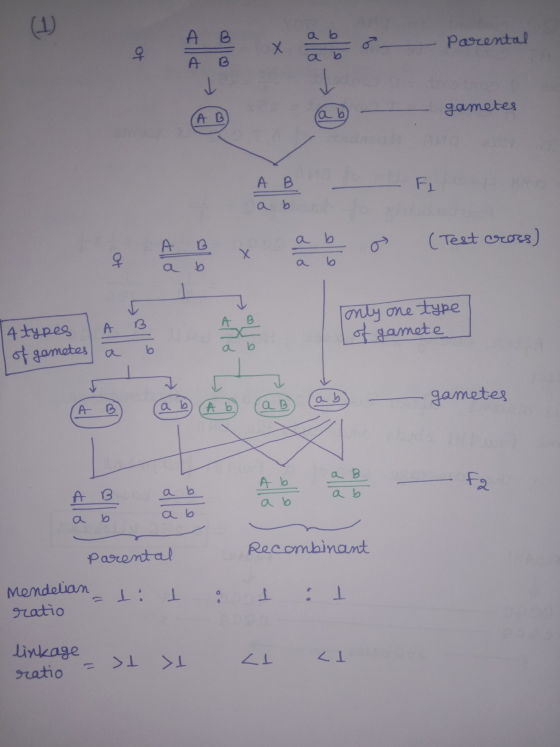
Test cross is a cross between heterozygous F1 and the double recessive homozygous. To study linkage, test cross is usually used because here it is easy to study the chromosome segregation in meiosis in only one parent (heterozygous one). The other F1 parent will give rise to only one kind of gametes. In Mendelian dihybrid test cross the phenotypic ratio should be 1:1:1:1, i.e., the parental combination in F2 will be 50% and recombinant frequency will be 50%. But if it is seen that parental frequency in F2 is more than 50%, then the two genes are said to be linked.
Picture is given below:
2) Thomas Hunt Morgan conducted experiments on heredity in Drosophila melanogaster and introduced the concept of sex linked inheritance.
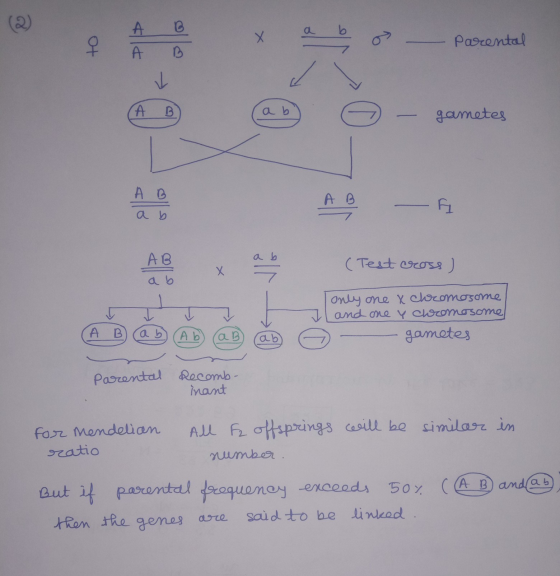
After studying sex linked inheritance we come to know that female has XX chromosomes, while male has XY chromosome, i.e., only one X chromosome. So it is easy to study the linkage pattern in only one parent (female) as male is hemizygous; so there is no chance of cross over between two different chromosome X and Y. So, we can follow chromosome segregation in meiosis in only one parent.
Picture is provided below:
Add Answer to:
1. Why is a test cross usually used in preference to
production of an F2 generation...
Problem 1 The data set below summarizes progeny (F2 generation) resulting from a cross between two...
 Problem 1 The data set below summarizes progeny (F2 generation) resulting from a cross between two F individuals, originating from a cross of two true breeding Drosophila strains (P generation), which differ with respect to two traits. Produce a hypothesis about the mode of inheritance of the genes and analyze whether the data fits your hypothesis by using the Chi-square test A1 wild type, females 334 purple eyes, females 98 purple eyes, tan body, males 47 wild type, males 161...
2. You cross a homozygous wildtype female Drosophila (fruit fly) with a male that has a black body (bb). You mate two of the F1 (first generation) flies and examine the F2 (second generation) off...
 2. You cross a homozygous wildtype female Drosophila (fruit fly) with a male that has a black body (bb). You mate two of the F1 (first generation) flies and examine the F2 (second generation) offspring. The phenotypes can be seen in the table below. a. Draw a pedigree to show the P, F1, and F2 generations. You only need to draw one fly with each phenotype for the F2 generation. seen in this cross. the expected values for a cross...
Dehybrid cross of F1 and F2 generation what is the Phenotype and genotype Ratio: 1). Apterous...
Dehybrid cross of F1 and F2 generation what is the Phenotype and genotype Ratio: 1). Apterous female (ap) X Sepia male (se).
Dehybrid cross of F1 and F2 generation what is the Phenotype and genotype Ratio: 1). White...
Dehybrid cross of F1 and F2 generation what is the Phenotype and genotype Ratio: 1). White Male (w/y) X Vestigial Female(vg).
The results for the F2 progeny are shown for a F1 cross using the two X-linked...
 The results for the F2 progeny are shown for a F1 cross using
the two X-linked markers:
w+ and m+.
As shown in the figure, the F1 cross is between the following
two parents:
- a phenotypically wild-type (red eye, full wing), heterozygous
female: w+m+/wm
- a double mutant male (white eye, miniature wing):
wm/Y
Answer the following questions:
1) In the F1 cross, can you infer the genotype for the phenotype
in the female? Why or why not?
2)...
The results for the F2 progeny are shown for a F1 cross using
the two X-linked markers:
w+ and m+.
As shown in the figure, the F1 cross is between the following
two parents:
- a phenotypically wild-type (red eye, full wing), heterozygous
female: w+m+/wm
- a double mutant male (white eye, miniature wing):
wm/Y
Answer the following questions:
1) In the F1 cross, can you infer the genotype for the phenotype
in the female? Why or why not?
2)...
Say that you were to cross a few plants from the F1 generation that you got...
Say that you were to cross a few plants from the F1 generation that you got after the crossing true breeding PP with true breeding pp (PP * pp the true breeding purple plants (PP) with the true breeding white plants (pp) )and end up with an F2-generation of 437 purple-flowered individuals and 163 white-flowered individuals. Perform a Chi Square test on your data to see if there is a significant difference between your expected F2-generation and your actual F2-generation....
Question 12 only. Punnett's square analysis for the parental cross r Rr Rr 9) If we...
 Question 12 only.
Punnett's square analysis for the parental cross r Rr Rr 9) If we used the above offspring (F1) in a new cross, what would be the genotypes and phenotypes of the offspring of the Fz generation? 10) What is the genotypic ratio of the F2 generation? 11) What is the phenotypic ratio of the F2 generation? 12) What would be the genotypic and phenotypic ratios of offspring from a cross between a homozygous recessive parent (r r)...
Question 12 only.
Punnett's square analysis for the parental cross r Rr Rr 9) If we used the above offspring (F1) in a new cross, what would be the genotypes and phenotypes of the offspring of the Fz generation? 10) What is the genotypic ratio of the F2 generation? 11) What is the phenotypic ratio of the F2 generation? 12) What would be the genotypic and phenotypic ratios of offspring from a cross between a homozygous recessive parent (r r)...
Which of these statements is incorrect? Syntenic genes are located on the same chromosome. Independent assortment...
Which of these statements is incorrect? Syntenic genes are located on the same chromosome. Independent assortment results in recombinant chromosomes. You can reliably predict the relative genetic distance from genes’ physical distance on a chromosome. Linked genes are always syntenic. What is the relative genetic distance between two linked genes if the recombination frequency is 0.49? 0.49 cM 4.9 cM 49 cM 490 cM What statement best explains the distortion in Mendelian ratios observed by Bateson & Punnett in 1905?...
Cross 1: wildtype x white eyes/yellow bodies Fi: Females- 80 wildtype Males- 121 white eyes/yellow bodies...
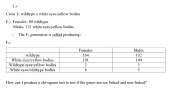 Cross 1: wildtype x white eyes/yellow bodies Fi: Females- 80 wildtype Males- 121 white eyes/yellow bodies The Fı generation is selfed producing: F2: wildtype White eyes/yellow bodies Wildtype eyes/yellow bodies White eyes/wildtype bodies Females 164 101 Males 132 109 3 How can I produce a chi-square test to test if the genes are sex linked and non-linked?
1) To determine experimentally if two genes are linked, you would do mating studies and look...
1) To determine experimentally if two genes are linked, you would do mating studies and look at the rate of _________. Select one: a. mutation b. nondisjunction c. crossing over d. codominance 2) For the results of Mendel's dihybrid cross to be a 9:3:3:1 ratio of traits, what must be true? Select one or more: a. The sample size must be sufficiently large. b. The alleles of the two genes involved must exhibit a simple dominant/recessive relationship. c. The genes...
 Problem 1 The data set below summarizes progeny (F2 generation) resulting from a cross between two F individuals, originating from a cross of two true breeding Drosophila strains (P generation), which differ with respect to two traits. Produce a hypothesis about the mode of inheritance of the genes and analyze whether the data fits your hypothesis by using the Chi-square test A1 wild type, females 334 purple eyes, females 98 purple eyes, tan body, males 47 wild type, males 161...
 2. You cross a homozygous wildtype female Drosophila (fruit fly) with a male that has a black body (bb). You mate two of the F1 (first generation) flies and examine the F2 (second generation) offspring. The phenotypes can be seen in the table below. a. Draw a pedigree to show the P, F1, and F2 generations. You only need to draw one fly with each phenotype for the F2 generation. seen in this cross. the expected values for a cross...
 The results for the F2 progeny are shown for a F1 cross using
the two X-linked markers:
w+ and m+.
As shown in the figure, the F1 cross is between the following
two parents:
- a phenotypically wild-type (red eye, full wing), heterozygous
female: w+m+/wm
- a double mutant male (white eye, miniature wing):
wm/Y
Answer the following questions:
1) In the F1 cross, can you infer the genotype for the phenotype
in the female? Why or why not?
2)...
The results for the F2 progeny are shown for a F1 cross using
the two X-linked markers:
w+ and m+.
As shown in the figure, the F1 cross is between the following
two parents:
- a phenotypically wild-type (red eye, full wing), heterozygous
female: w+m+/wm
- a double mutant male (white eye, miniature wing):
wm/Y
Answer the following questions:
1) In the F1 cross, can you infer the genotype for the phenotype
in the female? Why or why not?
2)...
 Question 12 only.
Punnett's square analysis for the parental cross r Rr Rr 9) If we used the above offspring (F1) in a new cross, what would be the genotypes and phenotypes of the offspring of the Fz generation? 10) What is the genotypic ratio of the F2 generation? 11) What is the phenotypic ratio of the F2 generation? 12) What would be the genotypic and phenotypic ratios of offspring from a cross between a homozygous recessive parent (r r)...
Question 12 only.
Punnett's square analysis for the parental cross r Rr Rr 9) If we used the above offspring (F1) in a new cross, what would be the genotypes and phenotypes of the offspring of the Fz generation? 10) What is the genotypic ratio of the F2 generation? 11) What is the phenotypic ratio of the F2 generation? 12) What would be the genotypic and phenotypic ratios of offspring from a cross between a homozygous recessive parent (r r)...
 Cross 1: wildtype x white eyes/yellow bodies Fi: Females- 80 wildtype Males- 121 white eyes/yellow bodies The Fı generation is selfed producing: F2: wildtype White eyes/yellow bodies Wildtype eyes/yellow bodies White eyes/wildtype bodies Females 164 101 Males 132 109 3 How can I produce a chi-square test to test if the genes are sex linked and non-linked?
Most questions answered within 3 hours.
-
Where is the error in this code sequence?
String s1 = "Hello";
String s2 = "ello";...
asked 10 months ago -
Financial data for Joel de Paris, Inc., for last year
follow:
Joel de Paris, Inc.
Balance...
asked 10 months ago -
Consider this reaction:
Al2(SO4)3 (aq)+ BaCl3
(aq) Al2Cl6 (aq)- +
3BaSO4(s) . What is the...
asked 10 months ago -
Suppose that Savneet is considering increasing her
recent random sample from 20 car rentals to 40...
asked 10 months ago -
Trucks arrive at an unloading terminal at an average rate of 120
per hour.
Trucks arrive...
asked 10 months ago -
Why are methanol and ethanol completely soluble in water while
octanol is not very little soluble....
asked 10 months ago -
A facilities manager at a university reads in a research report
that the mean amount of...
asked 10 months ago -
When the CuSO4 is rehydrated by adding water to the anhydrous
compound, is this an endothermic...
asked 10 months ago -
A ray of sunlight is passing from diamond into crown glass; the
angle of incidence is...
asked 10 months ago -
A block of mass 0.249 kg is placed on top of a light, vertical
spring of...
asked 10 months ago -
how do the kidneys compensate in the presences of acidosis
a) trigger hyperventilate
b) reserve acid...
asked 10 months ago -
Question 501 pts
The rental rate of capital to the firm increases. Which of the
following...
asked 10 months ago