Question 1- Assembly Line Balancing A ball-bearing assembly firm wants to set up an assembly line...
Question 1- Assembly Line Balancing
A ball-bearing assembly firm wants to set up an assembly line that must have an output of 60 units per hour. The work elements, task times and their precedence relationships are shown in Table 1:
| Work Element | Time (sec.) | Immediate Predecessor(s) |
| A | 40 | NONE |
| B | 30 | A |
| C | 50 | A |
| D | 40 | B |
| E | 6 | B |
| F | 25 | C |
| G | 15 | C |
| H | 20 | D, E |
| I | 18 | F, G |
| J | 30 | H, I |
Required:
a. Draw the precedence diagram showing the task precedence and
their times.
b. Determine the cycle time associated with the rate of output
required.
c. What is the theoretical number of work stations required to
satisfy this output rate?
d. Allocate the tasks to work stations taking into consideration
the precedence requirements and using the LOT rule to break ties
between feasible tasks.
e. What is the efficiency of the line and the idle time
percentage?
Question 2- Forecasting
a. Name and discuss three qualitative forecasting methods. Give
examples of situations in which each qualitative forecasting method
may be used.
b. Olivia Ltd. Sells cars to local companies and private owners.
The company tracked the sales for the last 6 years. Table 2 shows
the sales level for those 6 years.
| Year | Sales |
| 1 | 80 |
| 2 | 90 |
| 3 | 95 |
| 4 | 95 |
| 5 | 101 |
| 6 | 110 |
i. Calculate the slope
ii. Calculate the intercept
iii. Formulate the linear equation for this problem
iv. Develop a forecast for the firm’s annual sales for the next two
years.
Homework Answers
a)
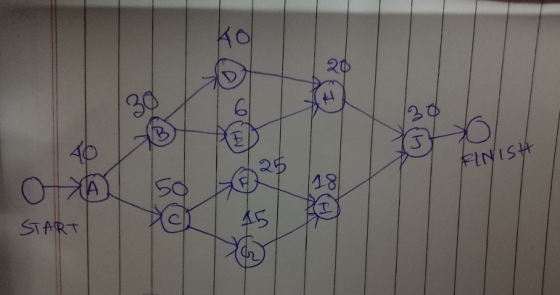
b)
Cycle time = available time for production/desired output = 60 minutes/60 units = 1 minute = 60 seconds
c)
theoretical minimum no of workstations = sum of task times/cycle time = 274/60 = 4.566666667 = 5 (Rounded to next whole number)
d)
| Workstation | Feasible task | Assigned task | Task time | Idle time remaining |
| I | A | A | 40 | 20 |
| II | B,C | C | 50 | 10 |
| III | B,F,G | B | 30 | 30 |
| D,E,F,G | F | 25 | 5 | |
| IV | D,E,G | D | 40 | 20 |
| E,G | G | 15 | 5 | |
| V | E,I | I | 18 | 42 |
| E | E | 6 | 36 | |
| H | H | 20 | 16 | |
| VI | J | J | 30 | 30 |
e) Efficiency = sum of task times/(no of workstations*cycle time) = (274/(6*60))*100 = 76.11111111%
Add Answer to:
Question 1- Assembly Line Balancing
A ball-bearing assembly firm wants to set up an assembly line...
Agent Smith, operations manager at the Matrix franchise, faces assembly line balancing problems. He has been...
Agent Smith, operations manager at the Matrix franchise, faces assembly line balancing problems. He has been told that the firm needs to assemble 1400 agents per day. There are 420 minutes of productive time in each working day. The assembly line activities are given below: Task Time (seconds) Predecessor A 13 - B 4 A C 10 B D 10 - E 6 D F 12 E G 5 E H 6 F, G I 7 H J 5 H...
The desired daily output for an assembly line is 540 units. This assembly line will operate...
The desired daily output for an assembly line is 540 units. This assembly line will operate 729 minutes per day. The following table contains information on this product's task times and precedence relationships: TASK TASK TIME (SECONDS) IMMEDIATE PREDECESSOR A 30 — B 28 A C 18 B D 69 B E 34 A F 36 E G 42 C, D H 24 F, G b. What is the workstation cycle time? Cycle time seconds c. Balance this line using...
) A firm is planning to set up an assembly line to assemble 40 units per...
) A firm is planning to set up an assembly line to assemble 40 units per hour, and 57 minutes per hour are productive. The time to perform each task and the tasks that precede each task are contained in the following table. Task Preceding Task Time to perform (min.) A -- .69 B A .55 C B .92 D B .59 E B .70 F B 1.10 G C, D, E .75 H G, F .43 I H .29...
Assembly Line Balancing
 Stanford Rosenberg Computing wants to establish an
assembly line for producing a new product, the Personal Digital
Assistant (PDA). The tasks, task times, and immediate predeces-
sors for the tasks are as follows:
Rosenberg’s goal is to produce 200 PDAs per hour.
a) What is the cycle time?
b) What is the theoretical minimum for the number of work-
stations that Rosenberg can achieve in this assembly line?
c. Draw a diagram of the production process.d. With the diagram that...
Stanford Rosenberg Computing wants to establish an
assembly line for producing a new product, the Personal Digital
Assistant (PDA). The tasks, task times, and immediate predeces-
sors for the tasks are as follows:
Rosenberg’s goal is to produce 200 PDAs per hour.
a) What is the cycle time?
b) What is the theoretical minimum for the number of work-
stations that Rosenberg can achieve in this assembly line?
c. Draw a diagram of the production process.d. With the diagram that...
EXAMPLE 8.2: Assembly-Line Balancing The Model J Wagon is to be assembled on a conveyor belt....
 EXAMPLE 8.2: Assembly-Line Balancing The Model J Wagon is to be assembled on a conveyor belt. Five hundred wagons are required per day. Production time per day is 420 minutes, and the assembly steps and times for the wagon are given in Exhibit 8.9A. Assignment: Find the balance that minimizes the number of workstations, subject to cycle time and precedence constraints SOLUTION I. Draw a precedence diagram. Exhibit 8.9B illustrates the sequential relationships identi- fied in Exhibit 8.9A. (The length...
The operations manager of an instruments company is balancing an assembly line. The company needs to...
 The operations manager of an instruments company is balancing an
assembly line. The company needs to build 96 instruments per
24-hour day. The assembly line activities are:
a. Draw the precedence diagram.
b. If the daily (24-hour) production rate is 96 units, what is
the greatest possible cycle time?
c. If the cycle time after allowances is given as 10 minutes,
what is the daily (24-hour) production rate?
d. With a 10-minute cycle time, what is the theoretical minimum
number...
The operations manager of an instruments company is balancing an
assembly line. The company needs to build 96 instruments per
24-hour day. The assembly line activities are:
a. Draw the precedence diagram.
b. If the daily (24-hour) production rate is 96 units, what is
the greatest possible cycle time?
c. If the cycle time after allowances is given as 10 minutes,
what is the daily (24-hour) production rate?
d. With a 10-minute cycle time, what is the theoretical minimum
number...
An assembly line is to operate eight hours per day with a desired output of 160...
 An assembly line is to operate eight hours per day with a desired output of 160 units per day. The following table contains information on this product's task times and precedence relationships: IMMEDIATE PREDECESSOR TASK TIME (SECONDS) 100 TASK A 70 D 50 40 C C. D 70 140 G H b. What is the required workstation cycle time meet the desired output rate? (Round your answer to the nearest whole number.) Workstation cycle time seconds per unit c. Balance...
You have been asked to balance a flow shop assembly operation to achieve an output rate...
You have been asked to balance a flow shop assembly operation to achieve an output rate of 80 units over two eight-hour shifts - 16 hours. Task times and precedence relationships are shown in the table below: Task Predecessor Time (minutes) A -- 2 B A 4 C 7 D A, B 11 E C 9 F D 10 G E, F 7 H D, G 4 What is the cycle time in minutes? What is the theoretical number of...
Wild Widget must set up an assembly line for widgets. Forecasts show that 68 units per...
 Wild Widget must set up an assembly line for widgets. Forecasts show that 68 units per hour should be produced. The tasks required, task times, and precedence relationships are as follows: TTT Task A B Time (seconds) 10 21 20 Predecessors A A 28 E 12 D 10 D G 40 E,F b. What is the takt time? (Round your answer to the nearest whole number.) Takt time seconds per unit c. What is the theoretical number of workstations? (Round...
Information regarding tasks in an assembly line run for an 8-hour shift each day is provided:...
Information regarding tasks in an assembly line run for an 8-hour shift each day is provided: Task Proceeding Task (s) Tme (min) A - 5 B - 3 C - 2 D A 1 E B 4 F C 6 G D,E 7 H G 5 I F,G 6 J H,1 4 K I 3 a)What is the theoretical minimum number of stations for a shift output of 40 units? B)if the line is balanced according to the desired cycle...
 EXAMPLE 8.2: Assembly-Line Balancing The Model J Wagon is to be assembled on a conveyor belt. Five hundred wagons are required per day. Production time per day is 420 minutes, and the assembly steps and times for the wagon are given in Exhibit 8.9A. Assignment: Find the balance that minimizes the number of workstations, subject to cycle time and precedence constraints SOLUTION I. Draw a precedence diagram. Exhibit 8.9B illustrates the sequential relationships identi- fied in Exhibit 8.9A. (The length...
 The operations manager of an instruments company is balancing an
assembly line. The company needs to build 96 instruments per
24-hour day. The assembly line activities are:
a. Draw the precedence diagram.
b. If the daily (24-hour) production rate is 96 units, what is
the greatest possible cycle time?
c. If the cycle time after allowances is given as 10 minutes,
what is the daily (24-hour) production rate?
d. With a 10-minute cycle time, what is the theoretical minimum
number...
The operations manager of an instruments company is balancing an
assembly line. The company needs to build 96 instruments per
24-hour day. The assembly line activities are:
a. Draw the precedence diagram.
b. If the daily (24-hour) production rate is 96 units, what is
the greatest possible cycle time?
c. If the cycle time after allowances is given as 10 minutes,
what is the daily (24-hour) production rate?
d. With a 10-minute cycle time, what is the theoretical minimum
number...
 An assembly line is to operate eight hours per day with a desired output of 160 units per day. The following table contains information on this product's task times and precedence relationships: IMMEDIATE PREDECESSOR TASK TIME (SECONDS) 100 TASK A 70 D 50 40 C C. D 70 140 G H b. What is the required workstation cycle time meet the desired output rate? (Round your answer to the nearest whole number.) Workstation cycle time seconds per unit c. Balance...
 Wild Widget must set up an assembly line for widgets. Forecasts show that 68 units per hour should be produced. The tasks required, task times, and precedence relationships are as follows: TTT Task A B Time (seconds) 10 21 20 Predecessors A A 28 E 12 D 10 D G 40 E,F b. What is the takt time? (Round your answer to the nearest whole number.) Takt time seconds per unit c. What is the theoretical number of workstations? (Round...
Most questions answered within 3 hours.
-
Where is the error in this code sequence?
String s1 = "Hello";
String s2 = "ello";...
asked 11 months ago -
Financial data for Joel de Paris, Inc., for last year
follow:
Joel de Paris, Inc.
Balance...
asked 11 months ago -
Consider this reaction:
Al2(SO4)3 (aq)+ BaCl3
(aq) Al2Cl6 (aq)- +
3BaSO4(s) . What is the...
asked 11 months ago -
Suppose that Savneet is considering increasing her
recent random sample from 20 car rentals to 40...
asked 11 months ago -
Trucks arrive at an unloading terminal at an average rate of 120
per hour.
Trucks arrive...
asked 11 months ago -
Why are methanol and ethanol completely soluble in water while
octanol is not very little soluble....
asked 11 months ago -
A facilities manager at a university reads in a research report
that the mean amount of...
asked 11 months ago -
When the CuSO4 is rehydrated by adding water to the anhydrous
compound, is this an endothermic...
asked 11 months ago -
A ray of sunlight is passing from diamond into crown glass; the
angle of incidence is...
asked 11 months ago -
A block of mass 0.249 kg is placed on top of a light, vertical
spring of...
asked 11 months ago -
how do the kidneys compensate in the presences of acidosis
a) trigger hyperventilate
b) reserve acid...
asked 11 months ago -
Question 501 pts
The rental rate of capital to the firm increases. Which of the
following...
asked 11 months ago