Explain the purpose of the following in the above experiment: a. phosphoric acid b. fractional distillation...
Explain the purpose of the following in the above experiment:
a. phosphoric acid
b. fractional distillation
c. sodium hydroxide
d. anhydrous sodium or magnesium sulfate
e. ice-cooled receiving flask
f. covering the flask with a watch glass in step 4
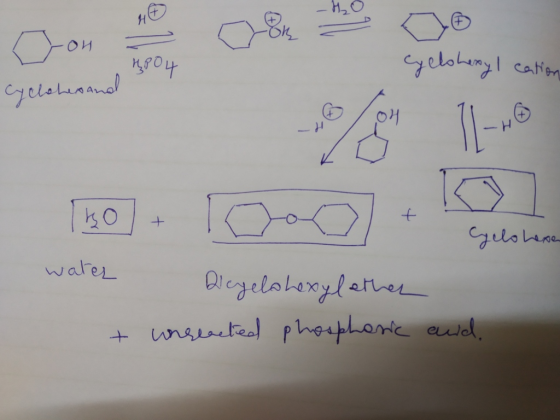
In this experiment, cyclohexanol will be dehydrated using a strong acid (concentrated phosphoric acid) to cyclohexene via an E1 MECHANISM.
Homework Answers
a. Phosphoric acid acts as dehydrating agent, catalyzed the reaction and to remove water from cyclohexanol and will get cyclohexene.
b. Fractional distillation: Since reaction is reversible, cyclohexyl cation will be reacted with cyclohexanol to form dicyclohexyl ether, some water and again cyclohexanol therefore reqiured fractional distillation to separate byproduct also.
c.
Sodium hydroxide:
It is necessary to be remove traces amount of phosphoric acid from the crude product. sodium hydroxide reacts with traces amount of phosphoric acid to form sodium phosphate salt.
d. To remove water from crude product required anhydrous sodium of magnesium sulphate.
e. Ice-cooled receiving flask: because low B.P.of cyclohexene and dicylohexyl ether, maintained low temperature
f. Cover the solution of cyclohexene and ether and then again redistill it.
Add Answer to:
Explain the purpose of the following in the above
experiment:
a. phosphoric acid
b. fractional distillation...
UDHUI U Caus lu le IUITSLUIT UI UULIT Pruuucis. 3) Explain the purpose of the following...
 UDHUI U Caus lu le IUITSLUIT UI UULIT Pruuucis. 3) Explain the purpose of the following in the above experiment: a. Sulfuric acid b. Simple distillation - in step 1 C. Sodium hydroxide extraction d. Anhydrous sodium sulfate e. Ice-cooled receiving/collecting flask 1. Covering the flask with a watch alass in step 10 Questions 1) Write the reactions that represent the addition of KMnO4 and Br2 to the two alkenes. 2) Draw the full mechanism (with arrow pushing) for the...
based on the amount of cyclohexanol used in the procedure, calculate the theoretical yield of cyclohexene...
 based on the amount of cyclohexanol used in the procedure,
calculate the theoretical yield of cyclohexene product. show all
work.
info attached below
ОН Н,РО,. H2SO + Н,о Procedure Cyclohexanol (10 g) is weighed into a 50 mL round-bottom three-necked flask, while avoiding getting the liquid on the ground-glass joint. To this is added 2.5 mL of 85% phosphoric acid along with two drops of sulfuric acid (again, avoiding getting the liquids on the joint) and a few boiling stones....
based on the amount of cyclohexanol used in the procedure,
calculate the theoretical yield of cyclohexene product. show all
work.
info attached below
ОН Н,РО,. H2SO + Н,о Procedure Cyclohexanol (10 g) is weighed into a 50 mL round-bottom three-necked flask, while avoiding getting the liquid on the ground-glass joint. To this is added 2.5 mL of 85% phosphoric acid along with two drops of sulfuric acid (again, avoiding getting the liquids on the joint) and a few boiling stones....
1. what is the purpose of the following in this experiment: a. concentrated (and not dilute)...
 1. what is the purpose of the following in this
experiment:
a. concentrated (and not dilute) hydrochloric acid
b. collecting the distillate in ice
c. sodium bicarbonate extraction
d. water extraction
e. anhydrous sodium or magnesium sulfate
chapter Alkyl Halides and Nucleophilic Aliphatic Substitution 13.1 SYNTHESIS OF BUTYL CHLORIDE Alkyl halides can be prepared by reacting an alcohol with concentrated hydrogen halides: R-OH + H-X- R-OH, R-X. HO where X-CI, Br, I. The reaction of hydrochloric acid with 2 and...
1. what is the purpose of the following in this
experiment:
a. concentrated (and not dilute) hydrochloric acid
b. collecting the distillate in ice
c. sodium bicarbonate extraction
d. water extraction
e. anhydrous sodium or magnesium sulfate
chapter Alkyl Halides and Nucleophilic Aliphatic Substitution 13.1 SYNTHESIS OF BUTYL CHLORIDE Alkyl halides can be prepared by reacting an alcohol with concentrated hydrogen halides: R-OH + H-X- R-OH, R-X. HO where X-CI, Br, I. The reaction of hydrochloric acid with 2 and...
Need help with #1 Synthesis of Cyclohexene PreSp19 (1)-Word REFERENCES MAILINGS REVIEW VIEW AaBbCcD AaBbccDc AaBbC...
 Need help with #1
Synthesis of Cyclohexene PreSp19 (1)-Word REFERENCES MAILINGS REVIEW VIEW AaBbCcD AaBbccDc AaBbC AaBbCcl A 11 Normal y.A-1圜ー It . Ig-B- π Νο Spac.. Heading 1 Heading 2 Paragraph Styles Organic Chemistry Lab 2 Spring 2019 Synthesis of Cyclohexene Pre-lab Questions Section/Instructor (20 points) Name: Date: Explain the purpose of the following in this experiment: (12 pts) a. Sulfuric acid b. Sodium hydroxide c. Anhydrous sodium sulfate d. Cold water cooled receiving flask e. Tared vial f....
Need help with #1
Synthesis of Cyclohexene PreSp19 (1)-Word REFERENCES MAILINGS REVIEW VIEW AaBbCcD AaBbccDc AaBbC AaBbCcl A 11 Normal y.A-1圜ー It . Ig-B- π Νο Spac.. Heading 1 Heading 2 Paragraph Styles Organic Chemistry Lab 2 Spring 2019 Synthesis of Cyclohexene Pre-lab Questions Section/Instructor (20 points) Name: Date: Explain the purpose of the following in this experiment: (12 pts) a. Sulfuric acid b. Sodium hydroxide c. Anhydrous sodium sulfate d. Cold water cooled receiving flask e. Tared vial f....
of each. Questions 1. Explain the purpose of the following in the above experiment and give...
 of each. Questions 1. Explain the purpose of the following in the above experiment and give pertinent equations when applicable: a. adding sodium hydroxide b. adding hydrochloric acid c. releasing the pressure in the separatory funnel while extracting d. using vacuum filtration instead of gravity filtration to isolate the benzoic acid e. placing a test tube inside the filter flask during the vacuum filtration process. 2. p-Nitroaniline is a basic compound. Draw a flow-chart in which you demonstrate the way...
Procedure Reaction: Add about 15 mL (measured precisely) of t-amyl alcohol to a 50 mL round...
Procedure Reaction: Add about 15 mL (measured precisely) of t-amyl alcohol to a 50 mL round bottom flask (the flask will become your stillpot). Cool the pot in an ice-water bath and slowly add, with swirling, about 5 mL of 9 M sulfuric acid. Add two boiling chips then clamp the flask to your ring stand. Do not leave the flask someplace it can be knocked over. Set up a fractional distillation with a foil wrapped Vigreux column. Use a...
Procedure Reaction: Add about 15 mL (measured precisely) of t-amyl alcohol to a 50 mL round...
Procedure Reaction: Add about 15 mL (measured precisely) of t-amyl alcohol to a 50 mL round bottom flask (the flask will become your stillpot). Cool the pot in an ice-water bath and slowly add, with swirling, about 5 mL of 9 M sulfuric acid. Add two boiling chips then clamp the flask to your ring stand. Do not leave the flask someplace it can be knocked over. Set up a fractional distillation with a foil wrapped Vigreux column. Use a...
12. Run and compare the top final distillate. 1. In this experiment, what is the purpose...
 12. Run and compare the top final distillate. 1. In this experiment, what is the purpose of the following: a. not allowing the temperature to go above 35°C when sodium dichromate is added to the alcohol b. oxalic acid c. sodium chloride d. anhydrous magnesium sulfate. 2. Provide balanced equations for the oxidation of the following: a. 2-propanol to acetone, by means of Cr,0,-/H b. oxalic acid to carbon dioxide, by means of Cr,0,-2/H c. benzaldehyde in basic MnO,-to yield...
I need help with this post lab from Orgo. Anyone please help me. I have included...
 I need help with this post lab from Orgo. Anyone please help
me. I have included the procedure from experiment, but let me know
if there is anything to add on this. Thank you
1. Write the overall balanced chemical equation (not the mechanism) for the reaction you carried out in this experiment. Equation must be charge and mass balanced. Use structures not molecular formula. (3 pts) Part A Table 2: Complete this table (15 pts) 2-methyl cyclohexanol cycloalkene Molecular...
I need help with this post lab from Orgo. Anyone please help
me. I have included the procedure from experiment, but let me know
if there is anything to add on this. Thank you
1. Write the overall balanced chemical equation (not the mechanism) for the reaction you carried out in this experiment. Equation must be charge and mass balanced. Use structures not molecular formula. (3 pts) Part A Table 2: Complete this table (15 pts) 2-methyl cyclohexanol cycloalkene Molecular...
Make a purpose statement synthesis equation table of contents and theoretical yield for the synthesis of...
 Make a purpose statement synthesis equation table of contents
and theoretical yield for the synthesis of veratraldehyde oxime (
example given)
NITRILE 1. SYNTHESIS oF VERATRALDEHYDE oxiME Review From previous lab procedures: suction filtration, recrystallization From organic chemistry text: sections 18.15, 18.16 Introduction oximes are usually prepared as derivatives of aldehydes and ketones, and they are used as a means of characterizing them and them. However, be reduced to amines or dehydrated to yield nitriles. Thus, they are also useful...
Make a purpose statement synthesis equation table of contents
and theoretical yield for the synthesis of veratraldehyde oxime (
example given)
NITRILE 1. SYNTHESIS oF VERATRALDEHYDE oxiME Review From previous lab procedures: suction filtration, recrystallization From organic chemistry text: sections 18.15, 18.16 Introduction oximes are usually prepared as derivatives of aldehydes and ketones, and they are used as a means of characterizing them and them. However, be reduced to amines or dehydrated to yield nitriles. Thus, they are also useful...
 UDHUI U Caus lu le IUITSLUIT UI UULIT Pruuucis. 3) Explain the purpose of the following in the above experiment: a. Sulfuric acid b. Simple distillation - in step 1 C. Sodium hydroxide extraction d. Anhydrous sodium sulfate e. Ice-cooled receiving/collecting flask 1. Covering the flask with a watch alass in step 10 Questions 1) Write the reactions that represent the addition of KMnO4 and Br2 to the two alkenes. 2) Draw the full mechanism (with arrow pushing) for the...
 based on the amount of cyclohexanol used in the procedure,
calculate the theoretical yield of cyclohexene product. show all
work.
info attached below
ОН Н,РО,. H2SO + Н,о Procedure Cyclohexanol (10 g) is weighed into a 50 mL round-bottom three-necked flask, while avoiding getting the liquid on the ground-glass joint. To this is added 2.5 mL of 85% phosphoric acid along with two drops of sulfuric acid (again, avoiding getting the liquids on the joint) and a few boiling stones....
based on the amount of cyclohexanol used in the procedure,
calculate the theoretical yield of cyclohexene product. show all
work.
info attached below
ОН Н,РО,. H2SO + Н,о Procedure Cyclohexanol (10 g) is weighed into a 50 mL round-bottom three-necked flask, while avoiding getting the liquid on the ground-glass joint. To this is added 2.5 mL of 85% phosphoric acid along with two drops of sulfuric acid (again, avoiding getting the liquids on the joint) and a few boiling stones....
 1. what is the purpose of the following in this
experiment:
a. concentrated (and not dilute) hydrochloric acid
b. collecting the distillate in ice
c. sodium bicarbonate extraction
d. water extraction
e. anhydrous sodium or magnesium sulfate
chapter Alkyl Halides and Nucleophilic Aliphatic Substitution 13.1 SYNTHESIS OF BUTYL CHLORIDE Alkyl halides can be prepared by reacting an alcohol with concentrated hydrogen halides: R-OH + H-X- R-OH, R-X. HO where X-CI, Br, I. The reaction of hydrochloric acid with 2 and...
1. what is the purpose of the following in this
experiment:
a. concentrated (and not dilute) hydrochloric acid
b. collecting the distillate in ice
c. sodium bicarbonate extraction
d. water extraction
e. anhydrous sodium or magnesium sulfate
chapter Alkyl Halides and Nucleophilic Aliphatic Substitution 13.1 SYNTHESIS OF BUTYL CHLORIDE Alkyl halides can be prepared by reacting an alcohol with concentrated hydrogen halides: R-OH + H-X- R-OH, R-X. HO where X-CI, Br, I. The reaction of hydrochloric acid with 2 and...
 Need help with #1
Synthesis of Cyclohexene PreSp19 (1)-Word REFERENCES MAILINGS REVIEW VIEW AaBbCcD AaBbccDc AaBbC AaBbCcl A 11 Normal y.A-1圜ー It . Ig-B- π Νο Spac.. Heading 1 Heading 2 Paragraph Styles Organic Chemistry Lab 2 Spring 2019 Synthesis of Cyclohexene Pre-lab Questions Section/Instructor (20 points) Name: Date: Explain the purpose of the following in this experiment: (12 pts) a. Sulfuric acid b. Sodium hydroxide c. Anhydrous sodium sulfate d. Cold water cooled receiving flask e. Tared vial f....
Need help with #1
Synthesis of Cyclohexene PreSp19 (1)-Word REFERENCES MAILINGS REVIEW VIEW AaBbCcD AaBbccDc AaBbC AaBbCcl A 11 Normal y.A-1圜ー It . Ig-B- π Νο Spac.. Heading 1 Heading 2 Paragraph Styles Organic Chemistry Lab 2 Spring 2019 Synthesis of Cyclohexene Pre-lab Questions Section/Instructor (20 points) Name: Date: Explain the purpose of the following in this experiment: (12 pts) a. Sulfuric acid b. Sodium hydroxide c. Anhydrous sodium sulfate d. Cold water cooled receiving flask e. Tared vial f....
 of each. Questions 1. Explain the purpose of the following in the above experiment and give pertinent equations when applicable: a. adding sodium hydroxide b. adding hydrochloric acid c. releasing the pressure in the separatory funnel while extracting d. using vacuum filtration instead of gravity filtration to isolate the benzoic acid e. placing a test tube inside the filter flask during the vacuum filtration process. 2. p-Nitroaniline is a basic compound. Draw a flow-chart in which you demonstrate the way...
 12. Run and compare the top final distillate. 1. In this experiment, what is the purpose of the following: a. not allowing the temperature to go above 35°C when sodium dichromate is added to the alcohol b. oxalic acid c. sodium chloride d. anhydrous magnesium sulfate. 2. Provide balanced equations for the oxidation of the following: a. 2-propanol to acetone, by means of Cr,0,-/H b. oxalic acid to carbon dioxide, by means of Cr,0,-2/H c. benzaldehyde in basic MnO,-to yield...
 I need help with this post lab from Orgo. Anyone please help
me. I have included the procedure from experiment, but let me know
if there is anything to add on this. Thank you
1. Write the overall balanced chemical equation (not the mechanism) for the reaction you carried out in this experiment. Equation must be charge and mass balanced. Use structures not molecular formula. (3 pts) Part A Table 2: Complete this table (15 pts) 2-methyl cyclohexanol cycloalkene Molecular...
I need help with this post lab from Orgo. Anyone please help
me. I have included the procedure from experiment, but let me know
if there is anything to add on this. Thank you
1. Write the overall balanced chemical equation (not the mechanism) for the reaction you carried out in this experiment. Equation must be charge and mass balanced. Use structures not molecular formula. (3 pts) Part A Table 2: Complete this table (15 pts) 2-methyl cyclohexanol cycloalkene Molecular...
 Make a purpose statement synthesis equation table of contents
and theoretical yield for the synthesis of veratraldehyde oxime (
example given)
NITRILE 1. SYNTHESIS oF VERATRALDEHYDE oxiME Review From previous lab procedures: suction filtration, recrystallization From organic chemistry text: sections 18.15, 18.16 Introduction oximes are usually prepared as derivatives of aldehydes and ketones, and they are used as a means of characterizing them and them. However, be reduced to amines or dehydrated to yield nitriles. Thus, they are also useful...
Make a purpose statement synthesis equation table of contents
and theoretical yield for the synthesis of veratraldehyde oxime (
example given)
NITRILE 1. SYNTHESIS oF VERATRALDEHYDE oxiME Review From previous lab procedures: suction filtration, recrystallization From organic chemistry text: sections 18.15, 18.16 Introduction oximes are usually prepared as derivatives of aldehydes and ketones, and they are used as a means of characterizing them and them. However, be reduced to amines or dehydrated to yield nitriles. Thus, they are also useful...
Most questions answered within 3 hours.
-
Where is the error in this code sequence?
String s1 = "Hello";
String s2 = "ello";...
asked 11 months ago -
Financial data for Joel de Paris, Inc., for last year
follow:
Joel de Paris, Inc.
Balance...
asked 11 months ago -
Consider this reaction:
Al2(SO4)3 (aq)+ BaCl3
(aq) Al2Cl6 (aq)- +
3BaSO4(s) . What is the...
asked 11 months ago -
Suppose that Savneet is considering increasing her
recent random sample from 20 car rentals to 40...
asked 11 months ago -
Trucks arrive at an unloading terminal at an average rate of 120
per hour.
Trucks arrive...
asked 11 months ago -
Why are methanol and ethanol completely soluble in water while
octanol is not very little soluble....
asked 11 months ago -
A facilities manager at a university reads in a research report
that the mean amount of...
asked 11 months ago -
When the CuSO4 is rehydrated by adding water to the anhydrous
compound, is this an endothermic...
asked 11 months ago -
A ray of sunlight is passing from diamond into crown glass; the
angle of incidence is...
asked 11 months ago -
A block of mass 0.249 kg is placed on top of a light, vertical
spring of...
asked 11 months ago -
how do the kidneys compensate in the presences of acidosis
a) trigger hyperventilate
b) reserve acid...
asked 11 months ago -
Question 501 pts
The rental rate of capital to the firm increases. Which of the
following...
asked 11 months ago