
Homework Answers
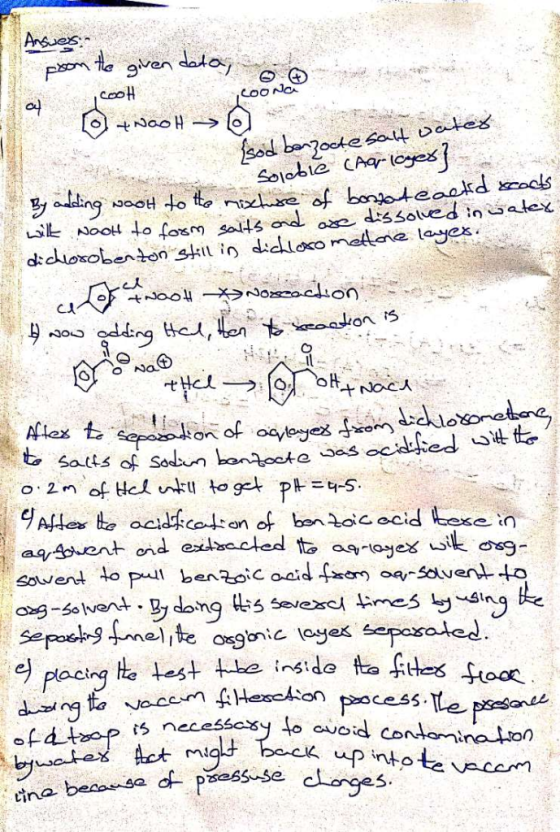
Sorry, As you posted 2 questions at a time, As per HOMEWORKLIB RULES we can able to answer only one question at a time per post. Please post remaining question separately then only we can able to answer due to the rules we have. I think you will understand my concern, Please cooperate.
For any quires please do
comment in the comment box below. Hope it will helps you. Please
give Thumbs Up!! Thank you for posting the question, All the
best.
Add Answer to:
of each. Questions 1. Explain the purpose of the following in the above experiment and give...
Experiment: A mixture of equal proportions of benzoic acid, ethyl 4-aminobenzoate, and 1,4-dimethoxybenzene are to be...
Experiment: A mixture of equal proportions of benzoic acid, ethyl 4-aminobenzoate, and 1,4-dimethoxybenzene are to be separated by extraction using the solvent diethyl ether. Day 1: Part A. Isolation of the basic component: In a small beaker, dissolve 3 g of the mixture (benzoic acid, ethyl 4-aminobenzoate, and 1,4-dimethoxybenzene) in 30 mL of diethyl ether and transfer the mixture to a 125- mL separatory funnel (see Fig. 1) using a little diethyl ether to complete the transfer. Add 10 mL...
Need help on providing reactions that describe the acid-base extraction and neutralization processes used in this exper...
 Need help on providing reactions that describe the acid-base
extraction and neutralization processes used in this experiment.
Provide a statement of solubility of each starting material and
product.
The experiment to be performed this week involves liquid-liquid extraction using a separatory funnel. Read chapter 15 in Zubrick to familiarize yourself with the use of the glassware for extraction and washing. Acid/Base Extraction Liquid-liquid extraction is a technique that can be used to physically separate two substances that have varying solubility...
Need help on providing reactions that describe the acid-base
extraction and neutralization processes used in this experiment.
Provide a statement of solubility of each starting material and
product.
The experiment to be performed this week involves liquid-liquid extraction using a separatory funnel. Read chapter 15 in Zubrick to familiarize yourself with the use of the glassware for extraction and washing. Acid/Base Extraction Liquid-liquid extraction is a technique that can be used to physically separate two substances that have varying solubility...
we have 1.5 g final product for following experiment. how can I draw acid- base curve...
we have 1.5 g final product for following experiment. how can I draw acid- base curve for following experiment? Experimental procedure Weigh approximately 2.5 gof benzoic acid contaminated withtable salt (NaCl) as precisely as possible (record the exact quantity). Transfer the solid to a 100 mL separatory funnel and add 30 mL of ethyl acetate. In a 50 mL beaker, add 20 mL of water and 1.0 mL of 3 M hydrochloric acid. Transferthe mixtureto the separatory funnel. The solid...
Acid/Base Extraction Liquid-liquid extraction is a technique that can be used to physically separate two substancesthat...
Acid/Base Extraction Liquid-liquid extraction is a technique that can be used to physically separate two substancesthat have varying solubility properties. Typically an aqueous solution can be extracted with anorganic solvent to isolate a compound or vice-versa. The specialized piece of glassware that isemployed for these types of separations is called a separatory funnel.In this experiment a mixture of benzoic acid and naphthalene will be purified using liquid-liquidextraction, more specifically an acid-base extraction. Since both compounds are soluble inethyl acetate (an...
Attached below are the pages from this lab report to help give context to the questions....
 Attached below are the pages from this lab report to help give
context to the questions. Please be as detailed as possible when
answering the questions and include any relevant information about
intermolecular forces at play. Thank you for your help!
Here are the questions which I need answered. Thank you in
advance for your help! :) Please be as detailed as possible and
discuss any intermolecular forces in detail if they are relevant to
the question. Thanks!
PARTA. SEPARATION...
Attached below are the pages from this lab report to help give
context to the questions. Please be as detailed as possible when
answering the questions and include any relevant information about
intermolecular forces at play. Thank you for your help!
Here are the questions which I need answered. Thank you in
advance for your help! :) Please be as detailed as possible and
discuss any intermolecular forces in detail if they are relevant to
the question. Thanks!
PARTA. SEPARATION...
Extraction of solids: Experiment outlined below Draw a “roadmap” of the experiment, containing chemical structures and...
 Extraction of solids: Experiment outlined below
Draw a “roadmap” of the experiment, containing chemical
structures and “layers” (organic and aqueous). This should contain
the individual reactions occurring in each step, and show which
layer the various components are present. Make sure you think about
whether the acetaminophen, caffeine and aspirin are neutral,
protonated or deprotonated.
Preliminary separation obtain a sample (1.0g) of the mixture. weigh the sample and record it. this sample should consist of a 2:1:1 mixture (by mass)...
Extraction of solids: Experiment outlined below
Draw a “roadmap” of the experiment, containing chemical
structures and “layers” (organic and aqueous). This should contain
the individual reactions occurring in each step, and show which
layer the various components are present. Make sure you think about
whether the acetaminophen, caffeine and aspirin are neutral,
protonated or deprotonated.
Preliminary separation obtain a sample (1.0g) of the mixture. weigh the sample and record it. this sample should consist of a 2:1:1 mixture (by mass)...
Would the methylene chloride layer be above or below the experiment? Justify your answer. 1. aqueous layer in today...
 Would the methylene chloride layer be above or below the experiment? Justify your answer. 1. aqueous layer in today's ium carbonate used in the isolation of caffeine? Be specific as to the 2. Why is potass chemical species the carbonate may act on. Why was sodium sulfate used? 3. 4. After introducing 1.0 g of potassium carbonate into the centri hot water extract, it was capped, shaken, and then cooled to room temperature. Following this, roug minute. Why wasn't the...
Construct a flow chart describing the seperation of the mixture and the isolation of each compound...
 Construct a flow chart describing the seperation of the
mixture and the isolation of each compound in this experiment. (Lab
steps/procedures includes for reference)
4. Construct a flow chart describing the separation of the mixture and the isolation of each compound in this experiment. A commonly used method of separating a mixture of organic compounds is known as liquid-liquid extraction. Most reactions of organic compounds require extraction at some stage of product purification. In this experiment you will use extraction...
Construct a flow chart describing the seperation of the
mixture and the isolation of each compound in this experiment. (Lab
steps/procedures includes for reference)
4. Construct a flow chart describing the separation of the mixture and the isolation of each compound in this experiment. A commonly used method of separating a mixture of organic compounds is known as liquid-liquid extraction. Most reactions of organic compounds require extraction at some stage of product purification. In this experiment you will use extraction...
I need to write out a procedure for extraction and recrystallization of a 1:1 (by mass)...
I need to write out a procedure for extraction and recrystallization of a 1:1 (by mass) mixture of 1,4-dichlorobenzene/ethyl 4-aminobenzoate. So far, I have that I am starting with extraction using 1 g. of the mixture and dissolving it in about 15mL of diethyl ether. Then I am putting it in a separatory flask and adding 15mL of 1M HCl to get layers. To the organic layer, I will add sodium sulfate and put in rotovap to get a solid....
Questions and Exercises 1. In the course of reflux of the triglyceride in a sodium hydroxide solu...
 Organic Chemistry Help!
Questions and Exercises 1. In the course of reflux of the triglyceride in a sodium hydroxide solution you will notice a lot of foaming. Explain. What is left behind in the aqueous layer after filtration of the saponification product? The starting material and the product of the saponification reaction have similar melting points. How do you know you actually isolated a new product rather than just recovered the starting material? Give at least two different methods to...
Organic Chemistry Help!
Questions and Exercises 1. In the course of reflux of the triglyceride in a sodium hydroxide solution you will notice a lot of foaming. Explain. What is left behind in the aqueous layer after filtration of the saponification product? The starting material and the product of the saponification reaction have similar melting points. How do you know you actually isolated a new product rather than just recovered the starting material? Give at least two different methods to...
 Need help on providing reactions that describe the acid-base
extraction and neutralization processes used in this experiment.
Provide a statement of solubility of each starting material and
product.
The experiment to be performed this week involves liquid-liquid extraction using a separatory funnel. Read chapter 15 in Zubrick to familiarize yourself with the use of the glassware for extraction and washing. Acid/Base Extraction Liquid-liquid extraction is a technique that can be used to physically separate two substances that have varying solubility...
Need help on providing reactions that describe the acid-base
extraction and neutralization processes used in this experiment.
Provide a statement of solubility of each starting material and
product.
The experiment to be performed this week involves liquid-liquid extraction using a separatory funnel. Read chapter 15 in Zubrick to familiarize yourself with the use of the glassware for extraction and washing. Acid/Base Extraction Liquid-liquid extraction is a technique that can be used to physically separate two substances that have varying solubility...
 Attached below are the pages from this lab report to help give
context to the questions. Please be as detailed as possible when
answering the questions and include any relevant information about
intermolecular forces at play. Thank you for your help!
Here are the questions which I need answered. Thank you in
advance for your help! :) Please be as detailed as possible and
discuss any intermolecular forces in detail if they are relevant to
the question. Thanks!
PARTA. SEPARATION...
Attached below are the pages from this lab report to help give
context to the questions. Please be as detailed as possible when
answering the questions and include any relevant information about
intermolecular forces at play. Thank you for your help!
Here are the questions which I need answered. Thank you in
advance for your help! :) Please be as detailed as possible and
discuss any intermolecular forces in detail if they are relevant to
the question. Thanks!
PARTA. SEPARATION...
 Extraction of solids: Experiment outlined below
Draw a “roadmap” of the experiment, containing chemical
structures and “layers” (organic and aqueous). This should contain
the individual reactions occurring in each step, and show which
layer the various components are present. Make sure you think about
whether the acetaminophen, caffeine and aspirin are neutral,
protonated or deprotonated.
Preliminary separation obtain a sample (1.0g) of the mixture. weigh the sample and record it. this sample should consist of a 2:1:1 mixture (by mass)...
Extraction of solids: Experiment outlined below
Draw a “roadmap” of the experiment, containing chemical
structures and “layers” (organic and aqueous). This should contain
the individual reactions occurring in each step, and show which
layer the various components are present. Make sure you think about
whether the acetaminophen, caffeine and aspirin are neutral,
protonated or deprotonated.
Preliminary separation obtain a sample (1.0g) of the mixture. weigh the sample and record it. this sample should consist of a 2:1:1 mixture (by mass)...
 Would the methylene chloride layer be above or below the experiment? Justify your answer. 1. aqueous layer in today's ium carbonate used in the isolation of caffeine? Be specific as to the 2. Why is potass chemical species the carbonate may act on. Why was sodium sulfate used? 3. 4. After introducing 1.0 g of potassium carbonate into the centri hot water extract, it was capped, shaken, and then cooled to room temperature. Following this, roug minute. Why wasn't the...
 Construct a flow chart describing the seperation of the
mixture and the isolation of each compound in this experiment. (Lab
steps/procedures includes for reference)
4. Construct a flow chart describing the separation of the mixture and the isolation of each compound in this experiment. A commonly used method of separating a mixture of organic compounds is known as liquid-liquid extraction. Most reactions of organic compounds require extraction at some stage of product purification. In this experiment you will use extraction...
Construct a flow chart describing the seperation of the
mixture and the isolation of each compound in this experiment. (Lab
steps/procedures includes for reference)
4. Construct a flow chart describing the separation of the mixture and the isolation of each compound in this experiment. A commonly used method of separating a mixture of organic compounds is known as liquid-liquid extraction. Most reactions of organic compounds require extraction at some stage of product purification. In this experiment you will use extraction...
 Organic Chemistry Help!
Questions and Exercises 1. In the course of reflux of the triglyceride in a sodium hydroxide solution you will notice a lot of foaming. Explain. What is left behind in the aqueous layer after filtration of the saponification product? The starting material and the product of the saponification reaction have similar melting points. How do you know you actually isolated a new product rather than just recovered the starting material? Give at least two different methods to...
Organic Chemistry Help!
Questions and Exercises 1. In the course of reflux of the triglyceride in a sodium hydroxide solution you will notice a lot of foaming. Explain. What is left behind in the aqueous layer after filtration of the saponification product? The starting material and the product of the saponification reaction have similar melting points. How do you know you actually isolated a new product rather than just recovered the starting material? Give at least two different methods to...
Most questions answered within 3 hours.
-
Where is the error in this code sequence?
String s1 = "Hello";
String s2 = "ello";...
asked 11 months ago -
Financial data for Joel de Paris, Inc., for last year
follow:
Joel de Paris, Inc.
Balance...
asked 11 months ago -
Consider this reaction:
Al2(SO4)3 (aq)+ BaCl3
(aq) Al2Cl6 (aq)- +
3BaSO4(s) . What is the...
asked 11 months ago -
Suppose that Savneet is considering increasing her
recent random sample from 20 car rentals to 40...
asked 11 months ago -
Trucks arrive at an unloading terminal at an average rate of 120
per hour.
Trucks arrive...
asked 11 months ago -
Why are methanol and ethanol completely soluble in water while
octanol is not very little soluble....
asked 11 months ago -
A facilities manager at a university reads in a research report
that the mean amount of...
asked 11 months ago -
When the CuSO4 is rehydrated by adding water to the anhydrous
compound, is this an endothermic...
asked 11 months ago -
A ray of sunlight is passing from diamond into crown glass; the
angle of incidence is...
asked 11 months ago -
A block of mass 0.249 kg is placed on top of a light, vertical
spring of...
asked 11 months ago -
how do the kidneys compensate in the presences of acidosis
a) trigger hyperventilate
b) reserve acid...
asked 11 months ago -
Question 501 pts
The rental rate of capital to the firm increases. Which of the
following...
asked 11 months ago